- Log in to post comments
Decades after the conclusion of the Iran hostage crisis, Iran continues to take Westerners hostage. The Iranian regime is currently holding the non-American Western citizens, residents, and asylees profiled below on trumped-up charges. Iran’s rationale for taking these hostages is manifold. These prisoners serve as bargaining chips for the regime to extract geopolitical concessions from the international community and also to curb internal dissent and punish undesirable behavior. Tehran also exploits captives for propaganda, claiming Iran had discovered and foiled purported plots by the hostages and their respective countries of nationality to undermine the Islamic Republic. Finally, Iran does not recognize dual citizenship, so by targeting dual citizens, the regime demonstrates to the Iranian expatriate community that it is not beyond their grasp.
|
French-Iranian academic
|
Fariba Adelkhah is a French-Iranian anthropologist who works as a researcher at the university SciencesPo in Paris. She has published a study of Islamic women in Iran and more recently has focused on Shiite clerics’ movements between Iran, Iraq, and Afghanistan. Adelkhah was arrested in June of 2019 in Iran, where she was conducting research and visiting her mother. Her SciencesPo colleague and longtime companion Roland Marchal, who had flown to Tehran to spend the Eid holiday with her, was also arrested. Adelkhah is being held in Tehran’s notoriously brutal Evin Prison. Adelkhah has not been allowed to meet with French consular officials because Iran does not recognize dual nationality. The regime held Adelkhah and Marchal for months without making criminal charges public, but finally disclosed that he would be tried for “collusion to endanger national security,” while she would be tried for both that charge and “propaganda against the political system of the Islamic Republic.” She was also initially charged with espionage, but that charge was later dropped. On December 24, 2019, Adelkhah and Kylie Moore-Gilbert, a fellow female hostage, began a hunger strike in support of all academics in Iran and across the Middle East who were in jail on trumped-up charges. Adelkhah ended her strike after 49 days. She was taken to stay at the prison’s hospital and receive treatment but was brought back to her cell at Evin despite complaining about severe kidney pain and despite the growing infection rate of coronavirus in Evin. In early February of 2020, Marchal and Adelkhah petitioned for permission to marry so that they could meet with each other inside the prison. Their trial commenced on March 3, 2020, though only Adelkhah appeared, but further proceedings were then postponed indefinitely with no explanation. The reason for Marchal’s absence was not disclosed. Iran freed Marchal on March 20, 2020, in exchange for France simultaneously releasing an Iranian accused of violating U.S. sanctions laws. Click here to read Fariba Adelkhah’s full story. |
|
Kameel Ahmady 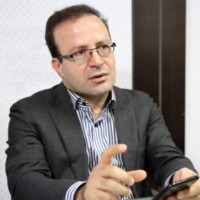
British-Iranian academic
|
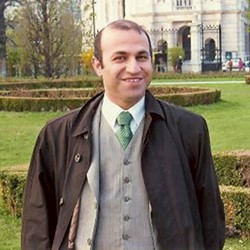
Kameel Ahmady is a British-Iranian social anthropologist who has conducted research in areas including female genital mutilation (FGM) and child marriage in Iran. He published a book in 2015 that claimed that FGM is performed in at least four major Iranian provinces, even as local authorities ignored the issue or claimed that FGM was not being carried out. Ahmady is an ethnic Kurd. Ahmady was arrested on August 11, 2019, and jailed in Tehran’s notoriously brutal Evin Prison, according to his wife, Shafagh Rahmani. On August 28, 2019, Rahmani claimed the authorities had not allowed her to visit Ahmady and the two were only allowed to speak by phone three times. She added that she was not told the reason for his arrest and that the judiciary had rejected several attorneys that Ahmady’s family had hired to represent him. In mid-September, Rahmani and Ahmady were finally able to meet at the prosecutor’s office. In mid-September, Rahmani said that the authorities had extended Ahmady’s detention by another month and still had not disclosed the charges against him, telling her that he faced several charges for unnamed actions, but Ahmady had told her that his interrogators had focused on his research activities. On October 1, 2019, the judiciary confirmed Ahmady’s arrest for the first time, claiming he was connected to institutes affiliated with foreign intelligence agencies. A judiciary spokesman said that Ahmady’s case was still in its initial investigation stage. Click here to read Kameel Ahmady’s full story. |
|
Aras Amiri 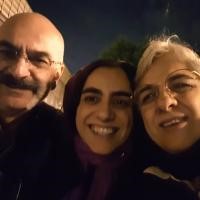
(center) Employed by the British government to promote education and culture
|
Aras Amiri is an Iranian citizen and British permanent resident who worked in London for the British Council, a U.K. government body that promotes education and culture. According to the Council’s chief executive, Amiri was “employed for five years in London to help greater appreciation of Iranian culture in the U.K., for example supporting translations of Iranian books into English.” Amiri was arrested in March of 2018 on the way to Tehran’s airport after visiting her grandmother. She traveled to Iran once or twice a year to see family, according to her fiancé, James Tyson. Amiri was released on bail in May of 2018 but arrested again on September 7 of that year. Amiri is being held in Tehran’s notoriously brutal Evin Prison. Her fiancé claims that Amiri “was led into a series of interrogations, imprisoned, solitary confinement and then a period of interrogations over two months.” Amiri spent a total of 30 days in solitary confinement. Iran’s judiciary charged her with “acting against national security” and “cultural infiltration by the British intelligence services in Iranian internal affairs.” Amiri said in a letter to the head of Iran’s judiciary that while she was out on bail, her interrogators contacted her and asked her to spy for them in the U.K. After she refused, they soon rearrested her and added a new charge, “founding and directing a network for overthrowing the regime.” Amiri was tried before the Revolutionary Court in Tehran in February and March of 2019. On May 13, 2019, a judiciary spokesperson announced that an unnamed woman (presumably Amiri) who headed the British Council’s Iran desk had been sentenced to 10 years in prison for espionage, namely, utilizing her arts and theater connections to “influence and infiltrate” Iran culturally. He added that the woman had confessed to working with British intelligence. Amiri stated that she only learned of her sentencing and the new espionage charge when watching television in prison. Amiri appealed her sentence and wrote a letter pleading her case to the head of Iran’s judiciary, Ebrahim Raisi. However, Iran’s supreme court rejected her appeal in August of 2019. Amiri has been temporarily released, according to a report by the National on April 9, 2020. She was furloughed as the highly dangerous COVID19 virus ravaged Iran, infecting over 32,000 and killing more than 4,100 as of April 9, 2020. Inmates living in appalling conditions in Iran’s prison system are at particular risk of contracting the virus. Click here to read Aras Amiri’s full story. |
|
Anousheh Ashoori
British-Iranian businessman |
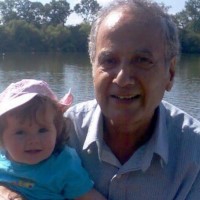
Anousheh Ashoori is a British-Iranian dual national and businessman who ran a building-supplies company and lived periodically in the U.K. since he was 17. His daughter Eilka, an actress, residing in London, said, “My father has nothing to do with politics and told us not to get involved in politics.” Ashoori was detained in Tehran in 2017 while visiting his mother. The regime has not given Ashoori British consular access because Iran does not recognize dual nationality. Iran’s judiciary announced on August 27, 2019, that Ashoori had been convicted for connections to the Mossad and “acquiring illegitimate wealth” and sentenced to a combined 12 years in prison. Click here to read Anousheh Ashoori’s full story. |
|
Abdolrasoul Dorri-Esfahani
Iranian-Canadian accountant and nuclear negotiator |
Abdolrasoul Dorri-Esfahani is an Iranian-Canadian accountant and former adviser to the governor of the Central Bank of Iran. He oversaw negotiations on the banking provisions of the 2015 Joint Comprehensive Plan of Action, also known as the Iran nuclear deal. Dorri-Esfahani was arrested in August of 2016 as he was about to leave Iran and return to Canada. He was released on bail pending trial. Dorri-Esfahani was accused of having links to British intelligence and giving sensitive information to the United States in exchange for payments by both countries. In October 2017, the judiciary announced that Dorri-Esfahani had been sentenced to five years in prison and Iran’s Tasnim News Agency reported that he would return to jail to begin his sentence. His appeal was rejected, even though Iran’s intelligence minister claimed that he was innocent and had even cooperated with the ministry’s counterintelligence branch. In September of 2018, the intelligence wing of the Islamic Revolutionary Guard Corps (IRGC) released a propaganda video portraying Dorri-Esfahani as having been paid to infiltrate Iran’s negotiating team for the nuclear deal and being influential in the deal’s formation. The video claimed Dorri-Esfahani worked with multinational firms like PricewaterhouseCoopers to provide key information to foreign negotiators. Click here to read Abdolrasoul Dorri-Esfahani’s full story. |
|
Kamal Foroughi
British-Iranian consultant |
Kamal Foroughi is an elderly British-Iranian who worked in Tehran as a consultant for the Malaysian oil-and-gas firm Petronas. His work for Petronas included facilitating meetings with senior Iranian oil-and-gas officials and arranging Iranian government-funded scholarships for Iranians to study in Malaysia. Foroughi’s family claims plainclothes officers arrested Foroughi in Tehran in May of 2011 without producing a warrant. Foroughi is being held in Tehran’s notoriously brutal Evin Prison, and reportedly spent 18 months in solitary confinement. Because Iran does not recognize dual nationality, the regime has not let British diplomats meet with him. As of 2015, the authorities have not permitted Foroughi’s family to meet with him in prison, though they were allowed to speak by phone. Foroughi was convicted in 2013 of espionage and possessing alcohol and sentenced to a combined eight years in prison. His family claims the judiciary has not provided them any evidence in support of those charges. Foroughi was tried before Tehran Revolutionary Court Judge Abolqassem Salavati, who is nicknamed “the hanging judge” or “the judge of death” for imposing harsh sentences, including capital punishment, in political cases. His family has repeatedly expressed concern about his access to medical care, stating that he did not undergo any medical tests until 2015. They said in 2016 that he was awaiting an operation for cataracts in both eyes. In 2017, Foroughi’s family claimed that the authorities were denying them and Foroughi access to his medical test results. Twice, the authorities have raised hopes that Foroughi would be released, only to dash them. In July of 2016, Foroughi’s son publicly announced that the Iranian judiciary had told the prisoner’s lawyer that he would be freed within a week, but no release occurred. In 2017, Foroughi was granted brief medical leave from prison but a promised extended furlough was later denied. Click here to read Kamal Foroughi’s full story. |
|
Kamran Ghaderi
Iranian-Austrian businessman |
Iranian-Austrian businessman Kamran Ghaderi was detained upon arrival in Tehran on January 2, 2016, when visiting for an official Austrian-Iranian trade meeting attended by senior Austrian officials. He is currently being held at Tehran’s notoriously brutal Evin Prison and was kept in solitary confinement for almost a year. He has been denied access to Austrian consular assistance and was not allowed to speak with a lawyer until two days before his trial. On October 18, 2016, Tehran Prosecutor General Abbas Jafari Dolatabadi said that Ghaderi was among six individuals who received 10-year sentences for spying and working with the U.S. government. According to an anonymous source, “They threatened him that if he didn’t cooperate, his wife would be taken into custody. They forced him to sign a confession under intimidation and psychological torture, otherwise they had nothing to convict him of espionage.” Ghaderi also stated that his interrogators lied to him, claiming that they had arrested his mother and brother and would keep them imprisoned until he agreed to make their desired confession. Click here to read Kamran Ghaderi’s full story. |
|
Roland Marchal
French academic |
Roland Marchal is a French sociologist employed by the university SciencesPo in Paris. Marchal’s research has focused on sub-Saharan Africa, particularly regarding civil wars and state formation in that region. Marchal flew to Tehran in June of 2019 to spend the Eid holiday with his colleague and longtime companion Faribah Adelkhah, but he was arrested upon arriving in Tehran. Adelkhah, a French-Iranian dual national, was also arrested. Adelkhah and Marchal are being held in Tehran’s notoriously brutal Evin Prison. Marchal has been allowed to meet with French consular officials several times, as well as with an attorney. Marchal is reportedly sick and getting sicker. The regime held Marchal and Adelkhah for months without making criminal charges public, but finally disclosed that he would be tried for “collusion to endanger national security,” while she would be tried for both that charge and “propaganda against the political system of the Islamic Republic.” In early February of 2020, Marchal and Adelkhah petitioned for permission to marry so that they could meet with each other inside the prison. Their trial commenced on March 3, 2020, though only Adelkhah appeared, but further proceedings were then postponed indefinitely with no explanation. The reason for Marchal’s absence was not disclosed. Click here to read Roland Marchal’s full story. |
|
Kylie Moore-Gilbert
Australian-British Academic |
Kylie Moore-Gilbert is an Australian and British citizen and a lecturer in Islamic studies at the University of Melbourne. Moore-Gilbert was arrested and imprisoned in October of 2018. She reportedly had begun taking a course in the Iranian holy city of Qom in 2018. The regime is holding Moore-Gilbert in Tehran’s notoriously brutal Evin Prison—reportedly in Ward 2-A, which is controlled by the intelligence wing of the Islamic Revolutionary Guard Corps (IRGC). She is reportedly being held in solitary confinement. Her family was not permitted to visit her, but Australian consular officials were allowed to meet with her. She reportedly was denied access to legal counsel and threatened to start a hunger strike until she could see a lawyer. CNN reported on September 18, 2019, that a source told them Moore-Gilbert had been tried and sentenced to ten years’ imprisonment for espionage. Iran’s foreign ministry and judiciary gave conflicting statements about the matter, with the former confirming that Moore-Gilbert had been sentenced in 2018 for espionage, but the latter claiming she was “spying for another country” but has yet to be tried. In January of 2020, she disclosed that the regime had repeatedly pressured her to spy for it in exchange for her release from prison. From June to December of 2019 wrote a series of letters to prison officials, seeking more food and medicine and an end to her solitary confinement, On December 24, 2019, Moore-Gilbert and Fariba Adelkhah, a fellow female hostage, began a hunger strike in support of all academics in Iran and across the Middle East who were in jail on trumped-up charges. Moore-Gilbert ended her strike two days later. Click here to read Kylie Moore-Gilbert’s full story. |
|
Ruhollah Zam
|
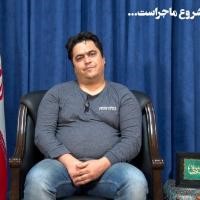
Ruhollah Zam is an Iranian activist and former journalist who had lived in exile with refugee status in France but was kidnapped in 2019 and imprisoned in Iran. He had openly sought the overthrow of the Islamic Republic, and ran Telegram channels used to spread information to Iranians protesting the regime and encourage viewers to join demonstrations. Zam’s channels—particularly AmadNews—disseminated times and places of upcoming rallies to its subscribers, who numbered more than a million. He also published controversial materials undermining the regime, including documents revealing government corruption and malfeasance. In mid-October of 2019, the Islamic Revolutionary Guard Corps (IRGC) announced that it had arrested Zam after he was “guided into the country” via a “complicated intelligence operation,” adding that Zam had “stepped into intelligence trap of the Guards some two years ago.” The IRGC posted news of Zam’s arrest on his Telegram channel, as well as a photo of Zam in captivity, with the caption “This is just the beginning.” The IRGC claimed Zam was being guided and safeguarded by American, Israeli, and French intelligence agencies, and called him “one of the main people of the enemy’s media network and psychological warfare.” A senior IRGC general said, “Zam was a key figure of intelligence services for throwing the country into disarray… and driving a wedge between the Iranian people and government.” On October 23, 2019, an IRGC spokesperson claimed that the Guards had “already captured many of [Zam’s] contacts inside the country.” Media and others tied to the IRGC have said that finding Zam’s network of sources is more important than capturing the activist himself. The regime forced Zam to confess on Iranian television to engaging in “counter-revolutionary” actions at the direction of France. He apologized to the Islamic Republic, said he regretted “what has happened in the past three or four years,” and stated that he was “wrong” to trust foreign governments like France’s, and “especially governments that show they do not have good relations with the Islamic Republic," including the United States, Israel, Saudi Arabia and Turkey. Click here to read Ruhollah Zam’s full story. |
|
Nazanin Zaghari-Ratcliffe
British-Iranian project manager at Thomson Reuters Foundation charity. |
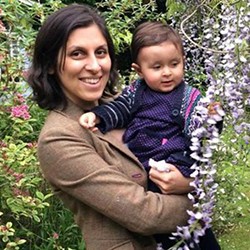
Nazanin Zaghari Ratcliffe is a British-Iranian project manager at Thomson Reuters Foundation, a charity organization promoting socio-economic progress, independent journalism, and the rule of law. Nazanin was detained on April 3, 2016, at Tehran’s Imam Khomeini Airport by officials believed to belong to Iran’s Revolutionary Guards. She had traveled to Iran on March 17, 2016, to visit her family during the Persian New Year holiday. She was detained as she was about to return to the U.K., along with her toddler daughter, Gabriella. Before being taken into custody, Nazanin was allowed to leave her daughter in the care of her parents, who had accompanied her to the airport. The authorities have confiscated the passport of her daughter, who holds British nationality. Nazanin was taken to an undisclosed detention center in Kerman in southern Iran for interrogation and was held in solitary confinement for 46 days. Her family paid bail to keep her from being returned to solitary. On June 5, 2016, Nazanin was transferred from Kerman Prison to a ward controlled by the intelligence organization of the Islamic Revolutionary Guard Corps (IRGC) in the notoriously brutal Evin Prison. Since her arrest, Nazanin has been denied the right to access a lawyer and is feared to have been coerced into making “confessions.” In October 2016, her husband Richard told Amnesty International that his wife’s health had sharply deteriorated and that she was even contemplating suicide. She is suffering from heart palpitations in addition to pain in her hands, arms and shoulders, and blurred vision. On November 13, 2016, Nazanin began a hunger strike to express her despair over the prospect of never being released. In January of 2019, the British press reported that the IRGC had unsuccessfully tried to recruit Nazanin as a spy in exchange for her release. The Guards wanted her to spy on the U.K. Department for International Development and the Small Media Foundation, which describes itself as a “human rights research lab and information design studio.” Nazanin issued an unprecedented open letter in October of 2019. She pleaded for her release and claimed that “My child and I are the playthings of politicians, inside and outside our homeland, who have used us as tools to try to achieve their own political goals.” Nazanin’s family and she herself expressed concern in February of 2019 that Nazanin had contracted the highly dangerous Coronavirus COVID-19. “I feel very bad in fact,” she said. “It is a strange cold. Not like usual. I know the kinds of cold I normally have, how my body reacts. This is different. I am just as bad as I was. I often get better after three days. But with this there is no improvement. I haven’t got one bit better.” She added that she had had a very sore throat and intermittent fever, as well as breathing difficulties and general pains and fatigue, and was not tested for the virus. A spokesman for Iran’s judiciary claimed that she was healthy and not suffering from COVID-19. Click here to read Nazanin Zaghari-Ratcliffe’s full story. |