Throughout its history, the Islamic Republic of Iran has exploited the free airwaves of the West to aggressively shape the way Americans and Europeans view the regime. These efforts—on display again last week with CNN’s fawning interview in Davos with Vice-President for Strategic Affairs Javad Zarif—have had modest success largely due to the cruelty and barbarity of the ayatollahs which speak louder than their spokespersons.

Lebanon

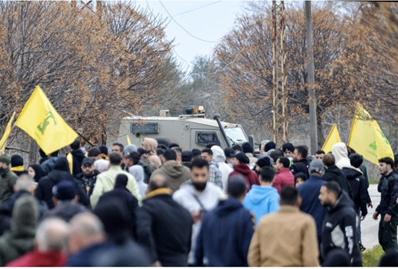
The images, like the one above, circulating on Lebanese social media leave little doubt: Hezbollah is still very much present in southern Lebanon.

The political scene in Lebanon underwent dramatic changes in recent days, as the influential position of Hezbollah, the unofficial “kingmaker” of Lebanese politics over the past two decades, was challenged. 

Lebanon ended two years of a vacancy in its presidency with the election of the Army Chief, Joseph Aoun, and shortly after the selection of Nawaf Salem, a Sunni diplomat and the head of the International Court of Justice (ICJ), to be Lebanon’s next prime minister. 

The Iranian Nuclear Crisis: Implications for the Incoming Trump Administration

President-elect Trump will enter the White House at a tumultuous time in the Middle East and at a watershed moment for Iran’s nuclear program. Though the United States has long looked to pivot U.S. military focus away from the Middle East and towards the Indo-Pacific, the massacre of October 7 and the resulting regional conflict have turned the spotlight once more towards Iran.

UANI’s final Tanker Tracker for 2024 reviews the year’s topline data points, UANI’s impact, and offers prescriptions for 2025.

Iran’s ability to sustain and increase its oil exports remains a critical factor in keeping the regime financially afloat. In 2024, despite U.S. sanctions, Iranian exports remained high, benefiting from OPEC+ cuts and the ongoing lax enforcement of sanctions. This helped the regime to bolster its economic resilience while continuing its support for human rights abuses and proxies like Hezbollah and Hamas.

As all eyes were focused over the last few days on Syria and the historic events unfolding there, little attention has been given to Lebanon and the troubling statements coming out from Beirut, which tried to downplay the importance of the ceasefire agreement with Israel and to minimize the scope of its conditions. 

The announcement of the ceasefire agreement that ended the war between Israel and Hezbollah was followed by efforts from Hezbollah officials to portray the war as a great victory. Nevertheless, outside of Hezbollah's immediate sphere of influence in the Shiite sect, few in Lebanon see the outcome of the year-long war as an achievement. 

The incoming second Trump Administration has reignited interest in the "Maximum Pressure" campaign on Iran, signaling intentions to further limit the Iranian regime’s oil exports and its financial resources. While these actions aim to curb Iran’s destabilizing influence, the persistence and expansion of illicit networks—operating under the guise of the "Dark Fleet"—underscore the ongoing challenges to enforcement.

As the war between Hezbollah and Israel is still ongoing, international mediators, led by the U.S. envoy Amos Hochstein, are trying to lay the groundwork for a ceasefire agreement. The operating assumption is that the Lebanese Armed Forces (LAF) is going to play a critical role in any such agreement that will dictate the nature of the next phase in the bilateral relationship between Israel and Lebanon.