USA

Honeywell

Industry
Electrical
Value of USG Contracts
12900
Value of USG Contract Source
http://www.nytimes.com/interactive/2010/03/06/world/iran-sanctions.html
Symbol
NYSE:HON
States
GA
NJ
NY
PA
WA
Country
USA
Sources

Iranian oil, gas, petrochemical and power industries services company Petrokalooj cites Honeywell as a supplier on its website.

--

According to its Annual report filed with the SEC for fiscal year 2018: "Following our completion of the wind-down activities authorized by OFAC after the United States’ withdrawal from the Joint Comprehensive Plan of Action, we have now ceased doing business in Iran."

--

"Honeywell has booked around $115 million of revenues from Iran through its non-U. S. subsidiaries since the beginning of 2016, largely in the past year, according to regulatory filings. Unless Honeywell is able to fulfill $100 million in current contracts by early November, it could lose future potential revenue, given that the firm indicated in its SEC disclosures that those contracts aren’t yet completed. U.S.-based Honeywell spokeswoman Victoria Streitfeld said the company and its non-U. S. subsidiaries “operate within the parameters of all applicable U.S. and international regulations and will continue to do so.”" (5/31/2018).

--

In the fiscal year ended December 31, 2017, the non-U.S. subsidiaries of our UOP business, part of Performance Materials and Technologies, engaged in the following activities related to Iran’s oil, gas and/or petrochemical sectors:
 

  • Delivered services to Iranian counterparties pursuant to new and existing contracts, which resulted in revenue of approximately $54.2 million (expected total value of these contracts is approximately $81.2 million).
  • Sold non-U.S. origin products to non-U.S. third-parties for end-use in Iran pursuant to new and existing contracts, which resulted in revenue of approximately $1.8 million (expected total value of these contracts is approximately $3.5 million).
  • In the fiscal year ended December 31, 2017, the non-U.S. subsidiaries of our Process Solutions business, part of Performance Materials and Technologies, engaged in the following activities related to Iran’s oil, gas and/or petrochemical sectors:
  • Sold non-U.S. origin products to non-U.S. third-parties for end-use in Iran pursuant to new contracts, which resulted in revenue of approximately $1.4 million (expected total value of these contracts is approximately $6.9 million).
  • Sold approximately $0.4 million of non-U.S. origin products to distributors (including an Iranian distributor) for use in the gas distribution sector in Iran.  

--

In 2017 the U.S. state of California identified Honeywell as a company under review for potentially having subsidiaries that have contracted to sell gas meters and absorbents for end use in the Iranian petrochemical industry.

--

In 2017 the U.S. state of Michigan listed Honeywell on its Iran restricted companies list rendering Honeywell ineligible for investment and/or state contracting.

--

According to its Annual Report filed with the SEC for fiscal year 2017: "In the fiscal year ended December 31, 2017, the non-U.S. subsidiaries of our UOP business, part of Performance Materials and Technologies, engaged in the following activities related to Iran’s oil, gas and/or petrochemical sectors:    

  • Delivered services to Iranian counterparties pursuant to new and existing contracts, which resulted in revenue of approximately $54.2 million (expected total value of these contracts is approximately $81.2 million).
  • Sold non-U.S. origin products to non-U.S. third-parties for end-use in Iran pursuant to new and existing contracts, which resulted in revenue of approximately $1.8 million (expected total value of these contracts is approximately $3.5 million).
  • In the fiscal year ended December 31, 2017, the non-U.S. subsidiaries of our Process Solutions business, part of Performance Materials and Technologies, engaged in the following activities related to Iran’s oil, gas and/or petrochemical sectors:  
  • Sold non-U.S. origin products to non-U.S. third-parties for end-use in Iran pursuant to new contracts, which resulted in revenue of approximately $1.4 million (expected total value of these contracts is approximately $6.9 million).
  • Sold approximately $0.4 million of non-U.S. origin products to distributors (including an Iranian distributor) for use in the gas distribution sector in Iran.

We intend to continue doing business in Iran under General Licenses H and I or under a specific license issued by OFAC, and otherwise in compliance with all applicable laws. Such activities may require additional disclosure pursuant to Section 13(r) of the Act."

--

"A new round of talks between Iran and UOP LLC Petroleum industry company of America has kicked off over investment and supply of new technologies. Association of Petrochemical Industry Corporations (APIC) announced that a fresh round of negotiations has begun between Iran’s petrochemical officials and three major American and European petrochemical companies with the main axes of talks being construction of new polymer units, knowledge and technology transfer as well as issuance of license for new petchem plans. On the sidelines of K Trade Fair 2016, the world's premier fair for the plastics and rubber industry in Germany, high ranking officials of Iran’s petrochemical industry held meetings with authorities of France’s Total and Air Liquide as well as America’s UOP, formerly known as Universal Oil Products." (Mehr News, "US petchem giant ready to return to Iran," 10/24/2016).

--

According to its Annual Report filed with the SEC for fiscal year 2016: "In the three months ended December 31, 2016, the UOP business, part of Performance Materials and Technologies, engaged in the following activities related to Iran’s oil, gas and/or petrochemical sectors:

  • Settled outstanding claims with Iranian counterparties under contracts originally entered into in compliance with then-applicable sanctions laws. Revenue in the three months ended December 31, 2016 from these settlements was approximately $28.6 million.
  • Delivered services to Iranian counterparties pursuant to new and existing contracts, which resulted in revenue of approximately $1.3 million in the three months ended December 31, 2016, (expected total value of these contracts is approximately $4.2 million).
  • Sold non-U.S. origin products to non-U.S. third-parties for end-use in Iran pursuant to new and existing contracts, which resulted in revenue of approximately $0.1 million in the three months ended December 31, 2016 (expected total value of these contracts is approximately $0.9 million).

In the three months ended December 31, 2016, the Process Solutions business, part of Performance Materials and Technologies, sold approximately $1.7 million of non-U.S. origin products to distributors (including an Iranian distributor) for use in the gas distribution sector in Iran.

In the three months ended December 31, 2016, the Industrial Safety business, part of Safety and Productivity Solutions, sold approximately $0.1 million of non-U.S. origin products to a non-U.S. distributor for use in the oil sector in Iran.

In addition to the activities described above, we previously disclosed in our periodic reports activities, transactions or dealings relating to Iran occurring in the first, second and third quarters of 2016. Our non-U.S. subsidiaries intend to continue doing business in Iran under General License H in compliance with all applicable laws, which sales may require additional disclosure pursuant to Section 13(r) of the Act."

--

According to its Annual Report filed with the SEC for fiscal year 2015: "A non-U.S. wholly-owned subsidiary of Honeywell (the Non-U.S. Subsidiary) inadvertently made four ground shipments of low value, non-U.S. items from Turkey to Uzbekistan from December 2013 to 
March 2014 that transited through Iran en route to Uzbekistan on trucks operated by a third party transportation vendor (the Vendor) retained by the Non-U.S. Subsidiary. The Non-U.S. Subsidiary hired the Vendor to facilitate shipment and the Vendor further engaged a trucking company to provide surface transport. The Vendor proposed the transport route for the shipment. The shipment of the items via Iran occurred inadvertently as a result of non-U.S. person employees approving the transport route proposed by the Vendor. Honeywell disclosed these past transactions voluntarily to the U.S. Treasury Department’s Office of Foreign Assets Control (OFAC).

The Non-U.S. Subsidiary did not pay, directly or indirectly, any duties or taxes to the Government of Iran as a result of these shipments because the shipments were made under TIR (Transports Internationaux Routiers) Carnets, a treaty system which allows for the transport of merchandise through contracting parties from the customs office of departure to the customs office of destination without payment of customs duties/taxes in transiting countries. Further, the Non-U.S. Subsidiary made all payments for shipping services to the Vendor on a flat-fee basis at a rate of $11,800 per shipment, and the Non- U.S. Subsidiary did not reimburse the Vendor for any fees or other expenses incurred in Iran."

--

“U.S. company, UOP, has not delivered a special catalyst to Iran's Isfahan Refinery under pressures as a result of sanctions imposed on Iran's oil sector. Abbas Kazemi, Managing director of National Iranian Oil Refining and Distribution Company, said that Iranian producers have been participating to produce the catalyst inside the country, Iran's Mehr news agency reported on May 20. The catalyst will be used in producing high-quality gasoline by the refinery, he noted…According to media reports, currently, some 6,000 tons of the catalysts is being used in the country per year. Iran imports some $2 billion worth of catalysts, additives, and equipment from European and Asian countries annually.” (Trend, “U.S. company shuns selling catalyst to Iranian refinery,” 5/20/14)

--

According to its Annual report filed with the SEC for fiscal year 2012: "The Company and its subsidiaries have a current policy not to conduct business with Iran." 

--

"Shell and UOP LLC, a unit of U.S.-based Honeywell International Inc., were among the companies named in the report published today by the state-run news agency." (Bloomberg, "Shell, UOP Among Companies Put on Blacklist by Iran, Mehr Says," 1/6/2012)

--

"A pressure group, United Against Nuclear Iran (UANI), is urging industrial conglomerate Honeywell International Inc to stop selling security technology to Iran, the group said on Thursday.


Honeywell security products can be used for surveillance of oil pipelines and nuclear reactors, UANI said in a letter faxed to Honeywell it provided exclusively to Reuters.

The sale of security technology, via a British subsidiary, violates company guidelines for business conduct, UANI said, adding it may sue or pressure the New York Stock Exchange to delist Honeywell if the company continues operations in Iran.

In response, Honeywell said it made a commitment not to undertake new projects in Iran, but is fulfilling its contractual obligations in accordance with U.S. and EU laws and regulations.

'Should the U.S. Congress pass a law that prohibits subsidiaries of U.S. companies from doing business in Iran, Honeywell will comply fully as it does with all other laws in the countries in which it operates,' the company said in a statement.

Honeywell shares were up 0.5 percent at $45.49 in afternoon trading on the New York Stock Exchange.

TARGETING IRAN'S OIL INDUSTRY

New York-based UANI has pressured industrial companies to stop serving Iran's energy sector. The group has said Ingersoll-Rand Plc, General Electric Co, Huntsman Corp and Caterpillar Inc have agreed to sever ties with Iran.

'In the face of overwhelming bipartisan support in the U.S. Congress to economically isolate Iran's oil and natural gas industry, Honeywell continues to make key contributions to the development of Iran's oil industry,' UANI President Mark Wallace said in a letter to Honeywell Chairman and CEO David Cote.

UANI said Honeywell regulatory filings have provided "zero disclosure" about dealings with Iran.

The group's website lists 200 companies targeted over their dealings with Iran, which it argues is developing a secret nuclear weapon and sponsors terrorism.

Its list includes names such as Royal-Dutch Shell Plc, Hewlett-Packard Co, Advanced Micro Devices Inc and Coca-Cola Co. (Reuters, "
U.S. Group Targets Honeywell Over Iran," 4/8/10)

--

"Honeywell acquired 100 percent ownership of Universal Oil Products (UOP), based in Des Plaines, Ill., in 2005. UOP has a British subsidiary that conducts business in Iran; it is part of a consortium with Axens, Technip, Sinopec Engineering Inc. and several Iranian firms that is expanding and upgrading the Arak Refinery in Iran. The project, budgeted to cost $3.7 billion, could nearly triple gasoline production, from 34,000 to 100,000 barrels per day, according to various news reports and FACTS Global Energy, an expert in the industry. Honeywell is a top federal contractor, and UOP recently won a $25 million grant to help develop renewable energy sources. In a statement, the company said that in early 2009 it committed to the State Department that it would not undertake any new projects in Iran, but that it is fulfilling its contractual obligations relating to the Arak refinery. 'Should the U.S. Congress pass a law that prohibits subsidiaries of U.S. companies from doing business in Iran, Honeywell will comply fully,' the statement said." From 2000 through March 2010, Honeywell has been the recipient of $12.9 billion in U.S. federal funds. (
The New York Times, "Profiting from Iran, and the U.S.", 3/6/10)

Response

"As disclosed in our Annual Report on Form 10 K filed on February 8, 2019, we have ceased doing business in Iran." (12/29/2019)

--

Response - “We want to make clear that Honeywell’s activities in Iran in no way impact our strong jobs record in the United States…With regards to our activities in Iran, Honeywell complies with all U.S. laws and with all laws in every country we operate.” (2017)

--
UANI has launched a campaign to pressure Honeywell to stop selling security technologies to Iran in addition to halting its oil projects in the country:


Flowserve

Industry
Energy
Value of USG Contracts
71
Value of USG Contract Source
http://www.nytimes.com/interactive/2010/03/06/world/iran-sanctions.html
Symbol
NYSE:FLS
States
TX
Country
USA
Sources

According to its Annual Report filed with the SEC for fiscal year 2013: "Section 219 of the Iran Threat Reduction and Syria Human Rights Act of 2012 (TRA) added subsection (r) to Section 13 of the Exchange Act.  That subsection requires issuers to disclose whether affiliates engaged in specified activities or transactions relating to Iran. The reporting requirement extends to activities that were permissible under U.S. law at the time they occurred.  As previously reported, in 2007, Flowserve implemented a phased withdrawal from Iran, Syria and Sudan. During the phased withdrawal, Company policy permitted foreign subsidiaries to engage in certain limited business with those countries, including the provision of spare parts for previously supplied equipment so long as those shipments complied with U.S. and other applicable law. In 2010, Flowserve France S.A.S., a Flowserve affiliate, made one shipment of spare parts valued at approximately €25,843 to Kala Naft in Iran. The 2010 shipment complied with U.S. law at the time, as it did not involve U.S. persons and did not involve any U.S.-origin content. Pursuant to Company policy, the shipment was reviewed by internal compliance personnel in Europe at the time to ensure compliance with U.S. and other applicable law.

Effective December 31, 2011, our foreign subsidiaries were directed to complete their withdrawal from Iran, Syria, and Sudan. At that time, no payment had been received from Kala Naft for the 2010 shipment of spare parts.  In the course of a compliance review in the first quarter of 2013, the Company discovered that our foreign affiliate received a final payment of €10,000 on March 15, 2013 associated with the 2010 shipment. The Company requested specific authorization from the Office of Foreign Assets Controls  (“OFAC”) at the U.S. Department of the Treasury to process that payment, as it was received one week after the expiration of the OFAC general license described at 31 C.F.R. 560.555. Additionally, through a subsequent compliance review, the Company discovered that two earlier payments of approximately €5,000 and €8,845 were received on March 22, 2012 and October 3, 2012, respectively, in connection with the 2010 shipment. Receipt and processing of those earlier payments were permissible under U.S. and other applicable law at the time.  Net profit associated with the 2010 shipment was approximately €18,000.  Flowserve and all of the Company's affiliates have withdrawn from the Iranian market.  Flowserve does not intend or expect to continue any activity related to those countries other than foreign government-mandated inspections, which we plan to conclude as soon as possible."

--

"Flowserve, which makes flow control equipment used in the oil and gas industry and has sold power and hand pumps to the Department of Defense, said in 2009 filings with the SEC that due to 'growing political uncertainties' its foreign subsidiaries had in 2006 begun a voluntary phased withdrawal from conducting new business in countries designated as state sponsors of terrorism, including Iran, Syria and Sudan. 'The aggregate amount of all business done by our foreign subsidiaries for customers in Iran, Syria and Sudan accounted for less than 1 percent of our consolidated global revenue in 2008,' the company said, adding that while it was voluntarily phasing out new business with those countries, "our foreign subsidiaries may independently continue to honor certain existing contracts, commitments and warranty obligations in compliance with U.S. and other applicable laws and regulations."

From 2000 through March 2010, Flowserve has been the recipient of $71.1 million in federal funds. (The New York Times, "Profiting from Iran, and the U.S.", 3/6/10)

Response

Flowserve is active in Iran but states it is not making new investments.

Dresser-Rand

Industry
Energy
Value of USG Contracts
253
Value of USG Contract Source
http://usaspending.gov/explore?fromfiscal=yes&tab=By+Prime+Awardee&fiscal_year=2001&contractorid=270202&fiscal_year=&tab=By+Prime+Awardee&fromfiscal=yes&carryfilters=on&Submit=Go%20http://usaspending.gov/search?query=&searchtype=&formFields=eyJSZWNpcGllbnROYW1lTGNhc2UiOlsiRHJlc3NlcitSYW5kIl19
Symbol
NYSE:DRC
States
TX
Country
USA
Sources

Listed as an approved vendor by NIOEC, NPC, POGC, NIGCENG, NISOC, SADAF, NIGC and IOOC.

--

--

According to its Annual Report filed with the SEC for fiscal year 2012: "Subsequently, in October 2012, the Company adopted a policy prohibiting all business with the government of Iran or any person subject to the jurisdiction of Iran. This recently adopted policy is consistent with the Iran Threat Reduction and Syria Human Rights Act of 2012 (“ITRSHRA”), which expanded sanctions against Iran effective in October 2012 and instituted disclosure requirements in annual and quarterly reports for public companies engaged in, or affiliated with an entity engaged in, specified activities under the ITRSHRA. This policy was effective immediately and applied to all contracts, including those in existence on the effective date of the policy.

During 2012, Guascor received payments from a customer in Iran pursuant to a contract for the sale of gas-powered generators. Guascor entered into this contract in January 2011, prior to it being acquired by the Company, and the shipments to the customer pursuant to this contract were not in violation of the U.S. sanctions on Iran or the Company’s policies in place at the time. Payments under the contract were received through a letter of credit issued in June 2011 by Bank Tejarat, an Iranian bank (the “Bank”). Guascor has not engaged in any direct dealings with the Bank, which was selected solely by the Iranian customer. However, Guascor was designated by the customer as the beneficiary under the letter of credit. On January 23, 2012, after the letter of credit was issued, the Bank was designated by the U.S. Treasury Department’s Office of Foreign Assets Control (“OFAC”) as subject to sanctions pursuant to Executive Order 13382. During 2012, Guascor received a total of three payments from the customer via the Bank-issued letter of credit totaling €1.2 (approximately $1.6), two of which, totaling €0.9 ($1.2) were received in November 2012 after the expanded sanctions against Iran were in effect. There were no net profits associated with the receipt of these payments under the letter of credit. Guascor is in the process of winding down all transactions with Iran in accordance with a general license from OFAC and, with the exception of one final payment of €0.1 (approximately $0.1) that is scheduled to be received on or before March 4, 2013, under the Bank-issued letter of credit, no additional dealings with or involving the Bank are contemplated. The Company has fully disclosed the receipt of these payments to OFAC, requesting a finding that no violation has occurred, and has requested from OFAC a license with respect to the final payment scheduled to be received in March 2013. Although there is a risk of sanctions associated with the November 2012 payments, under the particular facts and circumstances described above, the Company believes that sanctions, if any, would not have a material adverse effect on our financial condition.

The Company’s foreign subsidiaries’ aggregate 2012 sales into countries that are subject to these policies was less than 1% of the Company’s total sales in 2012 and only included sales to Iran before the new expanded sanctions against Iran went into effect in October 2012. We did not make any sales to Iran after these new sanctions were effective.

Although such sales are not material in magnitude to our overall business, certain investors may view even this level of business in such countries adversely. This could have an adverse impact on the market price of our common stock and our Senior Subordinated Notes." 

--

Several days after coverage in the New York Times (below), Dresser-Rand issued a press release explaining that it had barred its subsidiaries from entering into new business contracts with Iran. 

--

"Dresser-Rand, a Texas-based oil and gas equipment supplier, said in multiple filings with the SEC, including as recently as last month, that 'from time to time, certain of our foreign subsidiaries operate in countries that are or have previously been subject to sanctions and embargoes imposed by the U.S. government and the United Nations, including in Iran, Sudan and Syria.'"

As of March 2010, Dresser-Rand is classified as being "Active" in Iran. From 2000 through March 2010, Dresser-Rand has been the recipient of $215.1 million in federal funds. (The New York Times, "Profiting from Iran, and the U.S.", 3/6/10)


Advanced Micro Devices (AMD)

Industry
Technology
Value of USG Contracts
2
Value of USG Contract Source
http://usaspending.gov/explore?fromfiscal=yes&tab=By+Prime+Awardee&fiscal_year=2003&recipientid=175144&fiscal_year=&tab=By+Prime+Awardee&fromfiscal=yes&carryfilters=on&Submit=Go
Symbol
NYSE:AMD
States
CA
TX
Country
USA
Contact Information
Sources

AMD's website states that the company is "committed to fully comply with the United States and all applicable export and import laws and regulations governing the export, re-export, or import of AMD products, software, services and technology. AMD's Global Trade Compliance organization is responsible for providing guidance and support of AMD's global export and import compliance obligations... AMD products, services, and technology are prohibited for U.S. export or re-export to Cuba, Iran, North Korea, Sudan, and Syria or to any country or end-use subject to U.S. trade sanctions."

--

AMD says it hasn't authorised any product shipments to Iran, directly or indirectly, but somehow the Iranian High Performance Research Center (IHPCRC), which is located at Tehran's Amirkabir University of Technology, says it has assembled a Linux-based system with 216 Opteron processing cores (an AMD product).  There is a connection through Thacker, also known as Sky Electronics, an authorised distributor of AMD products based in the United Arab Emirates. (The Enquirer, "AMD is inside Iran's missiles and supercomputers," 6/17/2009)

--

In response to reports that AMD processors had been used to build Iran's most powerful supercomputer, the SEC wrote AMD the following correspondence on May 8, 2009:

"It appears from exhibit 21 to your Form 10-K, exhibit 99.1 to your Form 8-K, and the “AMD Worldwide” section of your website that you have operations in the Middle East and Africa, which are regions that include Iran, Syria, and Sudan. In addition, we are aware of a December 2007 news report that your processors have been used to build Iran’s most powerful supercomputer. Iran, Syria, and Sudan are identified by the State Department as state sponsors of terrorism, and are subject to U.S. economic sanctions and export controls. We note that your Form 10-K does not include disclosure regarding contacts with Iran, Syria, or Sudan. Please describe to us the nature and extent of any past, current, and anticipated contacts with the referenced countries, whether through joint ventures, distributors, resellers, or other direct or indirect arrangements. Your response should describe any products or technology you had provided to the referenced countries, directly or indirectly, and any agreements, commercial agreements, or other contacts you have had with the governments of those countries or entities controlled by those governments."

In a June 19, 2009 response letter to the SEC, AMD wrote:

"In response to the Staff’s comment, the Company advises the Staff that AMD has not had any direct authorized contacts with Iran, Syria or Sudan (collectively, the “Embargoed Countries”). The Company has not provided any products or technology to the Embargoed Countries and has had no agreements, commercial agreements or other business contracts with the governments of the Embargoed Countries or entities controlled by those governments.The Company has an established export management system (“EMS”) which sets forth strict policies relating to its export related activities. The Company has designed these policies to ensure compliance with U.S. export control laws. The EMS governs the review of all sales and shipments to countries which are subject to U.S. economic and export sanctions. In addition, it is the Company’s policy that all authorized distributors of AMD products contractually commit that they will fully comply with all U.S. export control laws with respect to their sales and shipments of AMD products. The Company also periodically requests that its authorized distributors reaffirm these commitments...

Supporting material sent to the Committee on Foreign Investment in the United States (“CFIUS”) in December 2008 corroborated the above findings. The responses detail the controls that AMD has in place, including EMS, to prevent its distributors from selling products to prohibited end-users. These materials also contradict the articles referenced by the Staff that AMD processors were used in the construction of an Iranian supercomputer, showing that there are no records that indicate any improper or illegal shipment of technology to Iran, Syria or Sudan by AMD. Again, we are happy to provide you with copies of these materials.

The Company respectfully advises the Staff that in the rare occasions in the past where the Company has discovered an unauthorized resale by a distributor or direct customer of its product to an Embargoed Country, AMD has immediately terminated the export of its products to such customers or distributors if such customer or distributor does not agree to immediately cease such sales."

--

"Chipmaker AMD is red-faced after a bunch of Iranian boffins smuggled 216 Opteron chips into the country and built themselves a supercomputer. Iran has loads of trade embargoes against it as part of a punishment for not liking America much. One of the embargos forbids the import of IT gear so that the Iranians cannot get their paws on a supercomputer.

Scientists at the Iranian High Performance Computing Research Center at the country's Amirkabir University of Technology have said that they have built a supercomputer using 216 AMD Opterons in a Linux cluster. They think that it can manage 860 giga-flops. But the development is extremely embarrassing for AMD which claims it has never shipped its chips to Iran or allowed anyone else to do so. No doubt AMD is expecting a visit from US law enforcement people who want to know how the chips got to Iran.

A spokesAMD said that the company complies with all United States export control laws. Any shipment of AMD products to Iran by any authorised distributor of AMD would be a breach of the specific provisions of their contracts with AMD." (The Inquirer, "AMD probed over Iran supercomputer build," 12/7/09)

--

"Despite federal antiterrorism trade sanctions that bar the sale of U.S.-made computer technology to Iran, a computing research center in Tehran claims to have used Advanced Micro Devices Inc.'s Opteron processor to build the Middle Eastern country's most powerful supercomputer. The Iranian High Performance Computing Research Center (IHPCRC), which is located at Tehran's Amirkabir University of Technology, said in an undated announcement on its Web site that it has assembled a Linux-based system with 216 Opteron processing cores. That's a relatively small supercomputer, with a claimed peak performance level of 860 billion floating-point operations per second, or gigaflops. But the research center said that the system, which will be used for weather forecasting and meteorological research, is the fastest built in Iran to date." (Computerworld, "Iranians claim to have built Opteron-based supercomputer," 12/6/07)

Genzyme

Industry
Medical*
States
AZ
CA
FL
MD
MA
NJ
NM
NY
OK
PA
TX
VA
WI
Country
USA
Sources

"One of the world's leading biotechnology companies, Genzyme is dedicated to making a major positive impact on the lives of people with serious diseases." (Company Website)

--

Over the last three presidential administrations, the United States government has granted Genzyme Corporation 14 special licenses to do business in Iran. (New York Times, "Companies with Permission to Bypass Sanctions," 12/24/10)

--

Website states that it does business with Iran and other Middle Eastern countries through its Dubai office.
Genzyme Middle East (Company Website)

--

The Dubai office will provide regional sales and marketing support to customers and distributors for its enzyme replacement treatments for Gaucher, MPS I, Fabry and Pompe, four Lysosomal Storage Diseases*. It will also support activities for Renagel, a treatment to reduce the phosphorus levels in chronic kidney disease patients on hemodialysis, Thymoglobulin, an immunosuppressant for treating and preventing acute rejection in renal transplant patients, and Thyrogen, an adjunct to thyroid cancer disease management designed to aid in the treatment and earlier detection of recurrence…

The Dubai office will represent Genzyme in Bahrain, Egypt, Iran, Iraq, Jordan, Kuwait, Lebanon, Qatar. Further activities in Yemen, Syria and Sudan could be foreseen.” (AMEinfo.com, “Genzyme inaugurates Middle East office in Dubai,” 11/6/06)


Sovereign Bank

Industry
Banking
Value of USG Contracts
54
Value of USG Contract Source
http://usaspending.gov/explore?fromfiscal=yes&fiscal_year=2007&recipientid=420780&fiscal_year=&tab=By+Prime+Awardee&fromfiscal=yes&carryfilters=on&Submit=Go
Symbol
NYSE:STD
States
CT
DE
MD
MA
NH
NJ
NY
PA
RI
Country
USA
Contact Information

[email protected] (Andrew Gully, Senior Vice President/Managing Director of Corporate Affairs); [email protected] (Ellen Molle, Vice President/Communications Manager); [email protected] (Carl Brown, Jr., Vice President/Communications Manager)

Sources

Sovereign Bank is a subsidiary of Banco Santander, "the third largest bank in the world in terms of profits." (Santander Company Website)

--

Banco Santander is also part of the Royal Bank of Scotland led consortium that owns ABN AMRO, which reportedly has done business with Iran. (ABN AMRO Company Website)

--

  • "In July 2007, it was reported that Santander “was doing business with Teheran-based Sepah as recently as March [2007]… Trading with businesses that are blacklisted for alleged links to terrorism is a serious breach of US law and can have draconian consequences... Santander is thought to have opened accounts for Sepah in various European countries and in Teheran. Allegations have also been made that Santander had a banking relationship with another Iranian bank that the US is targeting for its alleged links to terrorists. Santander said: ‘Neither of these institutions has an open account with Santander.’ The Spanish bank appears to have ended its relationship with Sepah after March. No details are known about the nature of its contact with the other bank. Santander said: ‘Banco Santander is confident that it complies with all relevant banking regulations in the territories in which it operates, and with international requirements placed on banks, including those concerning money-laundering and the financing of terrorism.’ Sepah, which is owned by the Iranian state, was placed on the US blacklist in January. At the time, Stuart Levey, under-secretary for terrorism and financial intelligence, said: ‘Sepah is the financial linchpin of Iran's missile procurement network and has actively assisted Iran's pursuit of missiles capable of carrying weapons of mass destruction.’" (The Daily Telegraph, "Santander Traded with Blacklist Iranian Bank," 7/23/07)

United Technologies Corporation (UTC)

Industry
Conglomerate, Manufacturing
Value of USG Contracts
63958
Value of USG Contract Source
http://www.usaspending.gov/explore?fromfiscal=yes&fiscal_year=2008&contractorid=1032&fiscal_year=&tab=By+Prime+Awardee&fromfiscal=yes&carryfilters=on&Submit=Go
Symbol
NYSE:UTX
States
CT
Country
USA
Contact Information
Sources

"Iran imposed sanctions on 15 American companies, saying that they were involved in human rights violations and had cooperated with Israel, the state news agency IRNA reported on Sunday, in a tit-for-tat reaction to a move by Washington...The affected companies, many of them military contractors, also included ITT Corporation, United Technologies and the specialty-vehicle maker Oshkosh Corporation. The affected companies, many of them military contractors, also included ITT Corporation, United Technologies and the specialty-vehicle maker Oshkosh Corporation." (March 26, 2017).

--

According to its Annual Report filed with the SEC in 2014:

  • "As part of UTC's on-going efforts to identify and terminate transactions with the Government of Iran, we recently determined that three non-U.S. subsidiaries operating through the UTC Climate, Controls & Security segment, sold fire safety products and related installation, maintenance and inspection services to certain Iranian parties located in France, Switzerland and the United Kingdom in 2012, 2013, and 2014. Each of the Iranian parties to the transactions described below has been designated by the U.S. Treasury Department’s Office of Foreign Assets Control (OFAC) as an entity owned or controlled by the Government of Iran. With respect to Bank Melli Iran, Melli Bank PLC, Bank Sepah, Bank Sepah International PLC, and IranAir, these parties have also been designated by OFAC as blocked pursuant to Executive Order No. 13382. With respect to Bank Saderat Iran, this party has also been designated by OFAC as blocked pursuant to Executive Order No. 13224. A portion of the 2012 transactions and all of the 2013 and 2014 transactions took place after the President issued Executive Order 13628 on October 9, 2012, which implemented Section 218 of the Iran Threat Reduction and Syria Human Rights Act by prohibiting any entity owned or controlled by a U.S. person and established or maintained outside the U.S. from knowingly engaging in any transaction, directly or indirectly, with the Government of Iran. Accordingly, UTC has filed appropriate disclosures with OFAC.
  • In 2012, 2013, and 2014, Chubb France SCS (Chubb France), a company organized under the laws of France, sold fire safety equipment and services to the Paris offices of Bank Sepah, Bank Saderat Iran, Bank Melli Iran, and IranAir. In 2012, Chubb France sold approximately $4,324.75 in the aggregate in fire safety equipment and services to these parties, with a net profit of $164.35. Approximately $1,175.18 of the 2012 payments were received before October 9, 2012 and were not prohibited by applicable law when received. In 2013, Chubb France sold approximately $2,402.99 in the aggregate in fire safety equipment and services to these parties, with a net profit of $91.32. In 2014, Chubb France sold approximately $22,070.81 in the aggregate in fire safety equipment and services to these parties, with a net profit of $1,378.48. Chubb France has informed each of these parties that it has terminated the relationships and will not provide further fire safety equipment or maintenance inspection services.
  • In 2012, 2013, and 2014, Chubb Fire & Security Limited (Chubb UK), a company organized under the laws of the United Kingdom, sold fire safety products and provided related maintenance inspection services to Petrochemical Commercial Company (U.K.) Limited (Petrochemical). In 2012, Chubb UK sold approximately $7,422.75 in the aggregate in fire safety equipment and services to Petrochemical, with a net profit of $442.83. Approximately $7,834.23 of the 2012 payments were received before October 9, 2012 and were not prohibited by applicable law when received. In 2013, Chubb UK sold approximately $10,078.17 in the aggregate in fire safety equipment and services to Petrochemical, with a net profit of $1,224.64. In 2014, Chubb UK sold approximately $2,243.10 in the aggregate in fire safety equipment and services to Petrochemical, with a net profit of $404.18. Chubb UK has informed Petrochemical that it has terminated the relationship and will not provide further fire safety equipment or maintenance inspection services.
  • In 2012, 2013, and 2014, Security Monitoring Centres Limited (SMC), a sister company of Chubb UK organized under the laws of the United Kingdom, provided security alarm monitoring services to the London office of Melli Bank PLC. SMC provided security alarm monitoring services to the London office of Bank Sepah International PLC in 2014. SMC provided the monitoring services to the Iranian banks pursuant to a contract between SMC and Total Security Systems Ltd. (Total Security), a third-party company organized under the laws of the United Kingdom. Total Security had contracts with the two Iranian banks to maintain and monitor their security alarm systems, and Total Security subcontracted the monitoring work to SMC. The contract between Total Security and SMC provides that Total Security will pay SMC a lump sum of $17,526 per year, in exchange for SMC providing monitoring services to 120 of Total Security’s customers. In 2012, SMC received total payments and net profit of approximately $868.90 and $230.28, respectively, for services provided to Melli Bank PLC. In 2013, SMC received total payments and net profit of approximately $857.14 and $229.69, respectively, for monitoring services provided to Melli Bank PLC. In 2014, SMC received total payment and net profit of approximately $961.74 and $381.01, respectively, for monitoring services provided to Melli Bank PLC and Bank Sepah International PLC. SMC has informed Total Security that it has terminated the monitoring services to both Iranian banks and will not provide further services.
  • In 2012 and 2013, Sicli Materiel-Incendie S.A. (Sicli Switzerland), a company organized under the laws of Switzerland, sold fire safety products and provided related maintenance inspection services to the Delegation and Permanent Representative of the Islamic Republic of Iran to the United Nations Office in Geneva, Switzerland. In 2012, Sicli Switzerland sold approximately $657.17 in the aggregate in fire safety equipment and services to the Permanent Representative of Iran, with a net profit of approximately $115.12. The 2012 payments took place before October 9, 2012 and were not prohibited by applicable law when received. In 2013, Sicli Switzerland sold approximately $159.13 in fire safety equipment and services to the Delegation of Iran, with a net profit of approximately $32.16. Sicli Switzerland has discontinued the services to the Delegation and Permanent Representative and will not provide further fire safety equipment or maintenance inspection services."

--

"United Technologies Corp. disclosed in regulatory filings Friday that one of its foreign businesses worked on the security system for the Paris branch of Iran's national bank, an entity singled out under U.S. economic sanctions against the Middle East country. Delta Security Solution's business with the Bank Melli Iran's Paris branch amounted to $7,582 in 2012 and 2013, a portion of which occurred after President Barack Obama signed an executive order last October limiting U.S. companies and their foreign subsidiaries from 'engaging in any transaction, directly or indirectly, with the Government of Iran.' According to securities filings, UTC reported sales of about $3.59 million over the past two years to banks, insurance companies, oil companies and embassies controlled or owned by the Iranian government. All of the sales were through foreign subsidiaries of the Hartford-based company, which declined to comment further on the sales. Though the sales amount to a sliver of UTC's annual revenue, they underline just how difficult a task U.S. companies and their overseas affiliates have complying with the expanded sanctions against Iran. In the past two months, a group of about two dozen companies — including Costco, Toyota, Oracle, Vodafone, Sony and FedEx — have filed similar notices... Jonathan M. Epstein, a partner at Holland & Knight in Washington D.C. who practices international trade law, said that the fact that UTC has ended the contracts should help it avoid sanctions. 'The winding down of something that was previously lawful and is suddenly unlawful would be a major mitigating factor,' he said, adding that the company's actions 'may very well just result in a warning letter.' The Paris-based subsidiary that did the security work, Delta Security Solutions, is owned by UTC Climate, Controls & Security. This year and last, it 'provided remote monitoring of the Paris branch's electronic alarm system as well as related maintenance services to verify the proper functioning of the branch's intrusion detection equipment,' the filings said. When the work contracts were signed in August 2010, neither the business agreements nor the services were prohibited by law, UTC said in its filings. In addition to reporting the business to the U.S. Securities and Exchange Commission, UTC Climate, Controls & Security filed this information with the Treasury's Office of Foreign Assets Control, as it has in all of these cases. Delta Security has terminated the contracts with the bank and 'does not intend to do any further business with Bank Melli Iran,' UTC said in filings. UTC also reported in April that another subsidiary sold fire safety equipment, including fire blankets, extinguishers, stands and spare parts, to the London office of the Bimeh Iran Insurance Company, another Iranian-controlled business. In February, UTC reported that two other subsidiaries, Simtronics and Water Mist Engineering AS, sold $3.51 million in fire detection and suppression equipment to the Pars Oil & Gas Company, a firm controlled by Iran. Also that month, the company reported that a foreign affiliate of Otis conducted service and maintenance at a number of Iranian 'diplomatic premises' in France, Kuwait and Hungary. That work amounted to $74,500." (The Courant, "UTC Reporting Business With Iran Despite Sanctions," 7/26/2013)


--

"United Technologies Corp. says two overseas affiliates earned $630,000 as the company ended business with Iran. The aerospace and building systems conglomerate based in Hartford, Conn., disclosed in its annual report Thursday that its non-U.S. affiliates generated $3.5 million in revenue 'related to the orderly winding down of legacy business related to sale of fire safety equipment' United Technologies said it stopped new business with Iran in 2009. It also said non-U.S. affiliates of its Otis subsidiary serviced, maintained and modernized elevators at Iranian diplomatic premises in France, Hungary and Kuwait last year. The Otis affiliates earned $6,000." (Washington Post, "United Technologies discloses $3.5M in revenue for 2 overseas affiliates ending Iran business," 2/7/13)

--

Carrier Corporation, a wholly-owned subsidiary of United Technologies Corporation, states it does business with Iran: "Delivering innovative solutions and trusted products for our customers in: Bahrain, Iran, Iraq, Oman, Qatar, Syria, Yemen." (Company Website)

United Technologies Corporation is also the parent company of three key defense contractors for the United States Military: Sikorsky Aircraft Corporation, Pratt & Whitney and Hamilton Sundstrand.

According to the Sikorsky website, "Sikorsky helicopters are used by all five branches of the United States armed forces, along with military services and commercial operators in 40 nations. Core U.S. military production programs are based on the Sikorsky H-60 aircraft: the BLACK HAWK helicopter for the U.S. Army and SEAHAWK® helicopter for the U.S. Navy. H-60 aircraft derivative aircraft perform multiple missions with other branches of the U.S. military. The CH-53E helicopter and MH-53E helicopter heavy-lift aircraft are flown by the U.S. Navy and Marine Corps to transport personnel and equipment, and in anti-mine warfare missions. Sikorsky is currently developing the next-generation CH-53K helicopter for the U.S. Marines. Sikorsky is the prime contractor in the U.S. Army's UH-60M aircraft program, which the Pentagon authorized for full rate production on June 26, 2007. The program calls for more than 1,200 of the newest BLACK HAWK aircraft during the next 25 years. In 2002, the U.S. Navy inducted the first MH-60S aircraft, the first all-new rotary wing aircraft to enter the service in a decade. The U.S. Navy's helicopter fleet will become all-Sikorsky by 2010, with the MH-60S helicopter and the MH-60R helicopter the only air platforms used." (Company Website)

Sikorsky is the manufacturer of the long-time presidential helicopter, "Marine One." (Sikorsky, "Sikorsky Submits VH-92 Proposal for Presidential Helicopter Mission," 1/26/04)

Pratt & Whitney From the P & W website: "Today, nearly 11,000 Pratt & Whitney military engines are in service with 27 armed forces worldwide, setting new standards for performance and dependability. With the best engine technology, world-renowned manufacturing techniques and a global service organization, Pratt & Whitney is completely focused on meeting the new demands of the 21st century. Pratt & Whitney currently produces the F135 engine for the F-35 Lightning II. This proven fifth-generation engine was selected by the Department of Defense as the best engine for the F-35 and is more reliable and cost-effective than adding an unwanted alternate engine. Learn why the F135 is the best engine for the F-35 at f135engine.com. Pratt & Whitney’s other military engines include the F119 for the F-22 Raptor, the F100 family that powers the F-15 and F-16, the F117 for the C-17 Globemaster III, the J52 for the EA-6B Prowler, TF30 for the F-111, and the TF33 powering AWACS, Joint STARS, B-52, and KC-135 aircraft. In addition, Pratt & Whitney offers a global network of MRO and MAS focused on maintaining engine readiness for our customers." (Company Website)

Hamilton Sundstrand Aerospace: "Hamilton Sundstrand's Aerospace business units provide technologically advanced systems, components and services for commercial and military aircraft and vehicles." (Company Website) Energy, Space & Defense: "Hamilton Sundstrand’s Energy, Space & Defense (ESD) business unit provides highly reliable, advanced technology solutions to a broad range of government and industry customers. ESD continues to bring innovative and integrated solutions to our traditional Space, Missile, Launch Vehicle, and Undersea markets, while seeking new applications for our advanced technologies in support of Army and Joint Services land-based forces, surface Navies, Renewable Energy Production, and the Nation’s Homeland Security needs." (Company Website)

Caterpillar Inc.

Industry
Construction
Value of USG Contracts
2000
Value of USG Contract Source
http://www.nytimes.com/interactive/2010/03/06/world/iran-sanctions.html#methodology
Symbol
NYSE:CAT
States
IL
Country
USA
Sources

Caterpillar Iran has its own website.

--

"Solar Turbines, a division of Caterpillar, requested this license because it wanted to bid on a project to build a natural mixing station needed by the Turkish government-owned pipeline company, Botas. In its application, Solar Turbines acknowledged that the mixing station in Sivas, Turkey, would serve a pipeline that carried Iranian gas through Turkey and into Western Europe.

The United States has a clear-cut policy that it does not support pipelines that deliver Iranian gas to customers outside that country’s borders, for the simple reason that Iran’s huge natural gas resources prop up its economy and help finance pursuits like its nuclear program. But in this case, the company argued, the station would primarily serve a different, United States-supported pipeline called the Shah Deniz, which pipes gas from Azerbaijan to Turkey, and thus would reduce reliance on Iranian gas. In fact, according to Botas and Turkish Embassy officials, the opposite was true. A Turkish diplomat, Tuncay Babali, said that back in 2005, when this license was issued, 'the Sivas station was primarily for Iran gas, actually.' And that is still the case today, according to Oguz Zimamoglu, the head of Botas's central gas control unit. 'Primarily the gas flowing from Sivas is Iranian gas,' he said. A Caterpillar spokesman, Jim Dugan, said the company relied on the best information it had in making its application, while OFAC said in a statement that its decision was the product of an interagency review that found that 'notwithstanding an Iranian nexus,' granting the license was in America’s foreign policy interest. In the end, another company won the right to build the station. But Elliott Abrams, who at the time served as the deputy national security adviser and should have been involved in any interagency review, said the fact that Solar Turbines was allowed to bid raises questions about the government’s vetting process. He did not recall any debate on the issue, which he called 'surprising' because 'the issues are significant.'" (New York Times, "Licenses Granted to U.S. Companies Run the Gamut," 12/24/10)

--

"Caterpillar, through foreign subsidiaries, sold heavy machinery to independent dealers that resold to users in Iran, where the company's equipment can be found at work in Iran’s oil and gas sectors. In addition, a Canadian subsidiary that Caterpillar acquired in 2008, Lovat, sold tunnel-boring equipment to Iran in the late 1990s for municipal projects, said a spokesman, Jim Dugan. Iran has since constructed tunnel complexes to shelter its uranium enrichment complexes, a fact noted in a letter sent last month to the company by United Against Nuclear Iran (UANI), a group that mounts public pressure campaigns against corporations doing business there. Caterpillar also sells products like armored bulldozers to the United States military. On Feb. 26, the company announced that while its sales to Iran amounted to less than 1 percent of worldwide revenue and complied with American law, it would now go “a step further” by prohibiting its foreign subsidiaries from accepting orders for machines, engines or parts that they know it will end up in Iran."  The company has received $2 billion in benefits and revenue from the US government to pursue business in Iran.  They have since withdrawn their investments in Iran.  (The New York Times, "Profiting from Iran, and the US," 3/6/2010)

--

Caterpillar has performed business in Iran through its wholly-owned subsidiary Lovat, (a Canadian tunnel-boring machine company), and Arya Machinery, which states it is the “exclusive dealer of Caterpillar in Iran.”

--

“Caterpillar Inc., of Peoria, Ill., says that under current U.S. sanctions its foreign subsidiaries may, under some circumstances, sell its heavy machinery to independent dealers that resell to users in Iran.

Closely held Arya Machinery, with offices in Tehran, markets itself on its Web site as Iran's exclusive dealer of Caterpillar equipment. A senior sales executive at the company said Arya buys equipment from a Caterpillar subsidiary in Europe.

A Caterpillar spokesman declined to comment about Arya, but said in a statement that Caterpillar has no assets, operations or employees in Iran and is in "full compliance with all applicable laws.” (The Wall Street Journal, "U.S. Enforces Existing Sanctions on Iran," 10/2/09)

Lovat

Lovat, a manufacturer of tunnel boring machines (TBMs) is a wholly-owned subsidiary of Caterpillar acquired in April 2008. (AP, “Caterpillar acquires tunnel boring company,” 4/2/08) Iran has been constructed tunnels to obscure and shield its nuclear program. (The New York Times, “Iran Shielding Its Nuclear Efforts in Maze of Tunnels,” 1/6/10)

Lovat’s business in Iran:

  • On its full worldwide contacts list, Lovat lists Mr. Amir Kheradmand of the Tehran-based “Tunnel Boresh Machine” as its main Iran contact. (Company Website  
  • Lovat’s website lists a completed drainage project in Tehran in its “Project section.” The project used a Lovat tunnel-boring machine. (Company Website)
  • The December 2009 article World Tunnelling magazine lists two recently completed Lovat tunneling projects for surface water collection in Khayyam and Bahmanyar. Lovat used the same tunnel-boring machine for both projects. (World Tunnelling, “Iranian TBMs continue steady march,” 12/23/09)

Arya

 “Arya Heavy Machinery (Exclusive dealer of Caterpillar in Iran) has been the Sole authorized representative for the supply of Caterpillar machines, engines, parts and services in Iran since August 18, 2005.” (Company Website

The Arya website lists four offices in Iran with its head office in Tehran. (Company Website

Arya sells a wide array of Caterpillar power generation equipment and machines in Iran. (Company Website)

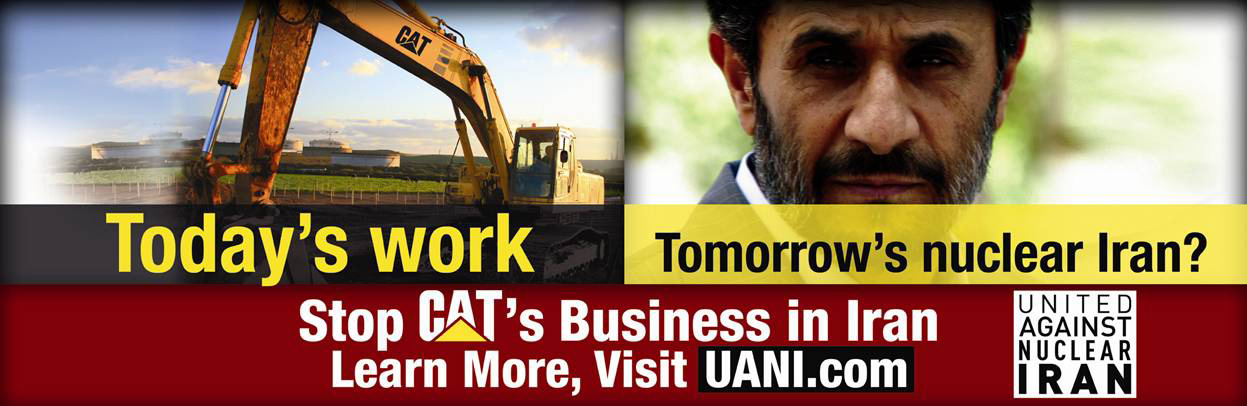
Billboard


Caterpillar Billboard Graphic


UANI Billboard in Peoria

Fametech America, Inc.

Industry
Technology
States
TX
Country
USA
Contact Information
Sources

“An Austin businessman pleaded guilty in federal court Wednesday to making false statements to federal agents about doing business with Iran, in violation of the U.S. trade embargo. A plea agreement calls for Rex Wen Wei Liang, 57, whose company Fametech America manufactures bar code and magnetic strip scanners, to receive probation. U.S. District Judge Sam Sparks must approve that deal at Liang's sentencing in October. Outside court, Assistant U.S. Attorney Gregg Sofer said such prosecutions have been rare in Austin. But, he said, the Justice Department is ‘keenly interested in making sure that this doesn't happen’ and is stepping up efforts to control the illegal flow of technology from Austin to Iran and other places where such trade is prohibited.” (American-Statesman, "Businessman admits to lying about violating ban on trade with Iran," 8/13/09)


Response

No response at this time.

Huntsman

Industry
Chemicals
Symbol
NYSE:HUN
States
TX
Country
USA
Sources
  • “Huntsman Corp., the world’s biggest maker of epoxy adhesives, said its foreign subsidiaries will discontinue sales in Iran due to concern over the government’s handling of protests of last year’s presidential election.

    ‘The small amount of business done there does not justify the reputational risk currently associated with doing business with entities located in Iran due to growing international concern over the policies of the current regime,’ Huntsman said in a statement.

    Huntsman, based in The Woodlands, Texas, said sales to entities located in Iran represented only a ‘minor fraction of one percent’ of its worldwide sales. The company said sales to third parties in Iran ‘have been done in full compliance with U.S. law.’

    Huntsman came under pressure last year from United Against Nuclear Iran to end all business in Iran, according to a spokeswoman for the New York-based advocacy group, Kimmie Lipscomb.

    ‘This shows that the American people are concerned with a company’s decision to do business in Iran,’ Lipscomb said in an interview.

    ‘We learned that one of Huntsman’s subsidiaries was conducting business in Iran, selling polyurethane, which can be used in the development of solid rocket fuel,’ she said. ‘We sent them a letter in November and they said they did not believe the polyurethane was being used for rocket fuel. We objected to them doing any business in Iran.’

    Huntsman spokesman Russ Stolle said the company had been in contact with United Against Nuclear Iran. He declined to say whether the decision to halt business in Iran was spurred by the group’s pressure. (Bloomberg News, “Huntsman Stops Sales in Iran on Concern for Government Actions,” 1/27/10)
Response