July 2026 Iran Tanker Tracker: Offshore Oil Reserves Cushion Iran as U.S. Reinstates Blockade
Introduction
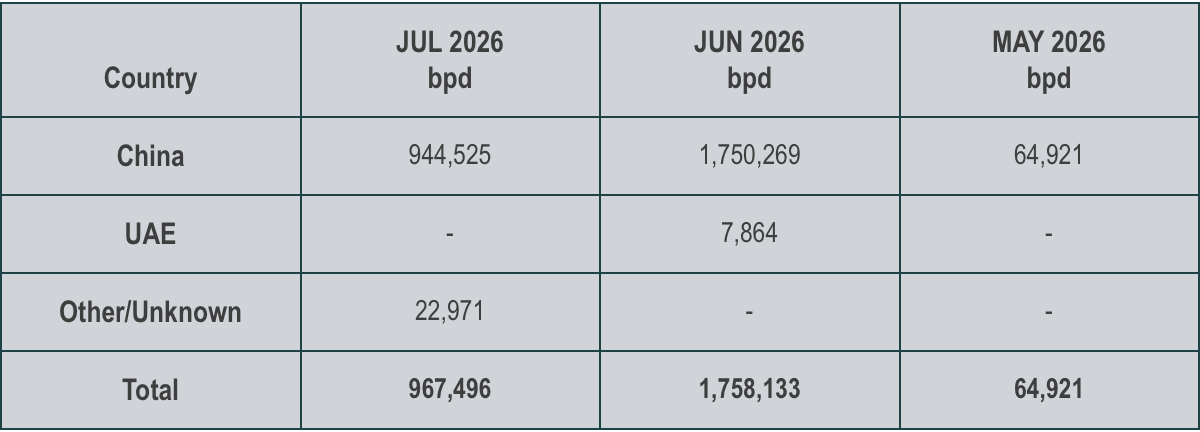
Iranian oil exports grew in the first half of July. However, following renewed attacks on commercial shipping by the Islamic Revolutionary Guard Corps (IRGC) beginning July 7, the United States revoked General License X—which had authorized the production, delivery, and sale of Iranian oil—and subsequently reinstated the U.S. blockade July 14. Despite Iran only managing to export oil and petrochemicals up until the reinstatement of the blockade, their exports still averaged almost one million barrels per day (bpd).
July 2026 Oil Export Data
A Note on Methodology
Due to the reinstatement of the blockade, UANI’s export figures are calculated when tankers cross the declared U.S. blockade line, rather than at the point of loading.
For July 2026, UANI tracked a total of 29.99 million barrels, averaging 967 thousand barrels per day (bpd) in physical exports out of Iran. This represents a significant drop from June’s 1.75 million barrels per day—reflecting the reinstatement of the U.S. blockade on July 14. The estimated value of oil exported in July 2026 stands at approximately $2.44 billion compared to $4.49 billion in June. So far in 2026, Iran has exported 260 million barrels for an estimated total value of $21.82 billion.
Renewed IRGC attacks have heavily impacted commercial shipping, driving a drop in vessel transits through the Strait of Hormuz as operators respond to heightened risk. Nevertheless, Iran’s export of more than 77 million barrels of crude oil and petrochemical products between June 16 and July 12 while the blockade was temporarily lifted provided an important short-term cushion for its oil sector, even as the broader security environment in the Persian Gulf deteriorated significantly throughout July. This immediate surge in tanker departures during this window demonstrated the preparedness of Iran’s sanctions-evasion network that allowed Iran to rebuild its offshore inventories in Southeast Asia under renewed pressure of the U.S. blockade.
Heightened insecurity is not solely concentrated in the Persian Gulf. In the Bab el-Mandeb chokepoint of the Red Sea, the Iran-backed Yemeni terrorist group, the Houthis, continues to disrupt maritime transit through ongoing threats and operational pressure on regional shipping lanes. The attacks on LNG tankers and facilities in the Egyptian port of Damietta expanded the area of risk even further. Meanwhile, Ukraine stepped up its campaign targeting Russian ghost fleet tankers across the Black Sea and the Sea of Azov, while later exposing Moscow's sharing of satellite intelligence to enhance Iran's defensive and strike capabilities.
U.S. Blockade
On July 13, President Trump announced the reinstatement of the U.S. blockade on Iranian ports. Effective July 14 at 4:00 p.m. ET, U.S. forces began enforcing the blockade against vessels transiting to or from Iranian ports and coastal areas, while continuing to facilitate compliant traffic in regional waters. Reimposing the blockade was a direct response to Iranian strikes on commercial shipping and Gulf States. It follows the initial blockade enforced from April 13 to June 18, which redirected over 140 compliant vessels, disabled nine non-compliant ships, and permitted more than 50 humanitarian-support vessels to pass.
In addition to enforcing blockades on Iranian ports, all Iranian vessels and those suspected of carrying contraband remain subject to the belligerent right to visit and search. Regardless of their location, these vessels face potential boarding, search, and seizure. Contraband—defined as goods destined for an enemy that are used to sustain armed conflict—is subject to capture anywhere beyond neutral territory if destined for Iranian-controlled or held territory. Between July 14 and July 31, U.S. forces redirected 30 commercial vessels attempting to run the blockade, disabled two non-compliant ships, and boarded two others to ensure full compliance.
Tankers laden with Iranian oil and petrochemicals are currently clustering at anchorages along the Iranian coastline due to the renewed restrictions. UANI has not observed any tanker laden with Iranian crude oil successfully departing the Gulf of Oman, without facing U.S. enforcement, since the blockade's reinstatement.
Meanwhile, empty Iran-flagged tankers that departed the Malaysian Eastern Outer Port Limits (EOPL), an anchorage 70km offshore from Johor, Malaysia known for ghost fleet operations, after conducting ship-to-ship (STS) transfers are now predominantly heading toward anchorages across the Indian Ocean region rather than returning to Iranian ports. As of July 30, five empty Iran-flagged tankers were loitering off Galle, Sri Lanka, according to their AIS signals and satellite imagery. Unladen cargo ships have similarly begun clustering on either side of the U.S. blockade line—most notably near Karachi, Pakistan—unwilling to risk U.S. enforcement measures.
Strait of Hormuz Maritime Security
Following the formal signing of the MoU on June 17, the Joint Maritime Information Center (JMIC) initially recorded an uptick in open transits through the Strait of Hormuz, peaking at 54 transits on June 24—the highest daily total since the conflict began. As of July 31, JMIC has logged a total of 740 transits through the Strait since the MoU took effect.
However, security in the Strait collapsed after Iran resumed attacks on commercial shipping on July 7. Iran targeted 12 vessels, including 11 tankers, across the month of July. These attacks caused traffic to drop drastically, particularly along the southern corridor near the Omani coastline where most strikes occurred. Consequently, traffic patterns have bifurcated: maritime transit has shifted heavily toward the northern corridor along the Iranian coast, dominated almost exclusively by Iranian- and Chinese-linked vessels, while the southern Omani corridor remains largely shunned by commercial operators.
Iranian strikes have caused severe damage, including vessel destruction and casualties among seafarers. Beyond targeting vessels at sea, Iran renewed its strikes on U.S. military facilities, Gulf ports, and critical energy infrastructure across neighboring Gulf states. On July 12, Iran claimed attacks on Bahrain, Kuwait, Jordan, Qatar and Oman.
Complicating matters further, the Mine Danger Area remains in effect in Traffic Separation Scheme (TSS) in the middle of the Strait of Hormuz. Demining operations are not publicly known or visible and have likely slowed dramatically or been placed on hold entirely due to the active security threats across July in the Strait.
Bab-el Mandeb Maritime Security
On July 20, Yemen’s Iran-backed Houthis declared a naval blockade against Saudi Arabian ports. On July 22, the Houthis claimed they attacked two tankers laden with Saudi crude oil in the Red Sea. Rising insecurity in the Red Sea has caused a drop in tanker transits through Bab el-Mandeb of roughly 40% since the Houthis declared their blockade, according to data published by JMIC. Houthi threats and attacks against Saudi-linked shipping are already prompting some, but not all, tankers carrying Saudi crude to reroute in the Red Sea. Re-routing would use the Suez Canal or, as the waterway cannot take VLCCs, the SuMed pipeline to Sidi Kirir, where VLCCs in the Mediterranean Sea can load and carry to buyers. These diversions will result in longer transits, higher freight and insurance costs as well as severe operational bottlenecks for crude bound for Asian refiners forced to detour around the Cape of Good Hope.
Some tankers do continue to transit the Bab el-Mandeb strait. On July 24, for example, two tankers carrying Saudi crude, transited despite Houthi threats and the declared blockade. Vessels have been observed broadcasting “CHINA CREW & OWNER” or “ARMED GUARD ON BOARD” as their destination during the transit, likely to help prevent being targeted.
Rebuilding the Malaysian EOPL Logistics Hub
The lifting of the blockade following the MoU triggered an immediate surge in Iranian oil exports. Between June 16 and July 12, 62 tankers departed the Gulf of Oman carrying approximately 77 million barrels of Iranian crude and petrochemicals. This generated an estimated revenue of over $6 billion for the IRGC, bolstering funding for its missile and drone programs. These figures remain estimates; volume and pricing for Chinese purchases of Iranian crude are not publicly disclosed, though cargoes are widely assessed to sell at a discount of $10 to $12 per barrel.
This outflow rapidly replenished floating storage at the Malaysian EOPL anchorage located approximately 70 km off the Malaysian coast. At least 26 Iran-flagged tankers, accompanied by numerous dark fleet vessels, arrived at the EOPL, switched off their AIS transponders, and conducted STS transfers with tankers bound for China. This massive accumulation of offshore floating storage provides a vital buffer for Chinese "teapot" refiners who rely on Iranian crude.
During the prior blockade, Iranian oil inventories at the Malaysian EOPL had been drawn down to depleted levels of Iranian crude. By July 31, however, floating reserves rebounded rapidly to over 28 million barrels of Iranian crude in this anchorage.
Ship-to-Ship (STS) Transfer Activity
Malaysian EOPL
The Malaysian EOPL anchorage remains a focal point for dark fleet operations and illicit STS transfers of sanctioned crude. Satellite imagery captured 26 STS transfers taking place in the EOPL during July, 12 of which involved Iranian crude.
Most discharging vessels were Iran-flagged tankers transferring cargo to dark fleet vessels for final delivery to China. During these operations, vessels routinely disable AIS or spoof their location signals. This concentrated dark fleet activity near the Malaysian coast introduces significant maritime security and environmental hazards to Southeast Asia.
Other Hotspots
Some ghost fleet operations utilized secondary anchorages in Southeast Asia. Approximately 90 km south of Hong Kong, several STS transfers of Iranian crude were observed on July 2 and July 9.
Additionally, an unusual STS transfer was observed on July 19 off Penang in the Malacca Strait between two Iran-flagged tankers. Two Iran-flagged tankers conducting an STS at Penang is uncommon; it is not known why the ships conducted an STS in this location, following the previously intercepted STS here in January 2026.
This activity highlights ongoing gaps in Malaysian enforcement against dark fleet operations. While Malaysian authorities intercepted two ghost fleet vessels—the stateless NORA (IMO 9237539) and Cameroon-flagged RCELEBRA (IMO 9286073)—north of Penang in January 2026, both were released upon payment of a $76,000 statutory fine. During the July transfer off Penang, Malaysian authorities appeared to have taken no enforcement action whatsoever.
Malaysia EEZ Regulations 2026
On June 26, Malaysia updated maritime regulations that significantly expand its legal authority over dark fleet operations within its Exclusive Economic Zone (EEZ). The Exclusive Economic Zone Regulations 2026 updated the framework originally established under the EEZ Act of 1984.
Key provisions relevant to illicit dark fleet and sanctions-evasion operations include:
- Part 3 (Protection and Preservation of Marine Environment): Section 7(1) prohibits unauthorized cargo transfers in the EEZ or continental shelf without written permission from the government, while Section 8(1) completely bans unauthorized bunkering operations.
- Part 4 (Enforcement): Section 10(3) empowers authorized officers to detain any vessel navigating the EEZ or continental shelf suspected of violating pollution or environmental standards or posing a damage threat to the marine environment.
- Part 5 (Offences): Section 13(1) establishes strict criminal penalties for breaking, damaging, or interfering with submarine cables or pipelines in marine sensitive areas within the EEZ.
While these regulations grant agencies like the Malaysian Maritime Enforcement Agency (MMEA) clear legal authority to crack down on dark fleet anchorages and illegal STS transfers in international waters within the Malaysian EEZ, the lack of any visible enforcement in practice has remained unchanged. UANI has observed no change in enforcement measures, allowing illegal anchoring and dark fleet transfers off Eastern Johor to continue unhindered.
Russia-Iran Intelligence Cooperation
Military and intelligence integration between Russia and Iran deepened significantly in July. On July 25, Ukrainian President Volodymyr Zelenskyy publicly alleged that Russia has been providing Iran with satellite surveillance data covering U.S. military assets and Gulf state infrastructure to assist Iranian targeting planning. Satellite imagery provided by Russia on July 19–20 reportedly targeted air bases in Bahrain, Kuwait, and Jordan prior to Iranian strikes. According to an exclusive report by NBC, Russian satellite surveillance and signals intelligence are likely allowing Iran to better defend itself against U.S. airstrikes and refine its own aerial assaults, U.S. and EU officials said. This cooperation follows earlier claims that Russia had shared information on the location of U.S. forces in the Middle East during the conflict. Neither Moscow nor Tehran has publicly commented on the reported intelligence-sharing, but it comes as Russia and Iran continue to deepen their strategic partnership.
At the same time, Ukrainian forces have intensified strikes on Russia’s dark fleet during a 12-day drone campaign in the Black Sea and Sea of Azov, as well as targeting an Iranian-flagged vessel carrying military cargo between Iran and Russia in the Caspian Sea on July 25. Ultimately, this expanding sharing of intelligence and military cargoes between Moscow and Tehran is a manifestation of this defence partnership aimed at systematically undermining U.S. and allied interests globally.
Conclusion
Developments throughout July demonstrate the operational resilience of Iran's maritime sanctions-evasion network. The temporary lifting of the U.S. blockade enabled Tehran to rapidly regenerate export capacity and the Malaysian EOPL quickly resumed its core role as an offshore floating buffer for Chinese trade.
Although regional states like Malaysia now possess enhanced legal frameworks to penalize dark fleet activity, enforcement remains lacking. Consequently, as security in the Strait of Hormuz grow increasingly fragile, sustained sanctions enforcement, active blockade monitoring, maritime interdictions, and coordinated regional cooperation remain indispensable to disrupting Iran's illicit oil trade.
Receive Iran News in Your Inbox.
Eye on Iran is a news summary from United Against Nuclear Iran (UANI), a section 501(c)(3) organization. Eye on Iran is available to subscribers on a daily basis or weekly basis.