Iran Shipping Update – July 9, 2026
Following the Islamic Republic of Iran's attacks on three commercial vessels transiting the Strait of Hormuz on July 7, uncertainty across the Persian Gulf has intensified. In response, the United States launched a series of strikes against Iranian military and IRGC targets associated with maritime threats. The U.S. Department of the Treasury also revoked General License X, the broad 60-day sanctions waiver issued on June 22 that had temporarily authorized Iranian oil exports under the U.S.-Iran Memorandum of Understanding (MoU). The revocation effectively ends the brief period during which Iranian crude could again be openly exported under U.S. authorization and marks a return to maximum economic pressure.
To read UANI's Statement on the MoU, click here.
Status of the Strait of Hormuz
Since the start of the Iran War, the International Maritime organization (IMO) has reported 52 maritime incidents involving commercial vessels have been reported across the Persian Gulf, Strait of Hormuz, and Gulf of Oman.
The most recent Islamic Revolutionary Guard Corps (IRGC) attacks on commercial shipping include the Qatari-owned LNG tanker AL REKAYYAT (IMO 9397339), Saudi-flagged tanker WEDYAN (IMO 9524970), and Liberian-flagged tanker CYPRUS PROSPERITY (IMO 9595216). In response, U.S. forces conducted 80 strikes targeting Iranian air defenses, command and control systems, coastal radar, anti-ship missile capabilities, and more than 60 IRGC small boats to degrade its ability to attack commercial shipping in the Strait. The United States and the Islamic Republic of Iran have since exchanged further strikes, with U.S. forces continuing to target military sites while Iran has targeted U.S. military bases across the Gulf.
Prior to the outbreak of the Iran War, about 138 vessels transited the Strait of Hormuz daily. Throughout the conflict, marine traffic data showed large clusters of loitering vessels on both sides of the Strait of Hormuz, with many ships refraining from transiting due to safety concerns. Since the signing of the MoU, the Joint Maritime Information Center (JMIC) has reported an increase in open transits through the Strait of Hormuz. On June 24, JMIC recorded 54 transits, the highest daily total since the outbreak of the conflict. As of July 8, JMIC has reported a total of 596 vessels transiting the Strait of Hormuz since the date of the signing of the MoU.
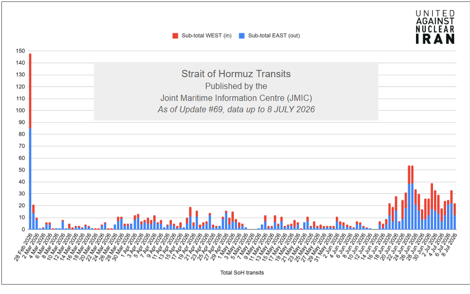
Vessel Transits of the Strait of Hormuz (Data Credit: JMIC)
In the days following the MoU, transits were dominated by Chinese- and Iran-linked traffic using the northern corridor of the Strait of Hormuz. However, there has since been an increase in transits, including Western-linked vessels, through the southern corridor, likely reflecting its gradual widening due to demining operations, as well as a broader increase in commercial willingness to transit the Strait. Open transits of commercial vessels through the southern corridor declined following the maritime strikes on June 25 and 27, as well as July 6 and 7, but have not ceased entirely.
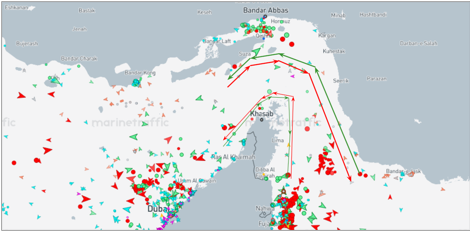
Strait of Hormuz transits on July 9 at 12:00 UTC (Credit: Marine Traffic)
Iranian Oil-Laden Tankers Departing the Gulf of Oman
Since the announcement of the MoU on June 14, UANI has tracked 56 tankers departing the Gulf of Oman laden with Iranian oil and petrochemicals. These exports represent approximately 68 million barrels of Iranian oil, generating an estimated revenue of over $5 billion for the IRGC, which continues to fund Iran’s missile and drone programs. These figures are estimates. The pricing and volumes associated with Chinese purchases of Iranian crude are not publicly disclosed, though such cargoes are widely assessed to be sold at a discount of around 10 to 12 dollars per barrel. On July 9, at least four tankers transited the Gulf of Oman laden with Iranian crude and fuel oil, transporting a combined volume exceeding 5 million barrels of oil.
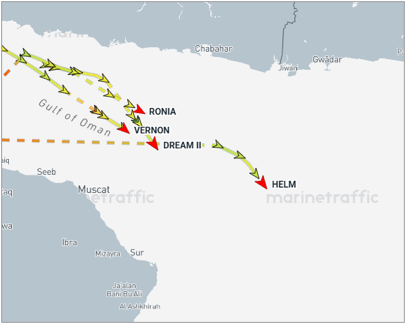
Tankers laden with Iranian oil transiting the Gulf of Oman on July 9 (Credit: ESA Copernicus & Marine Traffic)
Iranian Oil-Laden Tankers
UANI has identified at least 41 tankers laden with Iranian oil — primarily crude, but also other petroleum products and LPG — currently operating along the Iranian coastline.
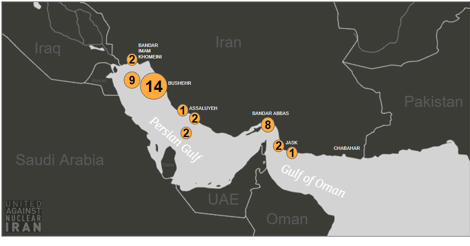
Positions of tankers laden with Iranian oil on July 9 (Credit: UANI)
Number of Iranian Loadings
Since the signing of the U.S.-Iran MoU on June 17, UANI has tracked at least 21 Iranian oil and petrochemical loadings, 11 of which originated from Kharg Island, Iran.
Iran-flagged Tankers Globally
UANI has also monitored Iran-flagged tankers operating beyond the Persian Gulf. Since the signing of the MoU and the lifting of the U.S. blockade, 15 Iran-flagged tankers have reached the Singapore Strait bound for the Eastern Outer Port Limits (EOPL) anchorage off Johor, Malaysia.
There are currently 12 tankers in the EOPL: DIAMOND II (IMO 9218478), FELICITY (IMO 9183934), DINO 1 (IMO 9569671), HEDY (IMO 9212888), DORE (IMO 9357717), SEVIN (IMO 9357353), HENNA (IMO 9212929), SILVIA I (IMO 9172052), DORENA (IMO 9569669), SNOW (IMO 9569619) HERO II (IMO 9362073) and SONIA I (IMO 9357365), which have all previously passed the Singapore Strait and have since stopped broadcasting their location on AIS. Seven of these tankers have since been spotted in satellite imagery, confirming their location. All these Iranian tankers are expected to conduct STS transfers in the EOPL, with three already observed in satellite imagery.
Meanwhile, Iran-flagged tankers AMBER (IMO 9357406) and STARLA (IMO 9569621) departed the EOPL, transited the Singapore Strait westbound and are currently sailing west in the Malacca Strait. They are reporting ballast condition on AIS after completing ship-to-Ship (STS) transfers in the EOPL, which were observed in satellite imagery yesterday, and are now most likely returning to Iran. They join DIONA (IMO 9569695), the first tanker to arrive in the EOPL after the U.S. blockade was lifted and the first to openly begin its return transit. Together, they make three Iran-flagged tankers that have departed the EOPL reporting empty since the lifting of the U.S. blockade.
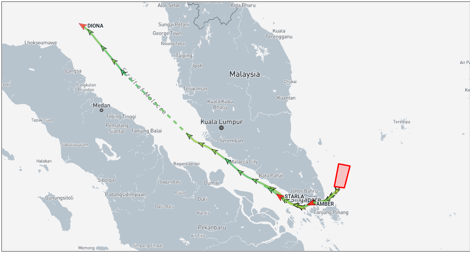
Iran-flagged tanker in Malacca Strait on July 9 (Credit: Marine Traffic)
On July 9, at least 47 tankers listed on UANI's Ghost Armada were anchored or loitering near the EOPL area with their AIS signals active, demonstrating that ghost fleet tankers continue to operate with impunity across Southeast Asia's sea lanes.
Iran-Flagged Cargo Ships Globally
Despite ongoing pressure of U.S. OFAC sanctions, approximately 50 Iranian flagged cargo ships continue to operate openly across sea lanes, ports, and anchorages throughout the Indo-Pacific region.
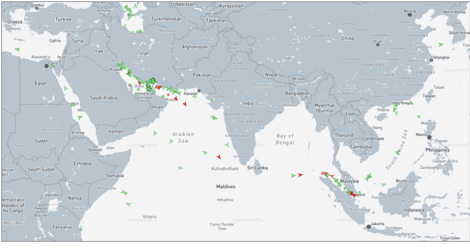
Iran-flagged vessels across the Indo-Pacific on July 9 (Credit: Marine Traffic)
At least 50 Iranian-flagged cargo ships are operating in waters outside of Iran, across the Indo-Pacific, the Red Sea and the eastern Mediterranean. Twenty-one cargo ships are sailing to or are already in Chinese ports.
The container ships ARTENOS (IMO 9283021) and RADIN (IMO 9820257) are about to depart Iranian waters in the Gulf of Oman, enroute to Zhuhai, China, and estimated to arrive by the end of July.
Three cargo ships are currently in the Gulf of Oman, on their way back to Iran. The bulk carriers BASKAR (IMO 9405942) and HAMGAM (IMO 9226956), both in ballast condition, are approaching Iranian waters. The container ships NORA (IMO 9259408) and AZARGOUN (IMO 9283019), are both in the Arabian Sea, sailing back to Iran from Zhuhai, China.
The container ship FLEXI 2 (IMO 9246322), which departed Novorossiysk, Russia, and then visited Misrata, Libya, for unknown operations is in the Suez Canal. Meanwhile, the general cargo ship AYSAN (IMO 9165803) has left the anchorage at Port Said, Egypt, and is sailing to Benghazi, Libya. In accordance with United Nations Security Council Resolution 2819 (2026), Libya remains under certain UN sanctions, and an arms embargo.
The cargo ships BEHTA (IMO 9349590), ALVAN (IMO 9165798) and NYRA 2 (IMO 9241487) continue to sail north in the Red Sea, to the Suez Canal. It is possible that they will also sail to further destinations in Libya or Russia.
General Cargo ships NESHAT (IMO 9167277) and GOLSAN (IMO 9165815) are both sailing the Arabian Sea towards Mombasa, Kenya. The bulk carrier VICTORIA 1 (IMO 9109550) remains at Dar es Salaam, Tanzania.
The container ship GOLBON (IMO 9283033) remained anchored in the gulf of Kutch, outside of Kandla, India. After departing Kandla, India, the container ship ARTAM (IMO 9284154) is currently sailing to Mumbai with an estimated arrival of July 10.
Five cargo vessels are sailing south in the Malacca Strait toward the Singapore Strait. The container ship ARZIN (IMO 9284142) is sailing to Zhuhai, while the bulk carriers DELNAVAZ (IMO 9387803) and AMINA (IMO 9305192) are all sailing to other ports in China.
The general cargo ship AREZOO (IMO 9165786) which had been sailing to the port of Belawan, Indonesia, is no longer broadcasting on AIS, but is presumed to be in port.
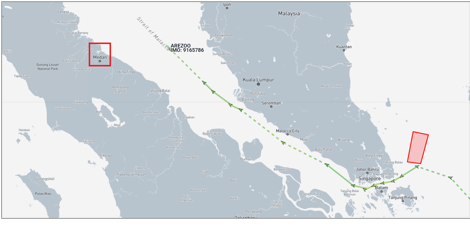
Iran-flagged cargo ship transiting the Malacca Strait on July 9 (Credit: Marine Traffic)
The container ships SHAMIM (IMO 9270658) and SHIBA (IMO 9270646) remain in the Port Klang anchorage. Two other ships are enroute to Port Klang: DAISY (IMO 9270684), which has an estimated arrival of July 10, and ZYRA (IMO 9237084), which is currently transiting the Arabian Sea has an estimated arrival of July 17. ZYRA is sailing from Misrata, Libya, and the Russian Baltic, prior to that. All of these ships are sanctioned by OFAC. ENZO 2 (IMO 9236652) departed the Port Klang anchorage and is most likely returning to Iran, though it is reporting its destination on AIS as Jebel Ali, UAE.
The container ship FLORA (IMO 9349576) transited the Singapore Strait eastbound and stopped in the Malaysian EOPL anchorage. Its destination is Zhuhai, with an estimated arrival of July 18.
The container ship RAYEN (IMO 9820245), which is bound for the CJK anchorage at Shanghai via the South China Sea, continued reporting “Not Under Command” (NUC) on AIS. RAYEN has been drifting east and reporting NUC, since July 5, and is about 220km west of Northern Luzon, just inside the Philippines EEZ. The AIS signal track is also suggestive of possible dark rendezvous with another ship that is not broadcasting on AIS.
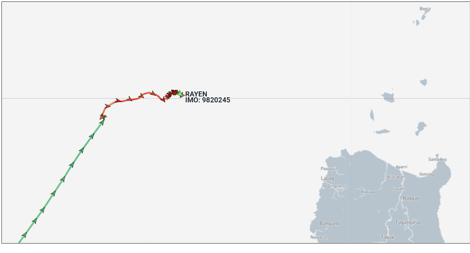
Iran-flagged container ship drifting in South China Sea on July 9 (Credit: Marine Traffic)
The container ship BARZIN (IMO 9820269), which had been sailing to CJK anchorage near Shanghai, made a U-turn in the Taiwan Strait, and is now loitering south of the Taiwan Strait, most likely due to Super Typhoon Bavi that will pass north of Taiwan in the next few days.
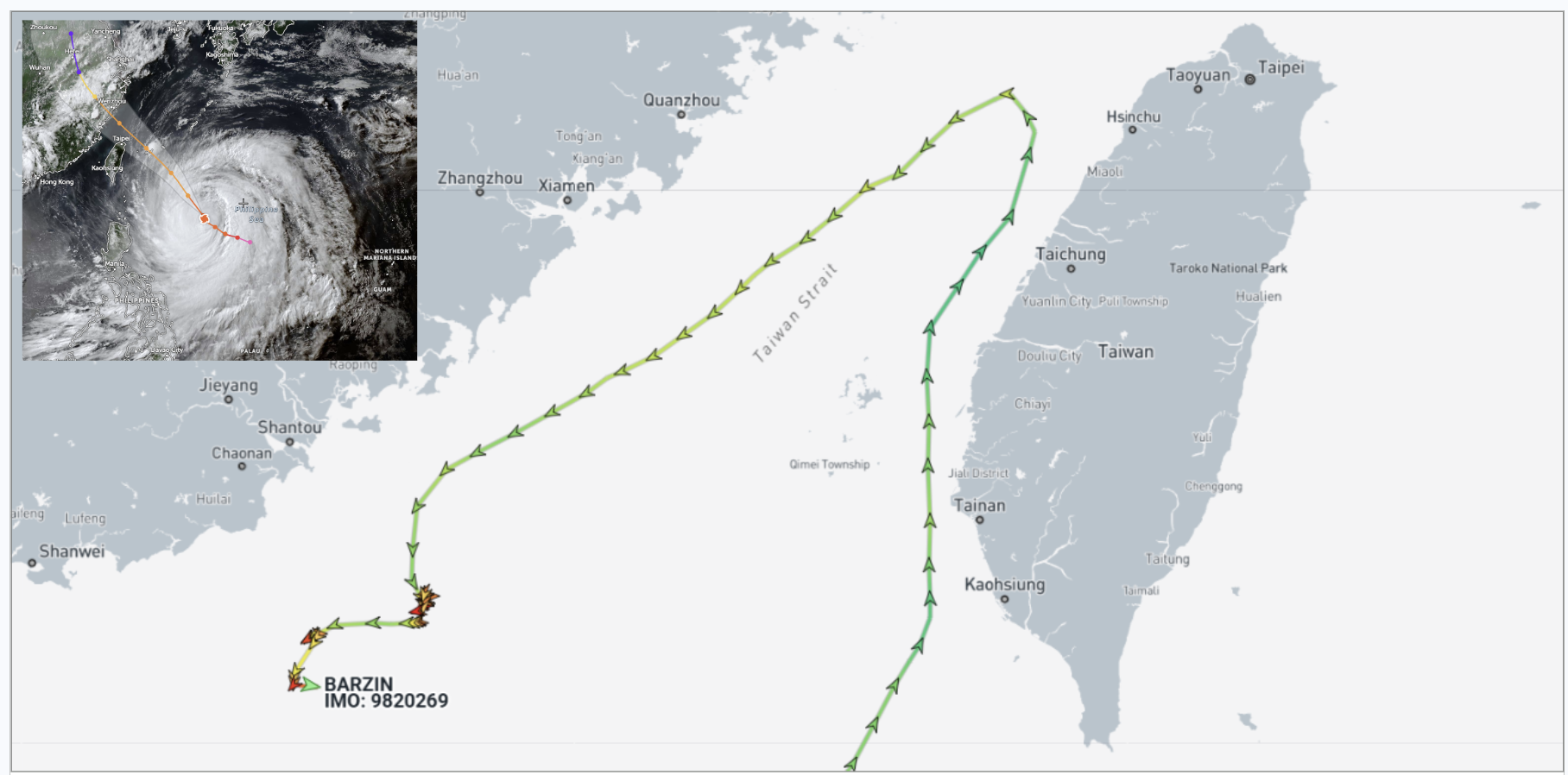
Iran-flagged container ship near the Taiwan Strait, on July 9 (Credit: Marine Traffic & Zoom Earth)
The bulk carrier BEHDOKHT (IMO 9405978) completed cargo operations at the bulk cargo terminal in Zhuhai port, and departed to its next destination, Songkhla, Thailand. It is reporting ballast condition with an estimated arrival of July 27. The container ships RAMA 3 (IMO 9303754) and BASHT (IMO 9346536) are in port at the Zhuhai container terminal, berthed next to each other. ZARDIS (IMO 9349679) and ABYAN (IMO 9349667) are anchored outside Zhuhai port in the anchorage area. Four other Iranian-flagged vessels that have departed Iran are reporting Zhuhai as their destination: FLORA (IMO 9349576), KASHAN (IMO 9270696), RADIN (IMO 9820257), and ARTENOS (IMO 9283021).
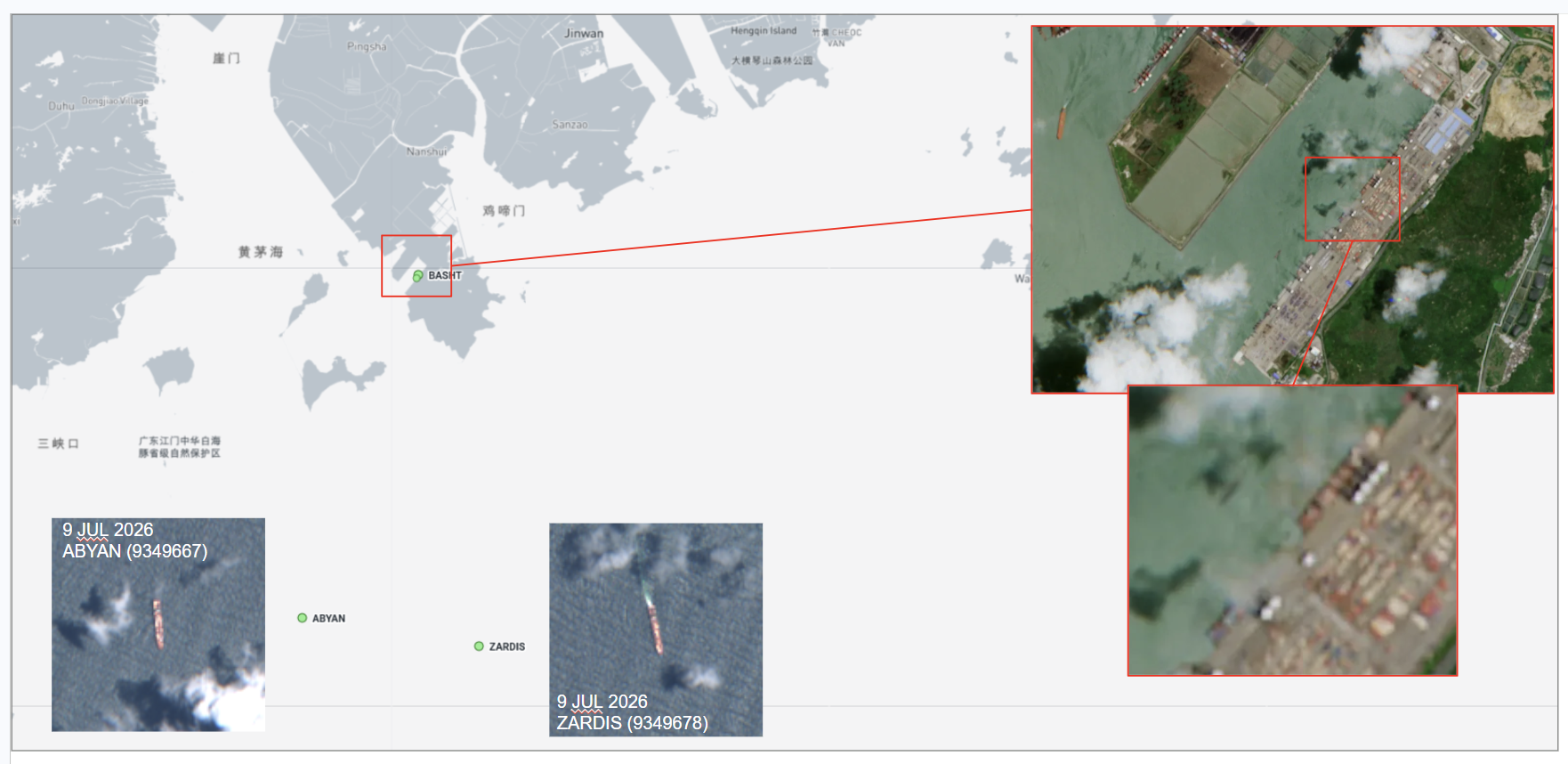
Iran-flagged container ships at Zhuhai, China, on July 9 (Credit: Marine Traffic & ESA Copernicus)
Receive Iran News in Your Inbox.
Eye on Iran is a news summary from United Against Nuclear Iran (UANI), a section 501(c)(3) organization. Eye on Iran is available to subscribers on a daily basis or weekly basis.