Iran Shipping Update – June 23, 2026
The U.S. Department of the Treasury has issued a broad 60-day authorization, General License X, for Iranian oil exports. This follows a U.S.-Iran Memorandum of Understanding between the United States and the Islamic Republic of Iran signed by President Trump on June 17, lifting a two month-long maritime blockade on Iranian ports and leading to a resumption of Iranian oil exports. To read UANI’s Statement on the MoU, click here.
General License X
General License X authorizes the production, delivery and sale of crude oil, petrochemical products, and petroleum products of Iranian origin through August 21, 2026. It also permits transactions to be conducted in U.S. dollars for the first time in decades. While Washington has issued limited waivers and technical licenses over the years, including this year with General License U, this is the first broad authorization for the production, sale, transport, financing, and import of Iranian oil since the reimposition of sweeping U.S. oil sanctions in 2019.
Restrictions on oil sales have served as a primary source of economic leverage over Tehran. By temporarily authorizing the production, sale, transportation, financing, and related services associated with Iranian oil, the administration is providing a form of sanctions relief that historically has been associated with later stages of negotiations and implementation.
On June 23, President Trump added that revenues generated under this framework, including oil-related proceeds, may be placed into escrow accounts subject to U.S. oversight. He stated that these funds would be restricted for humanitarian trade, including the purchase of food and medical goods exclusively from the U.S.
Status of the Strait of Hormuz
The Strait of Hormuz remains a critical maritime flashpoint. Since the start of the Iran War, 51 confirmed maritime incidents involving commercial vessels and offshore infrastructure have been reported across the Persian Gulf, Strait of Hormuz, and Gulf of Oman.
Despite the signing of the MoU, severe congestion and instability across the Persian Gulf’s shipping lanes persists. Prior to the outbreak of the Iran War, about 138 vessels transited the Strait of Hormuz daily. Throughout the conflict, marine traffic data showed growing clusters of loitering vessels on both sides of the Strait of Hormuz, with many refraining from transiting due to safety concerns. Since the signing of the MoU, the Joint Maritime Information Center (JMIC) has reported a slight increase in open transits through the Strait of Hormuz. On June 20, JMIC recorded 28 transits, the highest daily total since the outbreak of the conflict.
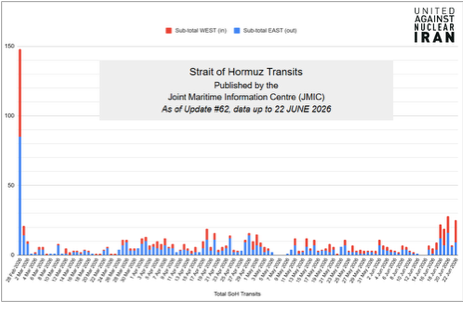
Vessel Transits of the Strait of Hormuz (Data Credit: JMIC)
Iranian Oil-Laden Tankers Departing the Gulf of Oman
Since the announcement of the MoU on June 14, UANI has tracked 31 tankers departing the Gulf of Oman laden with Iranian oil and petrochemicals. These exports represent approximately 41 million barrels of Iranian oil, generating an estimated revenue of over $3.5 billion for the IRGC, which continues to fund Iran’s missile and drone programs. These figures are estimates. The pricing and volumes associated with Chinese purchases of Iranian crude are not publicly disclosed, though such cargoes are widely assessed to be sold at a discount of around 10 to 12 dollars per barrel.
On June 23, five tankers carrying Iranian crude and petrochemicals departed the Gulf of Oman, with their cargoes most likely headed to Chinese buyers. Three of these five laden tankers, ELVA (IMO 9196644), VIRGO (IMO 9236250) and VIGOR (IMO 9262156) were also observed in satellite imagery transiting the Gulf of Oman, confirming their location.
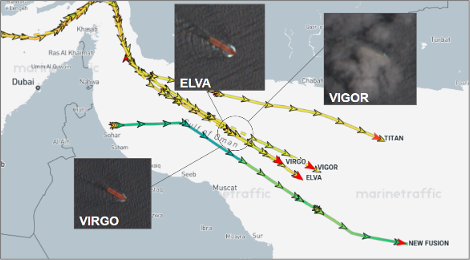
Tankers laden with Iranian hydrocarbons departing Gulf of Oman on June 23 (Credit: Marine Traffic)
Iranian Oil-Laden Tankers Inside Iranian Waters
UANI has identified at least 54 tankers laden with Iranian oil — primarily crude, but also other petroleum products and LPG — currently operating along the Iranian coastline.
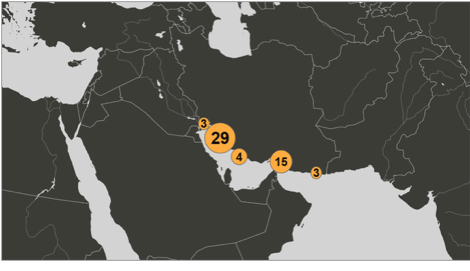
Map of Iranian oil laden tankers on June 23
Number of Iranian Loadings
Since the signing of the U.S.-Iran MoU on June 17, UANI has tracked at least 6 Iranian oil loadings, two of which originated from Kharg Island, Iran.
On June 20, two tankers were observed in satellite imagery loading Iranian crude from Kharg Island’s Azarpad Jetty. Notably, both vessels broadcasted their AIS signals while moored at the jetty, which is highly unusual for ghost fleet tankers. This may indicate a shift in operational patterns following the MoU.
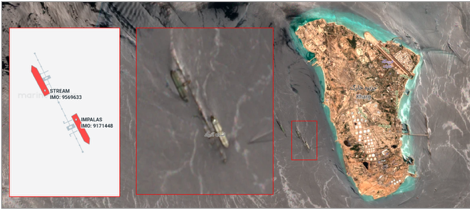
Two tankers loading Iranian crude at Kharg Island on June 20 (Credit: ESA Copernicus & Marine Traffic)
Iran-linked Vessels at Chabahar Port, Iran
Iran-linked vessels previously loitering and anchoring near Chabahar Port have largely departed. On June 15, satellite imagery showed 11 tankers laden with Iranian oil, alongside 14 cargo vessels, in the anchorage. As of June 22, however, only three tankers remain, including one Iran-flagged vessel and two dark fleet vessels. The eight departed vessels are likely en route to conduct ship-to-ship transfers with other tankers bound for China.
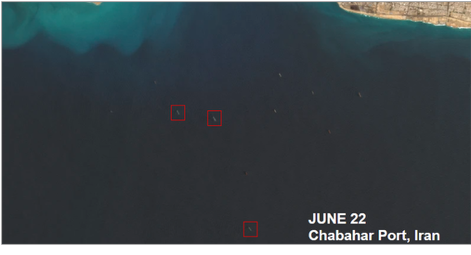
Iranian oil laden tankers at Chabahar Port, Iran on June 15 and 22 (Credit: ESA Copernicus)
Iran-flagged Tankers Globally
UANI has also monitored Iran-flagged tankers operating beyond the Persian Gulf. Since the conflict began, at least 32 Iran-flagged tankers have reached Southeast Asian waters bound for the Eastern Outer Port Limits (EOPL) anchorage off Johor, Malaysia.
Meanwhile, at least 42 Iran-flagged tankers, reporting empty, have begun attempts to return to Iran and from the Malaysian EOPL anchorage and Southeast Asian sea lanes, since the start of the conflict.
Iran-Oil Laden Tankers off the Malaysian Coast
On June 23, 41 tankers listed on UANI's Ghost Armada were anchored or loitering near the EOPL area with their AIS signals active, demonstrating that ghost fleet tankers continue to operate with impunity across Southeast Asia's sea lanes.
Iran-Flagged Cargo Ships Globally
Despite ongoing pressure of U.S. OFAC sanctions, approximately 75 Iranian flagged vessels continue to operate openly across sea lanes, ports, and anchorages throughout the Indo-Pacific region. Since the announcement of the Memorandum of Understanding (MoU) and the lifting of the blockade, nearly all the Iranian ships outside of the Persian Gulf have begun sailing back to Iran. Meanwhile, more than a dozen cargo vessels have departed Iranian ports for Asia.
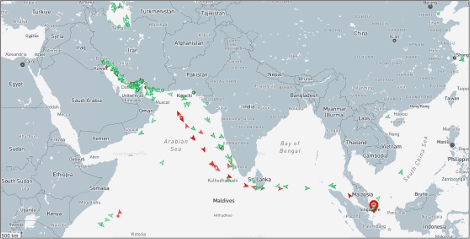
Iran-flagged vessels across the Indo-Pacific on June 23 (Credit: Marine Traffic)
Iran-flagged vessels transit towards the Persian Gulf. All the vessels previously anchored off Karachi, Pakistan, including TOUSKA (IMO 9328900), have returned to Iranian waters. TOUSKA was previously interdicted and disabled by US forces during the blockade but is seemingly operational again.
Ten Iran-flagged cargo ships are transiting back to Bandar Abbas, Iran.
The container ship BEHTA (IMO 9349590), which transited the Malacca Strait westbound on June 23, is reporting its destination as Colombo, Sri Lanka. The bulk cargo ship ROSHAK (IMO 9405966), departed Phuket port, Thailand and transited westbound with its destination listed as Bandar Imam Khomeini, Iran.
The general cargo ship PARNIA (IMO 9167265) remained at anchor about 25 km offshore of Galle, Sri Lanka. Meanwhile, the Iran-flagged laden tanker HERO II (IMO 9362073) transited toward the Malaysian EOPL, and the empty tanker SINOPA (IMO 9172038) transited back toward Iran.
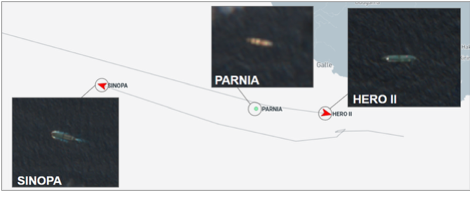
Iran flagged tankers and cargo ship near Galle, Sri Lanka on June 23
(Credit Marine Traffic & ESA Copernicus)
Fourteen Iranian-flagged cargo ships have departed Iranian waters and are reporting various destinations in China.
NYRA 2 (IMO 9241487) and ARTMAN (IMO 9405930) remain anchored outside Kandla, India in the Gulf of Kutch on June 23.
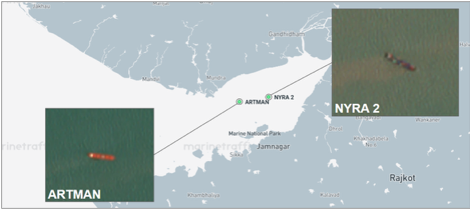
Two Iran flagged cargo ships in the Gulf of Kutch on June 23 (Credit: Marine Traffic & ESA Copernicus)
The Iranian-flagged general cargo ship NEGAR (IMO 9165839) remains anchored in Dar es Salaam.
The VICTORIA 1 (IMO 9109550) and AYSAN (IMO 9165803) are sailing south, along Omani waters toward the Gulf of Aden.
The Iranian-flagged container ship RAMA 3 (IMO 9303754) continued crossing the Indian Ocean toward the Laccadive Sea. Its destination is listed as Port Klang, Malaysia, with and estimated arrival of June 29. RAMA 3 previously departed a Russian Baltic port near St Petersburg on approximately May 26, although it had not been broadcasting AIS while in Russian waters.
ANDIA (IMO 9193197) and SHABGOUN (IMO 9346524) were anchored in Malaysian EOPL, meanwhile BEHNAVAZ (IMO 9346548) departed on June 23. Prior to the departure of BEHNAVAZ, the cargo ship was observed alongside SHABGOUN in satellite imagery of the EOPL anchorage.
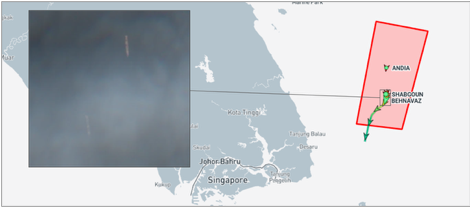
Three Iran flagged cargo ships in the EOPL on June 23 (Credit: Marine Traffic & ESA Copernicus)
The Iran-flagged general cargo ship AREZOO (IMO 9165786) transited the South China Sea northbound on June 23, with its destination listed as Haiphong, Vietnam. The Iran-flagged cargo ship AZARGOUN (IMO 9283019) also transited the South China Sea, but is sailing to Zhuhai, China, with an estimated arrival of June 24.
The container ships NORA (IMO 9259408) and SHABDIS (IMO 9349588) are anchored at CJK anchorage near Shanghai.
The Iran-flagged bulk cargo ship BATIS (IMO 9465760) is anchored off Tianjin in the Bohai Sea.
Receive Iran News in Your Inbox.
Eye on Iran is a news summary from United Against Nuclear Iran (UANI), a section 501(c)(3) organization. Eye on Iran is available to subscribers on a daily basis or weekly basis.