June 2026 Iran Tanker Tracker
Introduction
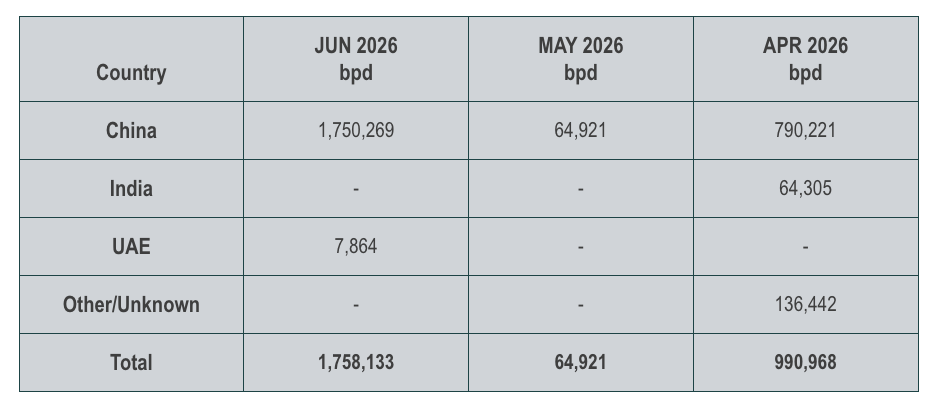
Iran's oil exports rebounded sharply in June, averaging 1.75 million barrels per day (bpd) after falling to historic lows in May amid a U.S. blockade on Iranian ports.
The recovery was driven by the signing of a U.S.–Iran Memorandum of Understanding (MoU) and the subsequent lifting of the blockade. As a result, Iranian crude exports resumed, Iran-flagged tankers and cargo vessels departed the Gulf of Oman in significant numbers, and commercial shipping began a cautious return to the Strait of Hormuz.
On June 22, the U.S. Treasury's Office of Foreign Assets Control (OFAC) issued General License X, temporarily authorizing the production, delivery, and sale of Iranian-origin crude oil, petroleum products, and petrochemicals.
However, renewed attacks by the Islamic Revolutionary Guard Corps (IRGC) on commercial shipping on June 25 and 27, and again on July 6 and 7, prompted the United States to revoke General License X on July 7.
The renewed security threats have already affected commercial shipping, with vessel transits through the Strait of Hormuz declining as operators respond to the increased risk. Nevertheless, Iran's export of more than 50 million barrels of crude oil and petrochemical products during June provides an important short-term cushion for its oil sector, even as the security environment in the Persian Gulf continues to deteriorate.
June 2026 Oil Export Data
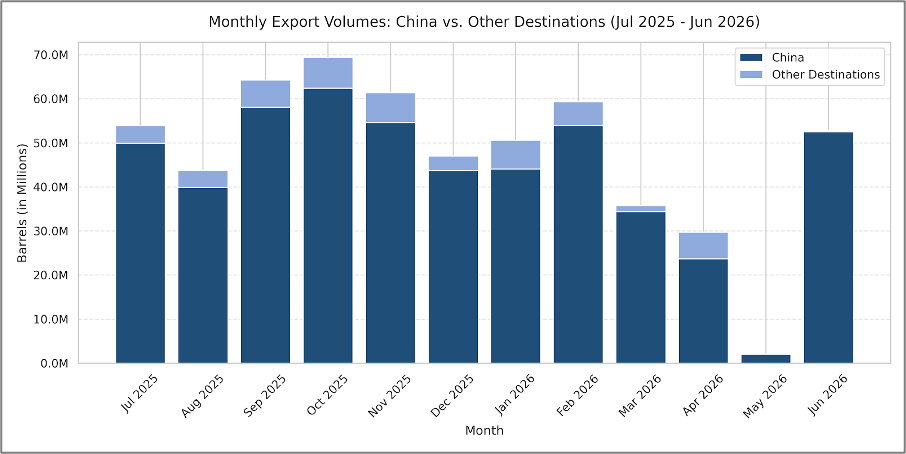
Total Iranian Oil Exports per Month (July 2025 – June 2026)
A Note on Methodology
UANI calculates Iran's exports based on the date tankers depart Iranian waters, rather than the date cargo is loaded. Consequently, UANI's export figures may exceed those reported by other organizations. This is particularly the case for June, when many tankers carrying oil and petrochemicals had been loaded in previous months but remained anchored off Iran's Gulf of Oman coast during the U.S. blockade. Once the blockade was lifted, these vessels departed in large numbers, causing a surge in recorded exports.
For the month of June 2026, UANI tracked a total of 52.7 million barrels (averaging 1,758,133 barrels per day, or bpd) in physical exports out of Iran, a sharp rebound from May’s 64,921 barrels per day reflecting the resumption of Iranian oil and petrochemical exports following the signing of the MoU and the lifting of the U.S. blockade. The estimated value of oil exported in June 2026 is approximately $4.51 billion, compared with $219 million in May. So far in 2026, Iran has exported 230.1 million barrels for an estimated total value of $19.4 billion.
U.S.-Iran Memorandum of Understanding
On June 17, President Trump signed a Memorandum of Understanding (MoU) between the United States and the Islamic Republic of Iran, lifting a two month-long maritime blockade on Iranian ports and leading to a resumption of Iranian oil exports.
Following the signing of the MoU, negotiations concerning the status of the Strait of Hormuz began and were set to continue to take place over 60 days. Point 5 of the MoU specified that, “the Islamic Republic of Iran will make arrangements using its best efforts for the safe passage of commercial vessels with no charge for 60 days only from the Persian Gulf to the Sea of Oman and vice versa.” The MoU stipulated that marine traffic would resume immediately and de-mining operations would be completed within 30 days. Iran also committed to consult Oman and other Gulf states on the future administration of the Strait of Hormuz.
During the first part of July and at the time of writing, the MoU has come under strain due to the IRGC’s repeated targeting of commercial shipping. On July 8, President Trump said that the MoU was “over”, adding that he didn’t want to engage with Tehran.
To read UANI’s full statement on the MoU, click here.
OFAC General License X
On June 22, 2026 the U.S. Treasury’s Office of Foreign Assets Control (OFAC) issued General License X, authorizing the production, delivery, and sale of Iranian-origin crude oil, petroleum products, and petrochemicals for a period of 60 days, up to August 21. However, the license was subsequently revoked on July 7 following repeated IRGC attacks on commercial vessels transiting the southern corridor of the Strait of Hormuz. It does not appear that any significant shipments were made via General License X.
Despite the brief authorization of General License X, Iran's oil and petrochemical exports continued to flow almost entirely to its primary buyer, China. This pattern is driven by several factors. First, a well-established network of intermediaries, brokers, and logistics providers—many operating through key offshore anchorages, especially the Malaysian EOPL—effectively functions as a marketplace where illicit Iranian cargoes are marketed, negotiated, and transferred between sellers and buyers, including China's independent "teapot" refineries. Second, intermediaries and service providers profit from facilitating ship-to-ship (STS) transfers, documentation changes, and other activities that enable sanctioned cargoes to flow in an illicit supply chain. Third, many of the vessels involved are decades old, substandard and lack the certifications required to enter legitimate ports, making them reliant on offshore transfer locations and less-regulated ports where compliance standards are lower. Their inability to enter legitimate ports is further compounded by the fact that a large and growing proportion of ghost fleet vessels are falsely flagged and stateless vessels. Finally, the broader political and economic partnership between Iran and China, underpinned by China's continued willingness to purchase Iranian oil despite sanctions and regional instability, ensures that Iran will continue to prioritize this relationship as the cornerstone of its export strategy. Consequently, coastal states in Southeast Asia that look the other way and allow these unsafe ships to sail with impunity in their sea lanes are both underwriting and absorbing the financial and environmental risks accumulating from this trade.
Strait of Hormuz Operations
Since the signing of the MoU, commercial traffic in the Strait of Hormuz initially showed a cautious recovery. Data from the Joint Maritime Information Center (JMIC) showed a clear uptick in open transits, with 54 recorded on June 24, the highest daily figure since the conflict began. But this was still far short of the pre-war average of about 140 vessels per day, far short of the pre-war average of about 140 vessels per day
In the first five days following the MoU, traffic was heavily skewed toward Chinese- and Iran-linked vessels using the northern corridor, where commercial traffic is controlled and authorized by the Iranian regime’s Persian Gulf Strait Authority (PGSA). However, there was a gradual return of more diverse traffic, including Western-linked vessels, through the southern corridor via Omani waters. This reflected both the continued demining efforts and an improvement in commercial risk appetite.
Demining operations in the Strait of Hormuz are, however, currently stalled by fresh security threats in the waterway. Clearing the estimated 80 naval mines from the critical waterway is expected to take up to 50 days, but the timeline remains highly uncertain.
US CENTCOM and JMIC established and published the Mine Danger Area, which effectively covered the normal international Traffic Separation Scheme (TSS) in the Strait of Hormuz.
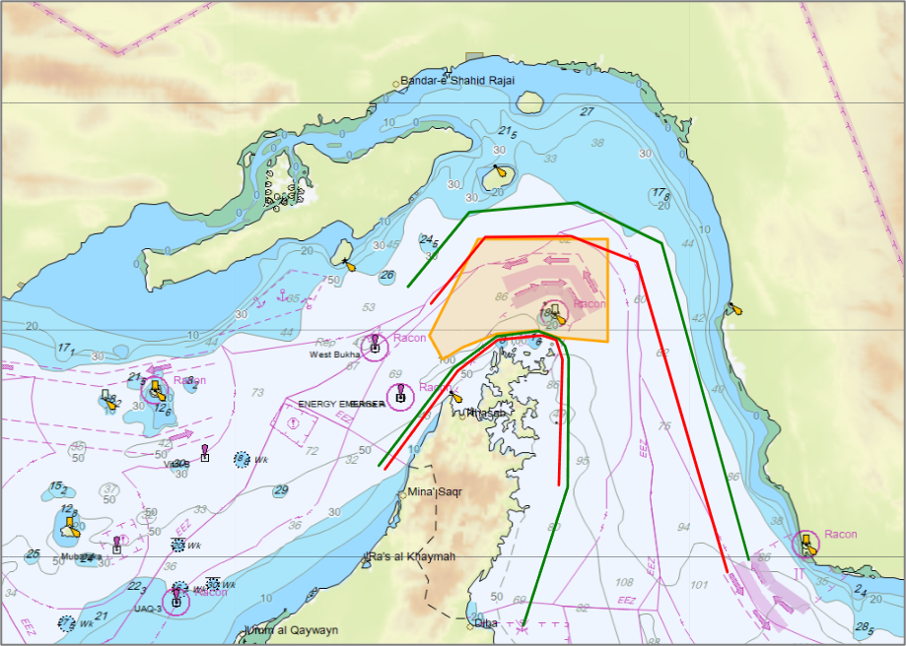
Mine Danger Area in the Strait of Hormuz (Credit: US CENTCOM & JMIC)
Until the Traffic Separation Scheme (TSS) is fully demined, shipping will be split into those shipping companies that choose to use the northern Iranian route and those that choose to use the southern Omani route. Iranian attacks on vessels transiting the southern corridor are increasing risk levels in all sectors of the shipping industry. Ship owners and operators remain highly sensitive to security incidents causing recorded transits through the southern corridor to drop following recent maritime strikes.
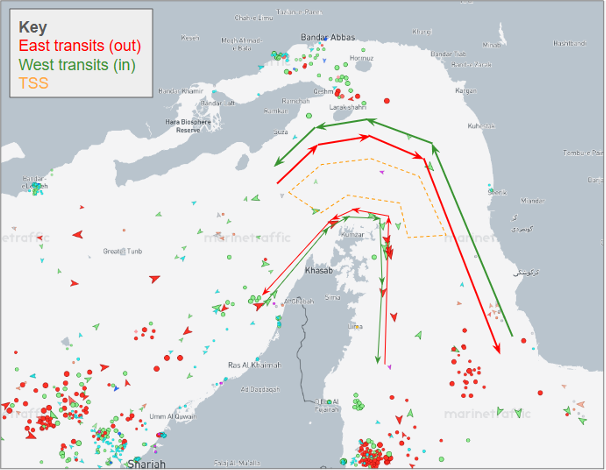
Strait of Hormuz transits on June 24 at 18:00 UTC (Credit: Marine Traffic/ UANI)
In line with the International Maritime Organization (IMO) call for a safe-passage framework as a provisional and urgent measure, the IMO began implementing a voluntary evacuation mechanism to facilitate the departure of merchant ships and seafarers stranded in the Gulf due to the conflict. The framework as designed to uphold the rights and freedoms of navigation under the United Nations Convention on the Law of the Sea (UNCLOS) and customary international law, and it applies to all SOLAS-compliant vessels confined in the Persian Gulf that wish to depart.
Working closely with relevant states and industry partners, the IMO developed a list of affected vessels and has published daily evacuation reports on outbound transits. However, following recent Iranian attacks on ships in the area, the IMO evacuation plan is currently paused.
Recovery of Iranian Oil Exports
The lifting of the maritime blockade triggered an immediate surge in outbound shipments of Iranian oil and petrochemicals. Around the time of the MoU signing, large clusters of tankers departed simultaneously carrying Iranian crude. On June 19 alone, 11 tankers left the Gulf of Oman laden, transporting a combined volume exceeding 16 million barrels of oil and petrochemicals—underscoring the urgency of restoring export flows.
Operationally, the shadow fleet appears to have reverted to pre-conflict patterns. The majority of exports continue to flow toward China, with established routing structures largely unchanged.
Tankers transit the Malacca and Singapore Straits with their AIS signals active before going dark near the offshore anchorage approximately 70 kilometers off Malaysia, where ship-to-ship (STS) transfers occur. Between the signing of the MoU and July 8, at least 15 Iran-flagged tankers appear to have arrived at this anchorage to conduct STS operations. Cargoes are then transferred onward to vessels supplying Chinese “teapot” refineries. Overall, Iranian export activity has resumed to “business as usual” again.
Iranian oil exports are expected to remain resilient in the near term, supported by entrenched trading networks and continued Chinese demand. After the lifting of the U.S. blockade, large volumes of Iranian oil departed Iranian waters throughout the rest of June. Once all laden tankers that have departed the Gulf of Oman reach the Malaysian Eastern Outer Port Limits (EOPL), more than 50 million barrels of Iranian crude will have arrived at this anchorage. This stockpile will act as a buffer, allowing exports to continue even as the security situation in the Strait of Hormuz and across the Persian Gulf remains volatile.
Malaysia EEZ Regulations 2026
On June 26, the Malaysian parliament passed an update to their Exclusive Economic Zone Act, to empower the Malaysian Coast Guard to enforce regulations on illegal anchoring and unapproved cargo transfers in the Malaysian EEZ, which includes the EOPL anchorage area. The new regulations prohibit ship-to-ship cargo transfers, bunkering and illegal anchoring within Malaysia's EEZ without prior government authorization, while granting enforcement officers expanded powers to detain vessels suspected of violating the regulations or applicable international pollution standards. These measures provide Malaysia with a stronger domestic legal framework to take action against the Iranian, Russian and Ghost Armada tankers operating in the EOPL and conducting illicit STS transfers supporting sanctioned oil exports to China.
Emerging Cargo Ship Networks
Prior to the signing of the MoU, Iranian-flagged cargo vessels accumulated at anchorages across Asia while awaiting the lifting of the U.S. blockade. Key congregation points included offshore Karachi, Pakistan, as well as the Malaysian EOPL anchorage, where they loitered among ghost fleet and Iran-flagged tankers, and areas near Port Klang in the Malacca Strait.
A notable pattern has emerged involving Iranian-flagged cargo vessels transiting from Russian ports to Misrata, Libya, and onward to Port Klang, Malaysia. While the cargoes remain unidentified, this routing raises significant sanctions concerns. These vessels are OFAC-designated, and their reported port calls in Libya suggest potential violations of multiple sanctions regimes. In accordance with United National Security Council Resolution 2819 (2026), Libya remains subject to UN sanctions and an arms embargo.
Activity at Port Klang is particularly suspicious, with Iranian-flagged cargo ships frequently berthing in close proximity and at similar times, indicating possible transshipment operations. This behavior is consistent with known sanctions evasion practices and warrants further monitoring.
Outlook
The revocation of General License X on July 7, following IRGC attacks on commercial shipping, underscores the conditional nature of sanctions relief and signals a return to stricter U.S. enforcement. With the MoU under strain and the ceasefire effectively ended as of July 8, instability across the Persian Gulf and renewed shipping disruptions are highly likely to increase.
The security environment in the Strait of Hormuz and the risk of further maritime incidents will remain key constraints on sustained recovery of transits and on a full resumption of Gulf oil exports. Any further escalation in Iranian attacks on commercial shipping or in regional military activity could quickly erode current traffic levels and complicate long-term export planning.
With more than 50 million barrels of Iranian crude accumulating the Malaysian EOPL anchorage, the Iranian oil trade will remain resilient in the near term. This stockpile will act as a buffer, allowing exports to continue even as the security situation in the Strait of Hormuz and across the Persian Gulf remains volatile.
Malaysia’s implementation of its new EEZ regulations can become an important new variable shaping dark fleet behavior in Southeast Asia, particularly if enforcement proves consistent and coordinated with regional partners. This could constrain ship-to-ship transfers and illegal anchoring in Malaysian EOPL. However, the overall impact will depend primarily on Malaysia’s political will for enforcement on Iranian linked vessels, which will likely depend on the how the geopolitical security environment in the Persian Gulf disrupts normal trade patterns.
UANI commends the revocation of General License X and the broader reimposition of sanctions. We also encourage Malaysia to vigorously enforce their new EEZ regulations to counter ghost fleet activity in the EOPL, particularly STS transfers as well as using this anchorage for floating storage. Effective sanctions enforcement is crucial in stemming Iran’s oil exports, which in turn means less revenue for the IRGC’s drone, missile, and nuclear programs.
Receive Iran News in Your Inbox.
Eye on Iran is a news summary from United Against Nuclear Iran (UANI), a section 501(c)(3) organization. Eye on Iran is available to subscribers on a daily basis or weekly basis.