Iran Shipping Update – July 1, 2026
The U.S. Department of the Treasury has issued a broad 60-day authorization, General License X, for Iranian oil exports. This follows a U.S.-Iran Memorandum of Understanding between the United States and the Islamic Republic of Iran signed by President Trump on June 17, lifting a two month-long maritime blockade on Iranian ports and leading to a resumption of Iranian oil exports. To read UANI’s Statement on the MoU, click here.
Status of the Strait of Hormuz
Since the start of the Iran War, 52 confirmed maritime incidents involving commercial vessels and offshore infrastructure have been reported across the Persian Gulf, Strait of Hormuz, and Gulf of Oman.
Prior to the outbreak of the Iran War, about 138 vessels transited the Strait of Hormuz daily. Throughout the conflict, marine traffic data showed growing clusters of loitering vessels on both sides of the Strait of Hormuz, with many refraining from transiting due to safety concerns. Since the signing of the MoU, the Joint Maritime Information Center (JMIC) has reported an increase in open transits through the Strait of Hormuz. On June 24, JMIC recorded 54 transits, the highest daily total since the outbreak of the conflict.
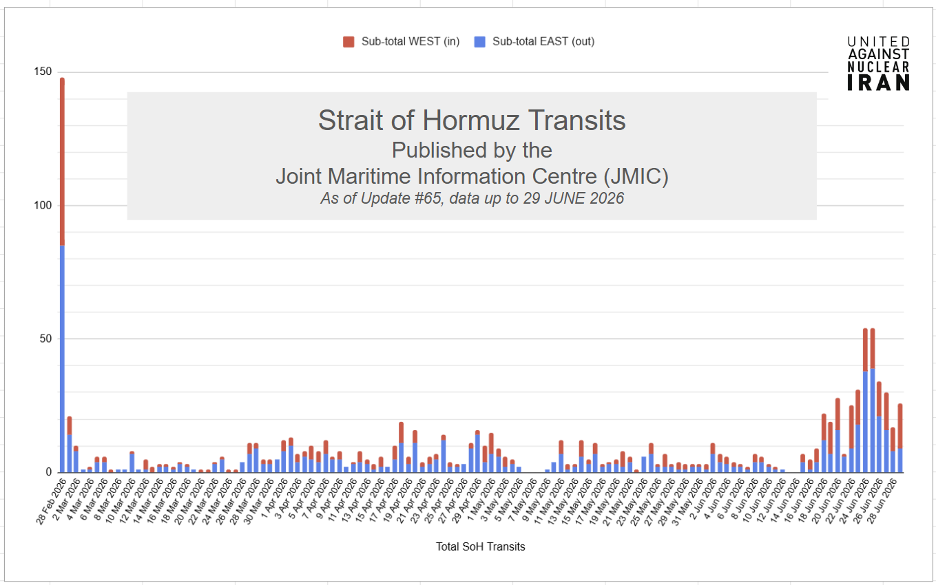
Vessel Transits of the Strait of Hormuz (Data Credit: JMIC)
In the first five days following the MoU, transits were dominated by Chinese- and Iran-linked traffic using the northern corridor of the Strait of Hormuz. However, there has since been an increase in transits, including Western-linked vessels, through the southern corridor, likely reflecting its gradual widening due to demining operations, as well as a broader increase in commercial willingness to transit the Strait. Open transits of commercial vessels through the southern corridor have declined since the most recent maritime strikes.
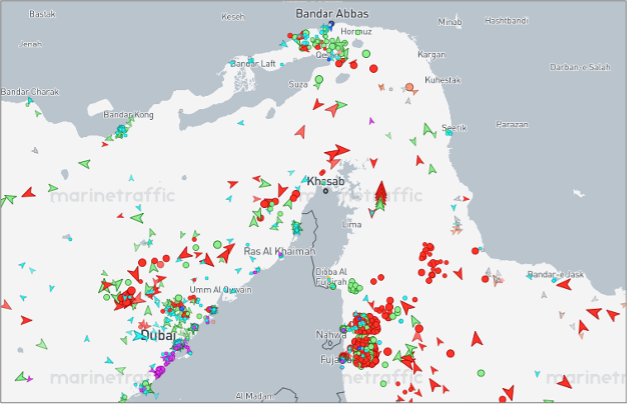
Strait of Hormuz transits on July 1 at 14:00 UTC (Credit: Marine Traffic)
Iranian Oil-Laden Tankers Departing the Gulf of Oman
Since the announcement of the MoU on June 14, UANI has tracked 40 tankers departing the Gulf of Oman laden with Iranian oil and petrochemicals. These exports represent approximately 50 million barrels of Iranian oil, generating an estimated revenue of over $4 billion for the IRGC, which continues to fund Iran’s missile and drone programs. These figures are estimates. The pricing and volumes associated with Chinese purchases of Iranian crude are not publicly disclosed, though such cargoes are widely assessed to be sold at a discount of around 10 to 12 dollars per barrel.
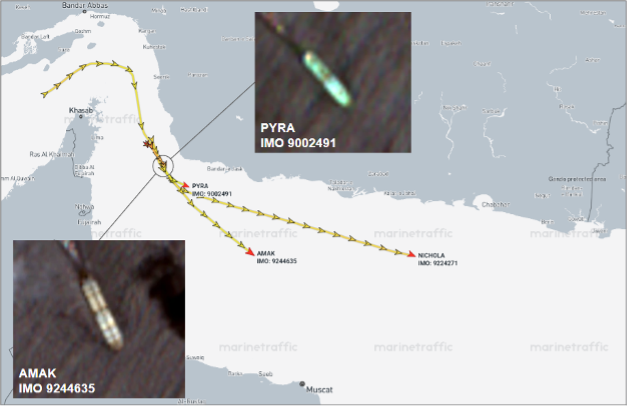
Laden tankers transiting the Gulf of Oman on July 1 (Credit: ESA Copernicus & Marine Traffic)
On July 1, at least nine tankers laden with Iranian crude and petrochemicals transited the Malacca Strait, likely bound for the Eastern Outer Port Limits (EOPL) anchorage off Johor, Malaysia, to conduct ship-to-ship (STS) transfers with tankers destined for China. Iran-flagged tankers AMBER (IMO 9357406), DORENA (IMO 9569669), SNOW (IMO 9569619) and STARLA (IMO 9569621) are carrying Iranian crude. Meanwhile, ghost fleet tankers PETREL (IMO 9278624), SIONA (IMO 9282106), RAINE (IMO 9223540), GALVIN (IMO 9387762) and GAFUS (IMO 9208239) are carrying Iranian LPG and naphtha.
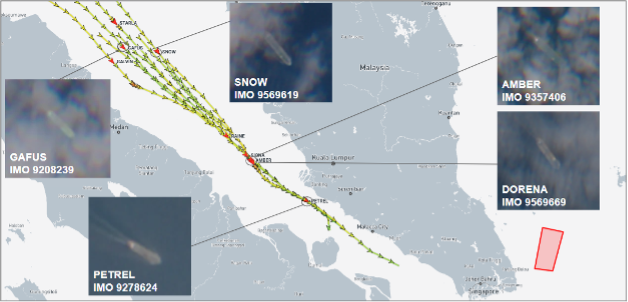
Laden tankers transiting the Malacca Strait on July 1 (Credit: ESA Copernicus & Marine Traffic)
Iranian Oil-Laden Tankers
UANI has identified at least 47 tankers laden with Iranian oil — primarily crude, but also other petroleum products and LPG — currently operating along the Iranian coastline.
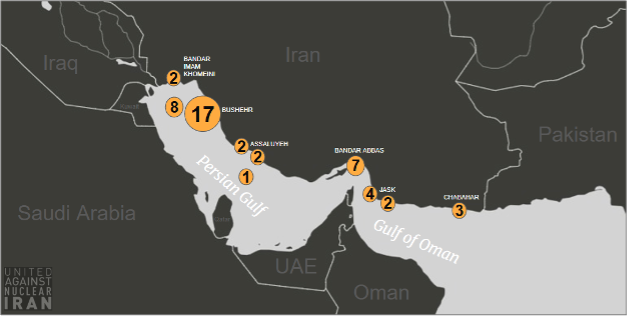
Positions of tankers laden with Iranian oil on July 1 (Credit: UANI)
Number of Iranian Loadings
Since the signing of the U.S.-Iran MoU on June 17, UANI has tracked at least 13 Iranian oil and petrochemical loadings, six of which originated from Kharg Island, Iran.
Iran-flagged Tankers Globally
UANI has also monitored Iran-flagged tankers operating beyond the Persian Gulf. Since the signing of the MoU and the lifting of the U.S. blockade, three Iran-flagged tankers have reached the Singapore Strait bound for the Eastern Outer Port Limits (EOPL) anchorage off Johor, Malaysia. DIONA (IMO 9569695), HERO II (IMO 9362073) and SONIA I (IMO 9357365) have all passed the Singapore Strait and have since stopped broadcasting their location on AIS. Following these vessels, at least six additional Iran-flagged tankers are transiting the Malacca Strait laden with Iranian oil. They will most likely conduct an STS transfer in the EOPL. Some may proceed to an anchorage area south of Hong Kong. It is unlikely that any will proceed directly to Chinese ports, but that would mark a significant change in operational procedure. It remains to be seen how the evolving patterns of Iran’s oil trade and dark fleet operations will change following the signing of the MoU.
Meanwhile, at least 42 Iran-flagged tankers, reporting empty, have begun attempts to return to Iran and from the Malaysian EOPL anchorage and Southeast Asian sea lanes, since the start of the conflict.
Iran-Oil Laden Tankers off the Malaysian Coast
On July 1, 38 tankers listed on UANI's Ghost Armada were anchored or loitering near the EOPL area with their AIS signals active, demonstrating that ghost fleet tankers continue to operate with impunity across Southeast Asia's sea lanes.
Iran-Flagged Cargo Ships Globally
Despite ongoing pressure of U.S. OFAC sanctions, approximately 80 Iranian flagged vessels continue to operate openly across sea lanes, ports, and anchorages throughout the Indo-Pacific region. Since the announcement of the Memorandum of Understanding (MoU) and the lifting of the blockade, nearly all the Iranian ships outside of the Persian Gulf have begun sailing back to Iran. Meanwhile, more than 30 cargo vessels have departed Iranian ports for Asia.
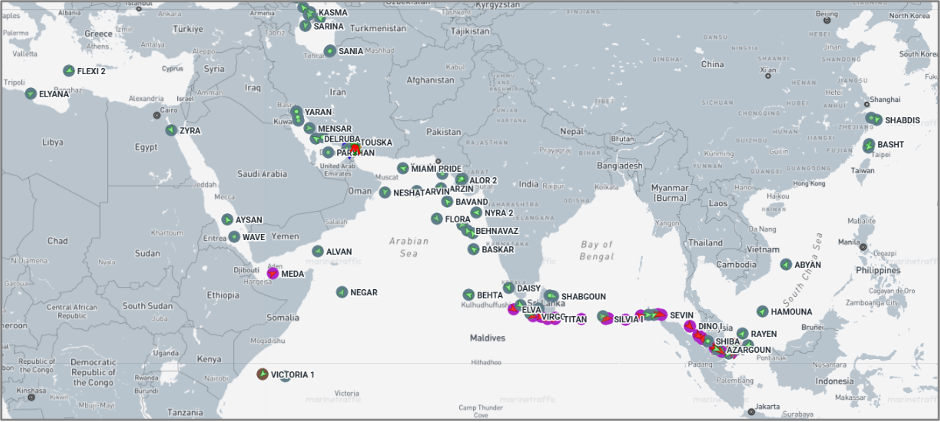
Iran-flagged vessels across the Indo-Pacific on July 1 (Credit: Marine Traffic)
Ten Iranian-flagged cargo ships are heading back from Asian waters to Iranian ports including, Chabahar, Bandar Abbas and Bandar-e Imam Khomeini (BIK).
The container ship FLEXI 2 (IMO 9246322) departed Novorossiysk on June 27 and is scheduled to arrive at Misrata, Libya, on July 2. If it follows the previously observed pattern, it may subsequently sail to Port Klang, Malaysia.
Meanwhile, at least 35 Iranian-flagged cargo ships have departed Iranian waters since the MoU. Twenty-nine are sailing to Asian ports: four to India; five to Sri Lanka; thirteen to China; two to Malaysia. Also, four vessels are sailing to the Suez Canal; one to Kenya; and one to Tanzania.
The Iranian-flagged general cargo ship AYSAN (IMO 9165803) is sailing north in the Red Sea after passing the Bab El-Mandeb Strait yesterday, on its way to the Suez Canel. The container ship ZYRA (IMO 9237084) transited the Suez Canal southward and entered the Red Sea, reporting its destination as Port Klang, with an estimated arrival of July 16. ALVAN (IMO 9165798) is sailing west in the Gulf of Aden, also to the Suez Canal. While VICTORIA 1 (IMO 9109550) is sailing southward, about 200 km off the Somalian coast, toward its destination, Dar es Salaam, Tanzania.
Three Iranian cargo ships are in Indian ports today. The container ships HAMGAN (IMO 9226956), ALOR 2 (IMO 9228538) and ARTAM (IMO 9284154) are all anchored in the Gulf of Kutch, near Kandla. Meanwhile, NYRA 2 (IMO 9241487) departed Nhava Sheva Container Terminal in Mumbai, after completing cargo operations. All of these vessels are designated by OFAC and are not covered by the recent OFAC General License X authorizing shipments of Iranian petroleum products.
Two Iran-flagged bulk carriers transited the Laccadive Sea heading for the anchorage off Galle, Sri Lanka on July 1. PARSHAD (IMO 9387786) departed from Bandar Abbas, Iran on June 19 and DELNAVAZ (IMO 9387803) departed from Bandar Abbas on June 21.
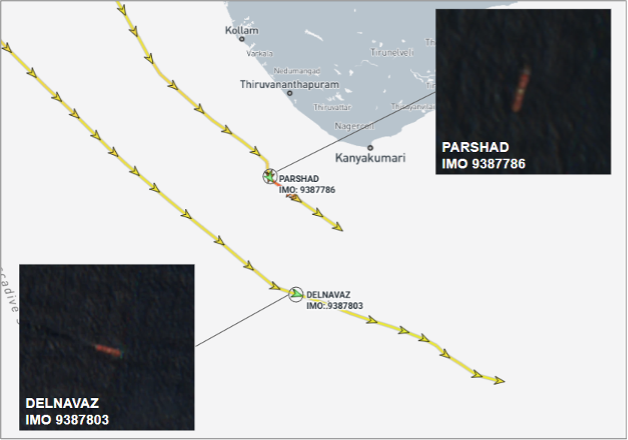
Iran flagged bulk carriers transiting the Laccadive Sea on July 1 (Credit: Marine Traffic & ESA Copernicus)
Two cargo ships have stopped at Sri Lankan ports. The bulk carrier AMINA (IMO 9305192) is anchored outside of Colombo port, while the bulk cargo ship ARDAVAN (IMO 9465863) arrived and anchored at Trincomalee, as the container ship SHABGOUN (IMO 9346524) departed. All three ships are OFAC sanctioned and are not covered by the recent OFAC General License X authorizing shipments of Iranian petroleum products.
Multiple other Iranian flagged vessels, including tankers and cargo ships, continue to transit past Sri Lanka, occasionally stopping briefly offshore off Galle, for logistics support.
Thirteen Iran-flagged cargo vessels have departed Iranian waters and are reporting various destinations in China, with eight currently transiting the Malacca Strait. Twelve Iran-flagged tankers are also presently in the Malacca Strait.
At Port Klang, Malaysia, the general cargo ship PARNIA (IMO 9167265), completed cargo operations and departed, sailing the Malacca Strait southbound. Its destination is Zhuhai, China, with an estimated arrival of July 6. SHAMIM (IMO 9270658) remained at the anchorage. Meanwhile, SHIBA (IMO 9270646) arrived and anchored near SHAMIM. All of these ships are OFAC sanctioned and are not covered by the recent OFAC General License X authorizing shipments of Iranian petroleum products.
After departing Port Klang, the container ship RAMA 3 (IMO 9303754) approached the Singapore Strait and began its westbound transit toward the South China Sea. It is likely to stop at the Malaysian EOPL anchorage, before sailing to its destination in Shanghai.
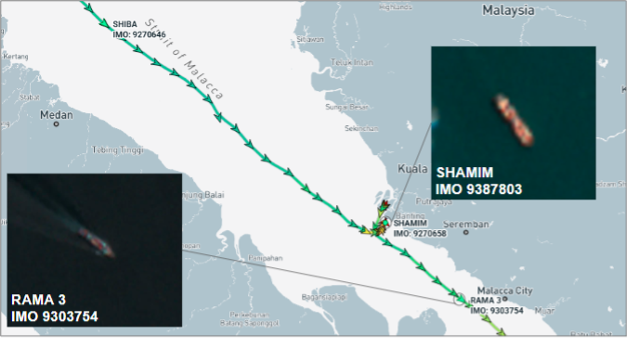
Iran-flagged cargo ships in the Malacca Strait on July 1 (Credit: ESA Copernicus & Marine Traffic)
Iran-flagged container ship BARZIN (IMO 9820269) and the general cargo ships AREZOO (IMO 9165786) and PARNIA (IMO 9167265) all arrived in the Malaysian EOPL, joining the bulk cargo ship ANDIA (IMO 9193197).
The Iran-flagged container ships AZARGOUN (IMO 9283019) and NORA (IMO 9259408) both departed Zhuhai Port, China, on June 27. AZARGOUN transited the Singapore Strait westbound and entered the Malacca Strait. However, NORA took an unusual route through Indonesian waters, loitering near the Riau Islands, before continuing toward the Malaysian EOPL anchorage.
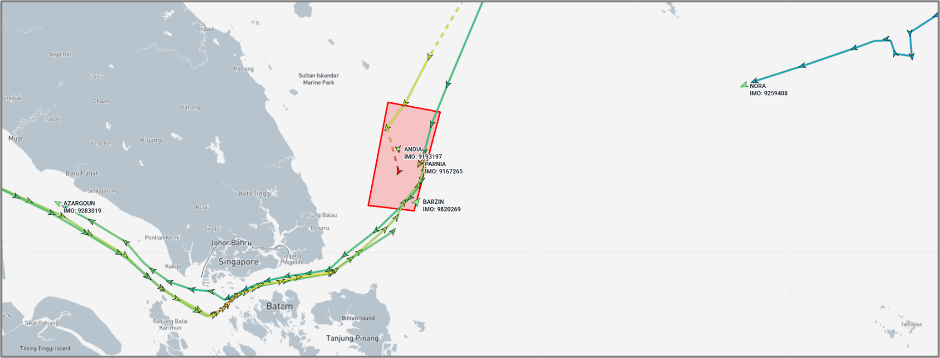
Iran-flagged cargo ships near the Malaysian EOPL on July 1 (Credit: Marine Traffic)
The container ships HARMOUNA (IMO 9820271) and RAYEN (IMO 9820245) continued to sail north in the South China Sea to their reported destination of Shanghai, China.
The container ship ABYAN (IMO 9349667) continued sailing north in the South China Sea to its destination Zhuhai, China, with an estimate arrival of July 3.
The container ship BASHT (IMO 9346536) transited the Taiwan Strait, within Taiwanese waters, and continued to the CJK anchorage near Shanghai.
The Iran-flagged bulk cargo ship BATIS (IMO 9465760) departed Tianjin Port, China, on June 27, and is currently transiting the East China Sea southbound, returning to Bandar Abbas, Iran, in laden status.
The container ship SHABDIS (IMO 9349588) departed the CJK anchorage outside Shanghai and began sailing the East China Sea southbound, with its destination listed as the Suez Canal.
Receive Iran News in Your Inbox.
Eye on Iran is a news summary from United Against Nuclear Iran (UANI), a section 501(c)(3) organization. Eye on Iran is available to subscribers on a daily basis or weekly basis.