Iran Shipping Update – July 24, 2026
The United States reinstated its naval blockade of Iranian ports on July 14, marking a likely end to the brief détente established under the U.S.-Iran Memorandum of Understanding signed June 17. The move follows Iran's attacks on commercial vessels transiting the Strait of Hormuz starting July 7, which reignited tensions across the Persian Gulf, ultimately collapsing the agreement's key confidence-building measures. The United States has since conducted a series of strikes against Iranian military and IRGC maritime assets.
To read UANI's June 2026 Tanker Tracker, click here.
U.S. Blockade
On July 13, President Trump declared that the U.S. blockade on Iranian ports has been reinstated. Starting on July 14 at 4 p.m. ET, U.S. forces will impose the blockade against vessels transiting to or from Iranian ports and coastal areas while supporting compliant traffic in regional waters. The measure follows the initial blockade from April 13 to June 18, which redirected more than 140 compliant vessels, disabled nine non-compliant ships, and allowed over 50 humanitarian-support vessels to pass.
In addition to enforcing the blockade on Iranian ports, all Iranian vessels and vessels suspected of carrying contraband, are subject to belligerent right to visit and search. These vessels, regardless of location, are subject to visit, board, search, and seizure. Contraband items are subject to capture at any place beyond neutral territory, if their destination is the territory belonging to, or occupied by, Iran. Contraband is defined as goods that are destined for an enemy and that may be susceptible to use in armed conflict.
As of July 23, U.S. forces have redirected 12 commercial vessels and disabled 1 to fully enforce the blockade.
Houthi Blockade
On July 20, Yemen’s Iran-backed Houthis declared a naval blockade against Saudi Arabian ports. On July 22, the Houthis claimed they attacked two tankers laden with Saudi crude oil in the Red Sea. JMIC also reported that a tanker was hit by projectiles and was fighting a fire near the mouth of the Bab el Mandeb strait approximately 70nm off the coast of Saudi Arabia. Houthi threats and attacks against Saudi-linked shipping are already prompting some, but not all, tanker rerouting in the Red Sea. The IMO Secretary General condemned the latest Houthi attacks on shipping and seafarers in the Red Sea.
Two supertankers COSNEW LAKE (IMO 9804289) and XIN LONG YANG (IMO 9761463) both transited the Bab el Mandeb strait on July 24 while carrying Saudi crude, despite Houthi threats and the declared blockade. Both vessels were broadcasting “CHINA CREW & OWNER” as their destination during the transit, likely to help prevent being targeted.
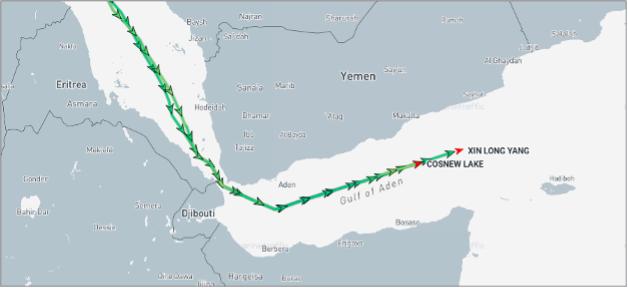
Tankers transiting the Bab el Mandeb laden with Saudi crude on July 24 (Credit: Marine Traffic)
Status of the Strait of Hormuz
Since the start of the Iran War, the International Maritime organization (IMO) has reported 61 maritime incidents involving commercial vessels have been reported across the Persian Gulf, Strait of Hormuz, and Gulf of Oman.
Prior to the outbreak of the Iran War, about 138 vessels transited the Strait of Hormuz daily. Throughout the conflict, marine traffic data showed large clusters of loitering vessels on both sides of the Strait of Hormuz, with many ships refraining from transiting due to safety concerns. Since the signing of the MoU, the Joint Maritime Information Center (JMIC) has reported an increase in open transits through the Strait of Hormuz. On June 24, JMIC recorded 54 transits, the highest daily total since the outbreak of the conflict. As of July 22, JMIC has reported a total of 705 vessels transiting the Strait of Hormuz since the date of the signing of the MoU.
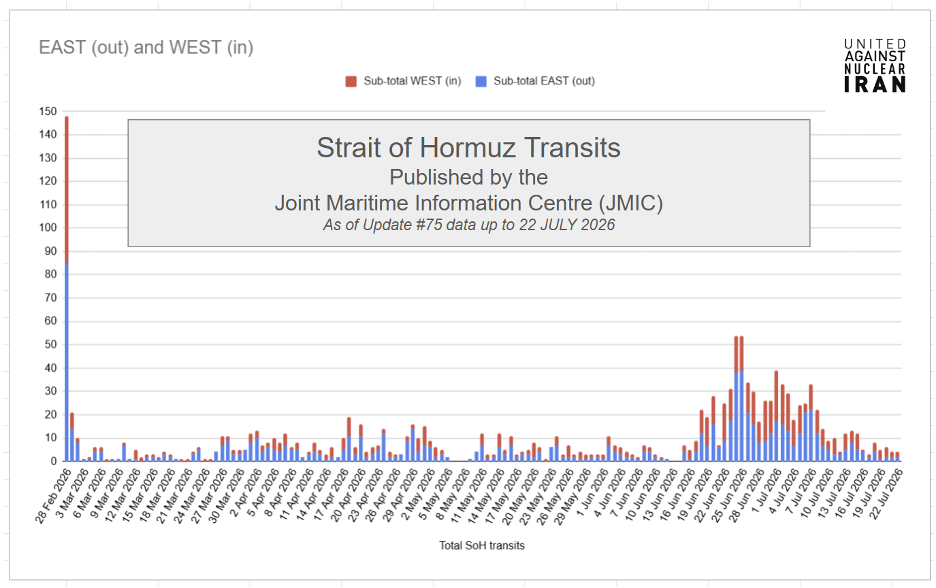
Vessel transits of the Strait of Hormuz (Data Credit: JMIC)
Open transits of commercial vessels through the southern corridor of the Strait of Hormuz declined following the IRGC strikes on commercial shipping starting July 7 but have not ceased entirely. Since the strikes, the traffic has been dominated by Iranian- and Chinese-linked vessels transiting via the northern corridor.
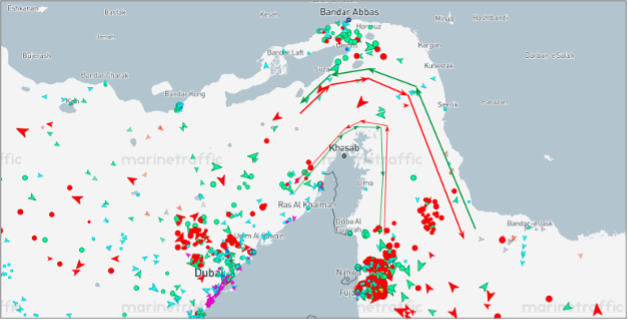
Strait of Hormuz transits on July 24 at 12:00 UTC (Credit: Marine Traffic)
Iranian Oil-Laden Tankers Departing the Gulf of Oman
Since the announcement of the MoU on June 14, UANI has tracked 66 tankers departing the Gulf of Oman laden with Iranian oil and petrochemicals. These exports represent approximately 80 million barrels of Iranian oil, generating an estimated revenue of over $6 billion for the IRGC, which continues to fund Iran’s missile and drone programs. These figures are estimates. The pricing and volumes associated with Chinese purchases of Iranian crude are not publicly disclosed, though such cargoes are widely assessed to be sold at a discount of around 10 to 12 dollars per barrel.
Tankers laden with Iranian oil and petrochemicals are currently clustering in anchorages along the Iranian coastline due to the U.S. blockade on Iranian ports. UANI has not tracked any tanker laden with Iranian crude oil that has departed the Gulf of Oman and avoided enforcement actions by U.S. forces since July 12, before the blockade was reinstated.
Iranian Oil-Laden Tankers
UANI has identified at least 43 tankers laden with Iranian oil — primarily crude, but also other petroleum products and LPG — currently operating along the Iranian coastline.
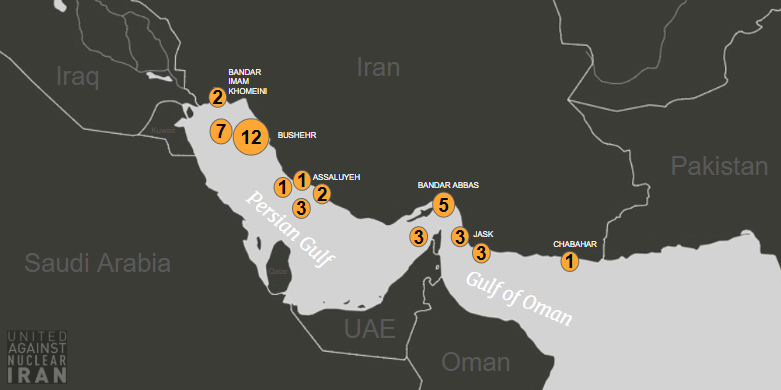
Positions of tankers laden with Iranian oil on July 24 (Credit: UANI)
Number of Iranian Loadings
Since the signing of the U.S.-Iran MoU on June 17, UANI has tracked at least 29 Iranian oil and petrochemical loadings, 12 of which originated from Kharg Island, Iran.
Iran-flagged Tankers Globally
UANI has also monitored Iran-flagged tankers operating beyond the Persian Gulf. Since the signing of the MoU, 25 Iran-flagged tankers have reached the Singapore Strait bound for the EOPL anchorage off Johor, Malaysia. On July 24, DREAM II (IMO 9356593) and DUNE (IMO 9569712) transited the Singapore Strait laden with Iranian crude and stopped broadcasting their location on AIS as they reached the EOPL anchorage.
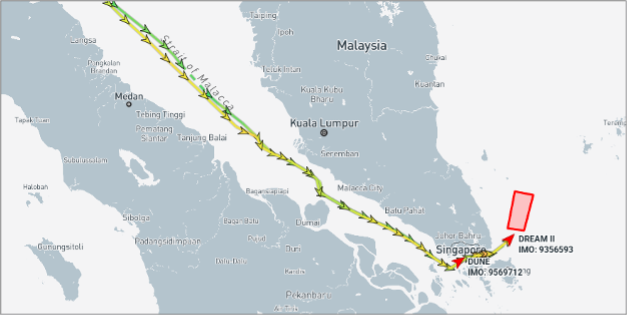
Iran-flagged tankers transited the Singapore Strait on July 24 (Credit: Marine Traffic)
DREAM II and DUNE join 16 other Iran-flagged tankers currently in the EOPL: STARLA (IMO 9569621), HILDA I (IMO 9357389), DAN (9357729), HELM (IMO 9357391), HALTI (IMO 9212890), HAPPINESS I (IMO 9212905), STREAM (IMO 9569633), DIAMOND II (IMO 9218478), DINO 1 (IMO 9569671), HEDY (IMO 9212888), DORE (IMO 9357717), SILVIA I (IMO 9172052), DORENA (IMO 9569669), SNOW (IMO 9569619) HERO II (IMO 9362073) and SONIA I (IMO 9357365), which have all previously passed the Singapore Strait and have since stopped broadcasting their location on AIS. All these Iranian tankers are expected to conduct STS transfers in the EOPL. Six of these STS transfers have been observed in satellite imagery.
HERBY (IMO 9362059) joined SEVIN (IMO 9357353), FELICITY (IMO 9183934), HENNA (IMO 9212929), AMBER (IMO 9357406) and DIONA (IMO 9569695) in departing the EOPL in ballast after completing STS transfers.
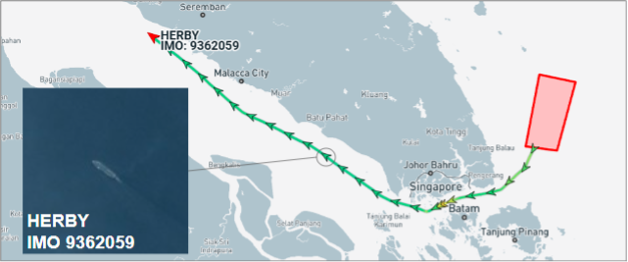
Iran-flagged tanker transited the Singapore Strait empty on July 24 (Credit: EOS Landsat & Marine Traffic)
These Iran-flagged tankers now most likely heading to anchorages across the Indo-Pacific rather than back to Iranian ports because of the U.S. blockade. DIONA was last observed loitering offshore Duqm, Oman in satellite imagery, while AMBER, HENNA and FELICITY are anchored off Galle, Sri Lanka. STARLA also left the EOPL empty, conducted another STS in the Malacca Strait, and has since returned to the EOPL laden with Iranian crude, bringing the total to seven Iran-flagged tankers that have departed the EOPL empty since the signing of the MoU, which has since collapsed.
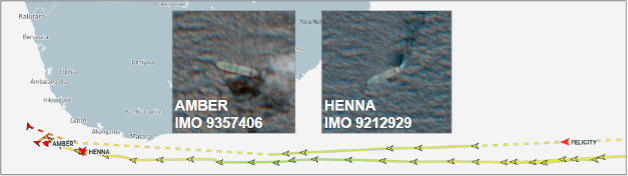
Iran-flagged tankers in ballast near Galle on July 23 (Credit: Marine Traffic)
On July 24, at least 55 tankers listed on UANI's Ghost Armada were anchored or loitering near the EOPL area with their AIS signals active, demonstrating that ghost fleet tankers continue to operate with impunity across Southeast Asia's sea lanes.
Iran-Flagged Cargo Ships Globally
Despite ongoing pressure of U.S. OFAC sanctions, and new constraints of the U.S. Blockade on Iranian ports, approximately 50 Iranian flagged cargo ships continue to operate openly across sea lanes, ports, and anchorages throughout the Indo-Pacific region, the Red Sea, the eastern Mediterranean and the Baltic Sea.
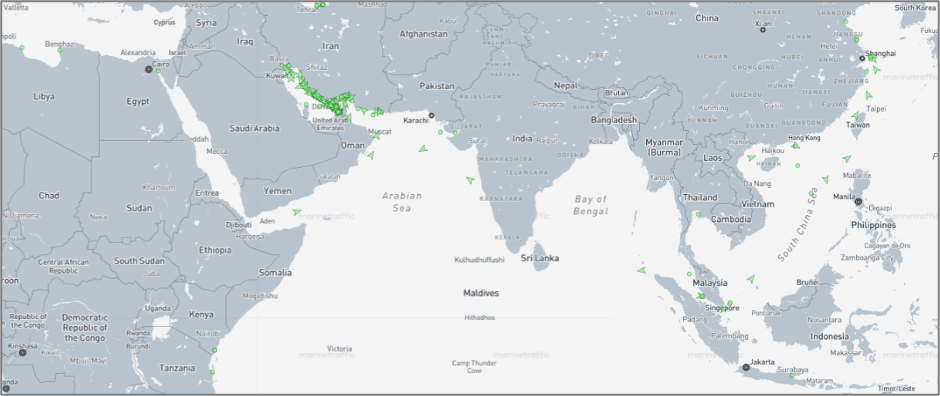
Iran-flagged cargo vessels across the region on July 24 (Credit: Marine Traffic)
No Iranian-flagged cargo ships have openly crossed the U.S. blockade line since it was formally declared on June 14. The last cargo ship to openly cross inbound was GOLBON (IMO 9283033) which arrived in Bandar Abbas from Kandla, India. The last cargo ship to openly exit was ARTMAN (IMO 9405930) which then conducted cargo operations at Kandla, India.
The container ships VELON 1 (IMO 9122473) and ENZO 2 (IMO 9236652) both are returning to Mumbai, after turning around in the Gulf of Oman, likely in response to the U.S. blockade and to avoid interdiction by U.S. naval forces. Both have gone dark on AIS for almost 48 hours, suggesting that they are avoiding attention from U.S. naval forces.
In the Mediterranean Sea, the Iran-flagged general cargo ship ALVAN (IMO 9165798) is in port at Benghazi, Libya, while AYSAN (IMO 9165803) remains anchored off Misrata. Libya is under certain UN sanctions, and an arms embargo, in accordance with United Nations Security Council Resolution 2819 (2026).
The container ship SHABDIS (IMO 9349588) is currently anchored in the southern Suez Canal anchorage, after sailing north in the Red Sea from its previous port visit in Shanghai, China.
The ARTMAN (IMO 9405930) remains anchored in the Gulf of Kutch, while ARTAM (IMO 9284154) is still anchored outside the Gulf of Kutch. FLEXI 2 (IMO 9246322) is sailing west across the Arabian Sea toward the Gulf of Aden. The container ship VIRA 1 (IMO 9088524) continued east in the Gulf of Aden where hijackings by Somali Pirates have recently taken place. VIRA 1 is en route to Port Klang, Malaysia, after previously visiting the Russian Baltic.
The container ship ZYRA (IMO 9237084) transited the Six-Degree Channel westbound from the Malacca Strait into the Bay of Bengal, returning to the Persian Gulf. On AIS, ZYRA lists its destination as Jebel Ali, UAE but ZYRA is most likely not heading there and will instead wait in the vicinity of Karachi due to the U.S. Blockade.
The container ships DAISY (IMO 9270684), SHIBA (IMO 9270646) and ARTABAZ (IMO 9283007) remained at the Port Klang anchorage. The container ship ALOR 2 (IMO 9228538) passed the vicinity of Port Klang in the Malacca Strait with its destination listed as Singapore but is most likely heading to the Malaysian EOPL anchorage. The SHAMIM (IMO 9270658) remained anchored off Penang, Malaysia in international waters. It is possible that this ship is loitering here to monitor the movements of U.S. naval vessels in the Malacca Strait, a tactics previously used by similar Iranian ships at various strategic maritime chokepoint locations.
The container ships BASHT (IMO 9346536) and PARNIA (IMO 9167265) remain anchored in the Malaysian EOPL anchorage area, while the bulk cargo ship ARTENOS (IMO 9283021) transited the Singapore Strait eastward with its destination listed as Zhuhai.
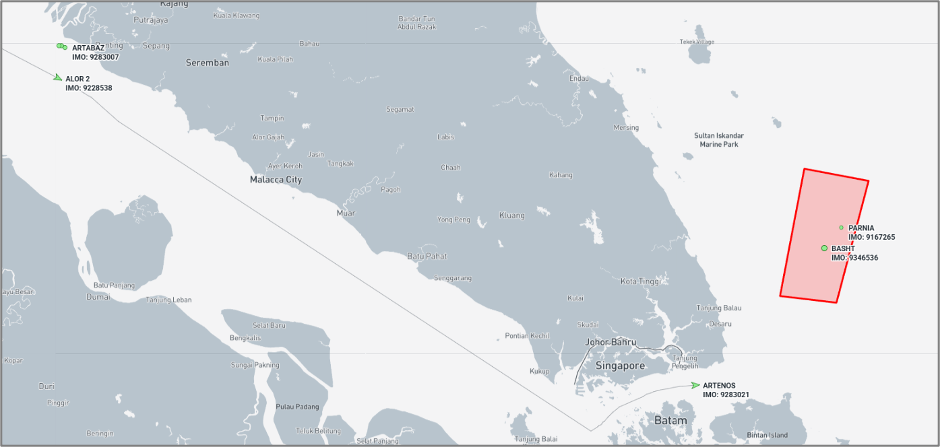
Iran-flagged vessels in the Malacca and Singapore Straits on July 24 (Credit: Marine Traffic)
The bulk carrier BEHDOKHT (IMO 9405978) remained anchored near Laem Chabang port in Thailand. Meanwhile, the general cargo ship AREZOO (IMO 9165786) arrived in Surabaya, Indonesia.
The container ship KASHAN (9270696) completed cargo operations and returned to the anchorage south of Zhuhai Port, joining HAMOUNA (IMO 9820271). Meanwhile, RADIN (9820257) which had been sailing to Zhuhai, stopped and began to loiter 240km south of Zhuhai in the South China Sea. The laden bulk carrier PARSHAD (IMO 9387786) continued to drift in the South China Sea for a fourth day reporting “Not Under Command” on AIS. ARTIN (IMO 9305221) also stopped and began to report “Not Under Command” in the South China Sea, about 300 km offshore from Luzan, Philippines.
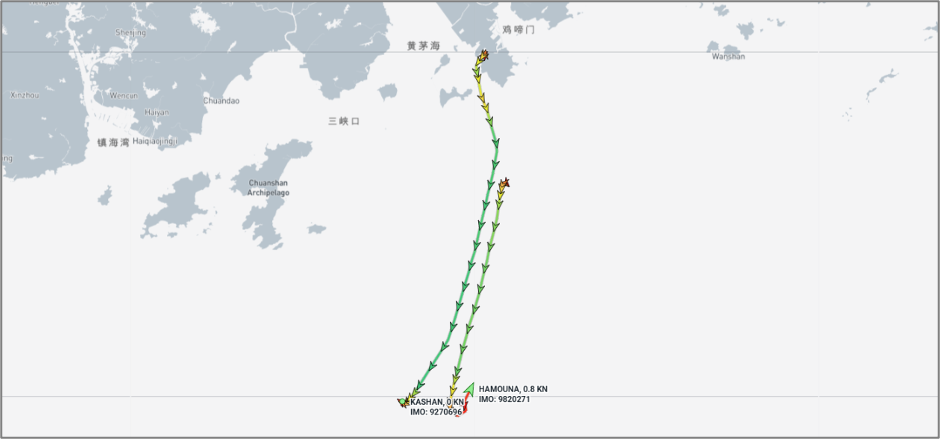
Iran-flagged vessels at Zhuhai on July 24 (Credit: Marine Traffic)
The container ship RAMA 3 (IMO 9303754) which had departed Shanghai for Zhuhai, has stopped and is loitering in the East China Sea for a second day.
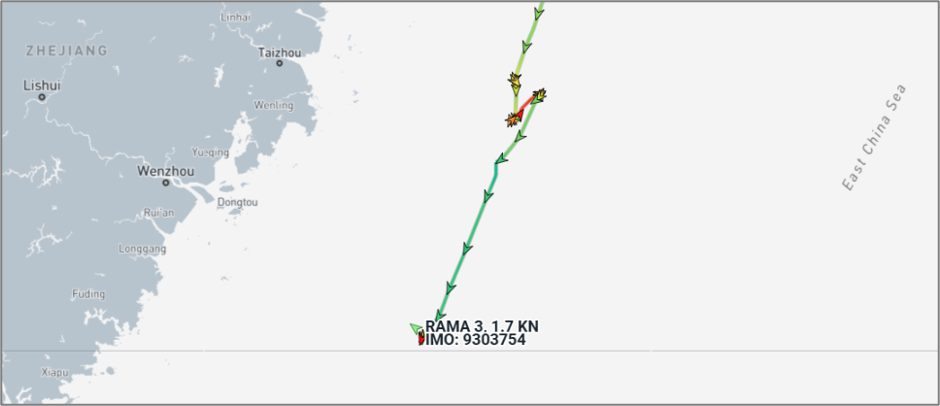
Iran-flagged vessel loitering in East China Sea on July 24 (Credit: Marine Traffic)
Six container ships are currently anchored at CJK anchorage off Shanghai, China: BARZIN (IMO 9820269), AMINA (IMO 9305192), FLORA (IMO 9349576), ZARDIS (IMO 9349679), RAYEN (IMO 9820245), and ARZIN (IMO 9284142). Other ships previously anchored here are now in port at Shanghai, but due to Chinese regulations, their AIS signals are not visible. China implemented data security laws that significantly restricted the export of certain geographic and transport data. Many domestic AIS shore stations stopped providing their data to foreign commercial AIS aggregators.
Three bulk cargo ships are currently at Dafeng, China, while one is in Lanshan Port, China, off the Yellow Sea.
The container ship BEHTA (IMO 9349590) arrived and anchored in the Russian Baltic, near St. Petersburg.
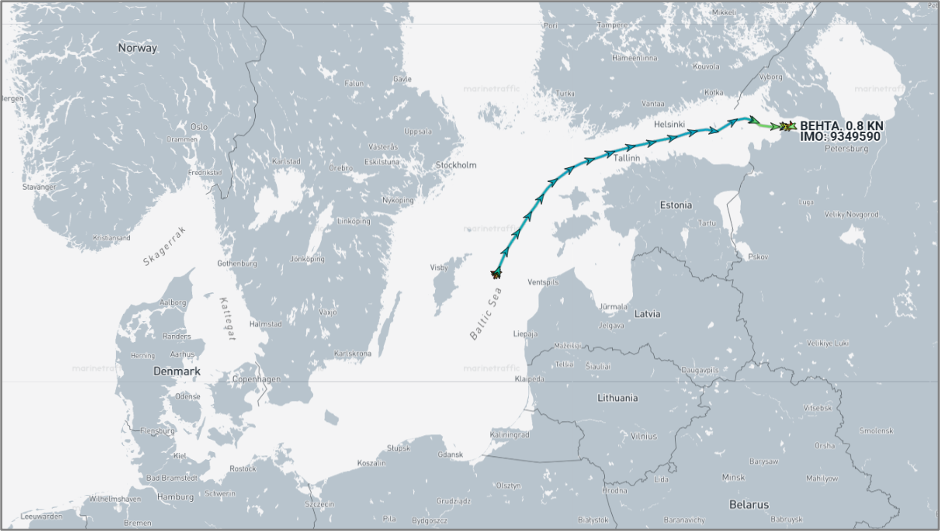
Iran-flagged vessel in the Russian Baltic on July 24 (Credit: Marine Traffic)
Receive Iran News in Your Inbox.
Eye on Iran is a news summary from United Against Nuclear Iran (UANI), a section 501(c)(3) organization. Eye on Iran is available to subscribers on a daily basis or weekly basis.