Iran Shipping Update – July 14, 2026
The United States today reinstated its naval blockade of Iranian ports, marking a likely end to the brief détente established under the U.S.-Iran Memorandum of Understanding signed June 17. The move follows Iran's attacks on commercial vessels transiting the Strait of Hormuz starting July 7, which reignited tensions across the Persian Gulf, ultimately collapsing the agreement's key confidence-building measures. The United States has since conducted a series of strikes against Iranian military and IRGC maritime assets.
To read UANI's Statement on the MoU, click here.
U.S. Blockade
On July 13, President Trump declared that the U.S. blockade on Iranian ports has been reinstated. Starting on July 14 at 4 p.m. ET, U.S. forces will impose the blockade against vessels transiting to or from Iranian ports and coastal areas while supporting compliant traffic in regional waters. The measure follows the initial blockade from April 13 to June 18, which redirected more than 140 compliant vessels, disabled nine non-compliant ships, and allowed over 50 humanitarian-support vessels to pass.
In addition to enforcing the blockade on Iranian ports, all Iranian vessels and vessels suspected of carrying contraband, are subject to belligerent right to visit and search. These vessels, regardless of location, are subject to visit, board, search, and seizure. Contraband items are subject to capture at any place beyond neutral territory, if their destination is the territory belonging to, or occupied by, Iran. Contraband is defined as goods that are destined for an enemy and that may be susceptible to use in armed conflict.
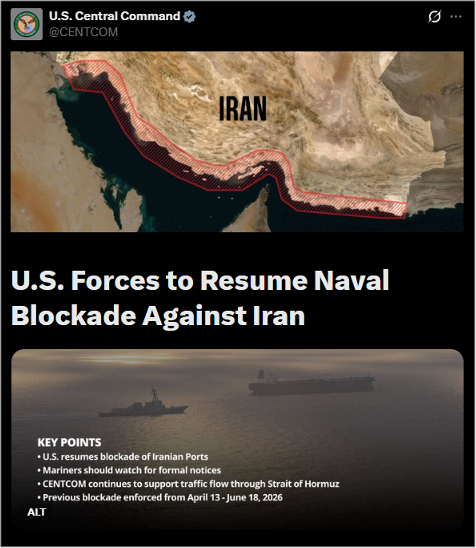
U.S. CENTCOM update on July 13 (Credit: US CENTCOM/X)
Status of the Strait of Hormuz
Since the start of the Iran War, the International Maritime organization (IMO) has reported 56 maritime incidents involving commercial vessels have been reported across the Persian Gulf, Strait of Hormuz, and Gulf of Oman.
On July 13, two Liberian-flagged tankers, AL BAHYAH (IMO 9937799) and MOMBASA B (IMO 9739501), were struck by Iranian missiles while transiting outbound on the southern corridor of the Strait of Hormuz.
Prior to the outbreak of the Iran War, about 138 vessels transited the Strait of Hormuz daily. Throughout the conflict, marine traffic data showed large clusters of loitering vessels on both sides of the Strait of Hormuz, with many ships refraining from transiting due to safety concerns. Since the signing of the MoU, the Joint Maritime Information Center (JMIC) has reported an increase in open transits through the Strait of Hormuz. On June 24, JMIC recorded 54 transits, the highest daily total since the outbreak of the conflict. As of July 13, JMIC has reported a total of 645 vessels transiting the Strait of Hormuz since the date of the signing of the MoU.
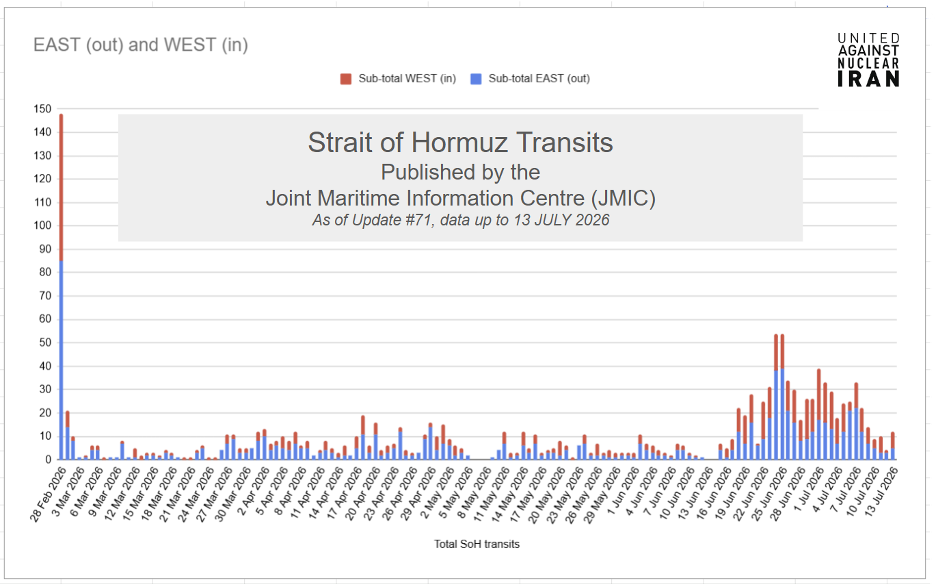
Vessel transits of the Strait of Hormuz (Data Credit: JMIC)
In the days following the MoU, transits were dominated by Chinese- and Iran-linked traffic using the northern corridor of the Strait of Hormuz. However, there has since been an increase in transits, including Western-linked vessels, through the southern corridor, likely reflecting its gradual widening due to demining operations, as well as a broader increase in commercial willingness to transit the Strait. Open transits of commercial vessels through the southern corridor declined following the maritime strikes on June 25 and 27, as well as July 6 and 7, but have not ceased entirely. Most of the traffic since the strikes has been via the northern corridor.
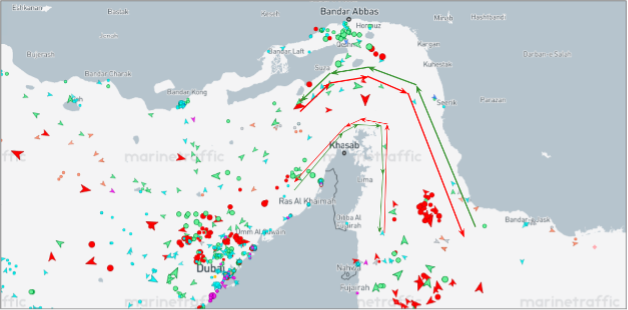
Strait of Hormuz transits on July 14 at 12:00 UTC (Credit: Marine Traffic)
Iranian Oil-Laden Tankers Departing the Gulf of Oman
Since the announcement of the MoU on June 14, UANI has tracked 63 tankers departing the Gulf of Oman laden with Iranian oil and petrochemicals. These exports represent approximately 77 million barrels of Iranian oil, generating an estimated revenue of over $6 billion for the IRGC, which continues to fund Iran’s missile and drone programs. These figures are estimates. The pricing and volumes associated with Chinese purchases of Iranian crude are not publicly disclosed, though such cargoes are widely assessed to be sold at a discount of around 10 to 12 dollars per barrel.
Despite the reinstatement of the U.S. blockade today, there was no large group of tankers departing the Gulf of Oman laden with Iranian oil and petrochemicals. This is most likely because Iran already exported a large volume of oil and petrochemicals since the previous blockade was lifted, leaving a significant portion of the Iran-flagged NITC tankers outside the Gulf of Oman and now concentrated in the Southeast Asian sea lanes.
Iranian Oil-Laden Tankers
UANI has identified at least 36 tankers laden with Iranian oil — primarily crude, but also other petroleum products and LPG — currently operating along the Iranian coastline.
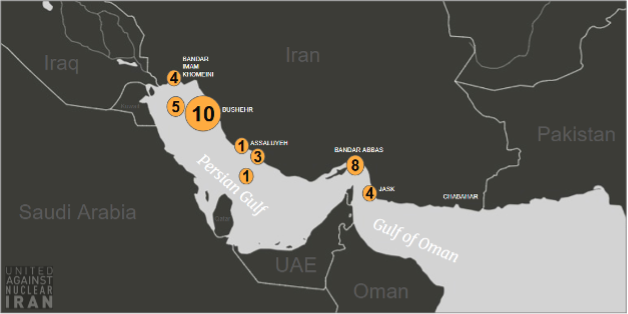
Positions of tankers laden with Iranian oil on July 14 (Credit: UANI)
Number of Iranian Loadings
Since the signing of the U.S.-Iran MoU on June 17, UANI has tracked at least 25 Iranian oil and petrochemical loadings, 10 of which originated from Kharg Island, Iran.
Iran-flagged Tankers Globally
UANI has also monitored Iran-flagged tankers operating beyond the Persian Gulf. Three Iran-flagged tankers, HILDA I (IMO 9357389), DREAM II (IMO 9356593) and HELM (IMO 9357391), all laden with Iranian crude, are currently sailing the Arabian and Laccadive Seas, most likely bound for the Malaysian Eastern Outer Port Limits (EOPL) anchorage to conduct a ship-to-ship transfer of Iranian crude. In total, these vessels are carrying almost 6 million barrels of Iranian crude.
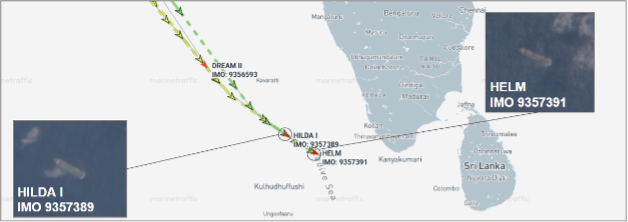
Iran-flagged laden tankers transiting Arabian and Laccadive Seas on July 14 (Credit: ESA Copernicus & Marine Traffic)
Since the signing of the MoU, 18 Iran-flagged tankers have reached the Singapore Strait bound for the EOPL anchorage off Johor, Malaysia.
There are currently 15 Iran-flagged tankers already in the EOPL: HAPPINESS I (IMO 9212905), STREAM (IMO 9569633), HERBY (IMO 9362059), DIAMOND II (IMO 9218478), FELICITY (IMO 9183934), DINO 1 (IMO 9569671), HEDY (IMO 9212888), DORE (IMO 9357717), SEVIN (IMO 9357353), HENNA (IMO 9212929), SILVIA I (IMO 9172052), DORENA (IMO 9569669), SNOW (IMO 9569619) HERO II (IMO 9362073) and SONIA I (IMO 9357365), which have all previously passed the Singapore Strait and have since stopped broadcasting their location on AIS. Seven of these tankers have since been spotted in satellite imagery, confirming their location. All these Iranian tankers are expected to conduct STS transfers in the EOPL, with four already observed in satellite imagery. Today, FELICITY was observed in satellite imagery conducting an STS transfer with another tanker in the EOPL.
Meanwhile, Iran-flagged tankers AMBER (IMO 9357406), STARLA (IMO 9569621) and DIONA (IMO 9569695) have departed the EOPL, reporting ballast condition on AIS after completing ship-to-Ship (STS) transfers in the anchorage, and are now most likely returning to Iran. They are the first three Iran-flagged tankers that have departed the EOPL reporting empty since the lifting of the U.S. blockade.
On July 14, at least 50 tankers listed on UANI's Ghost Armada were anchored or loitering near the EOPL area with their AIS signals active, demonstrating that ghost fleet tankers continue to operate with impunity across Southeast Asia's sea lanes.
Iran-Flagged Cargo Ships Globally
Despite ongoing pressure of U.S. OFAC sanctions, approximately 50 Iranian flagged cargo ships continue to operate openly across sea lanes, ports, and anchorages throughout the Indo-Pacific region, the Red Sea and the eastern Mediterranean.
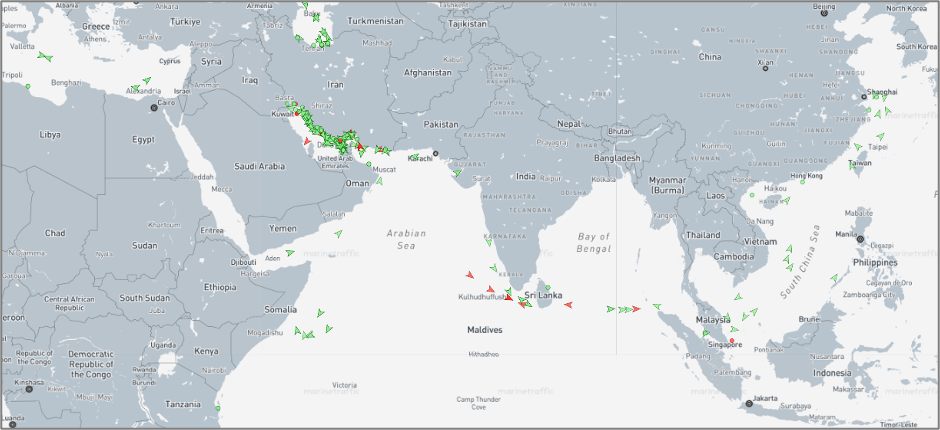
Iran-flagged vessels across the Indo-Pacific on July 15 (Credit: Marine Traffic)
Twenty-three cargo ships are headed to or already at Chinese ports.
The container ships GOLBAN (IMO 9283033) and ARTAM (IMO 9284154) are currently in the Gulf of Oman returning to Iran from Indian ports of Kandla and Mumbai. GOLBAN entered Iranian territorial waters and was approaching Chabahar. ARTMAN is currently in international waters, but in Pakistan Exclusive Economic Zone (EEZ) and about 250km from Iranian waters. It is possible that the U.S. might interdict this vessel to enforce the U.S. blockade on Iranian ports.
The bulk carrier ARTMAN (IMO 9405930) has entered Indian waters in the Gulf of Kutch and is approaching the port of Kandla. ARTMAN is sanctioned by OFAC. The port of Kandla faces the risk of secondary sanctions.
The cargo ships ARTABAZ (IMO 9283007), ARTENOS (IMO 9283021), ARIES (IMO 9369722) and RADIN (IMO 9820257) are all sailing south in the Laccadive Sea, off the coast of India. RADIN is approaching the south coast of Sri Lanka. ARTABAZ is heading to Port Klang, Malaysia. ARTENOS, AERIS and RADIN are heading to ports in China.
ENZO 2 (IMO 9236652) is approaching Cape Comorin, India and the Laccadive Sea on its return to Iran.
The container ship SHABDIS (IMO 9349588) is anchored in Trincomalee, Sri Lanka. SHABDIS is OFAC-sanctioned, so the Port of Trincomalee and any logistic vessels providing support to it face the risk of U.S. sanctions.
The cargo ships ZYRA (IMO 9237084), ARTIN (IMO 9305221) and KASHAN (IMO 9270696) are sailing east in the Bay of Bengal toward the Strait of Malacca on their way to ports in China.
The bulk carrier BATIS (IMO 9465760) transited the Six-Degree Channel westward and entered the Bay of Bengal, on its way back to Iran.
The container ship DARYABAR (IMO 9284142) is sailing south in the Malacca Strait, and passed One Fathom Bank, toward the Singapore Strait.
The container ships DAISY (IMO 9270684), SHAMIM (IMO 9270658), SHIBA (IMO 9270646) and AREZOO (IMO 9165786 are anchored outside of Port Klang. AREZOO has still not been detected on AIS after arriving at the anchorage but is assumed to still be in the vicinity of Port Klang.
The container ship FLORA (IMO 9349576) departed the Malaysian EOPL anchorage and sailed north in the South China Sea to its destination at Zhuhai, China.
The container ships PARNIA (IMO 9167265) and BASHT (IMO 9346536) are sailing toward the Singapore Strait, on their return to Iran. They may stop and loiter in the Malaysian EOPL due to the reinstatement of the U.S. blockade; PARNIA has already stopped and is loitering about 120 km from the EOPL.
The bulk cargo ship PARSHAD (IMO 9387786) was sailing northward toward the Gulf of Thailand and the Thai port of Ko Sichang but made a U-turn and maneuvered within 7 km offshore of Kuala Terengganu, Malaysia. It then continued south again, although its listed destination has not changed. It is possible that PARSHAD met another vessel and conducted a transfer of cargo or personnel ashore.
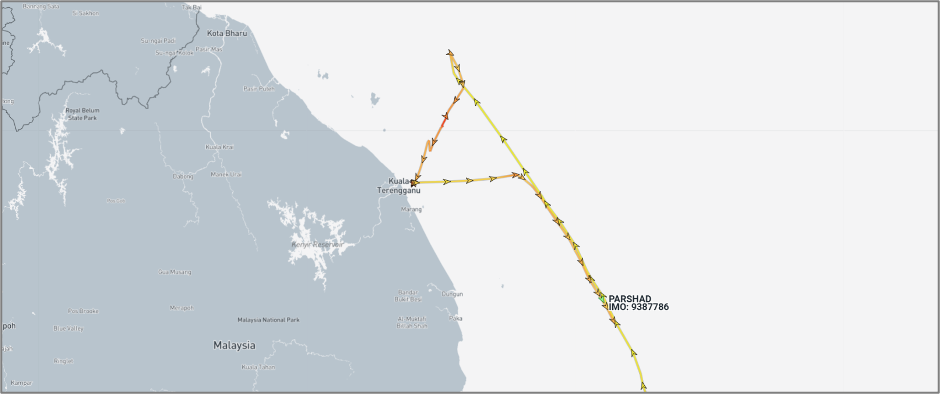
Iran-flagged vessel off peninsular Malaysia on July 14 (Credit: Marine Traffic)
The bulk carrier BEHDOKHT (IMO 9405978) entered the territorial waters of Thailand and approached the port of Songkhla, with estimated arrival of July 15. Notably, the U.S. Navy and U.S. Coast Guard are currently in Songkhla for the bilateral naval engagement, Exercise CARAT Thailand, with the Royal Thai Navy.
The bulk cargo ship ANDIA (IMO 9193197) which is headed to Zhoushan Port, near Ningbo China, is taking an unusual route along the coast of Palawan. ANDIA is reporting that it has Restricted Maneuverability.
The bulk carrier PARISAN (IMO 9465851), which is reporting Dafeng, China, on the coast of the Yellow Sea as its destination, passed east of Hainan but continued north in the South China Sea, following a route closer to China’s coastal area.
The container ship ABYAN (IMO 9349667) remained anchored off Zhuhai, China.
The bulk carrier ARDAVAN (IMO 9465863) entered the Taiwan Strait, in Taiwanese waters, on its voyage to Dafeng, China. The bulk carrier GANJ (IMO 9305219) passed the Taiwan Strait and turned west toward Ningde, China but does not list any specific destination on AIS.
The container ship BARZIN (IMO 9820269) arrived in the anchorage area at CJK outside Shanghai, near ZARDIS (IMO 9349679), while RAYEN (IMO 9820245) and RAMA 3 (IMO 9303754) continued approaching CJK. GOLAFRUZ (IMO 9323833) sailed north in the East China Sea toward Dafeng, while the container ship HAMOUNA (IMO 9820271) continued to sail south, past the CJK anchorage area.
In the western Indian Ocean, the general cargo ships NESHAT (IMO 9167277) and GOLSAN (IMO 9165815) both continue sailing south to Mombasa, Kenya. The bulk carrier VICTORIA 1 (IMO 9109550) remains at Dar es Salaam, Tanzania.
The container ship FLEXI 2 (IMO 9246322), which departed Novorossiysk, Russia, and then visited Misrata, Libya, for unknown operations, sailed east in Gulf of Aden sailing east to its next port in Mumbai, India.
In the Mediterranean Sea, the general cargo ship ALVAN (IMO 9165798) sailed west from Port Said to Misrata, Libya. The container ship NYRA 2 (IMO 9241487) which was sailing north from Port Said toward its next destination in Turkey, stopped and began loitering in the Eastern Mediterranean.
The container ship BEHTA (IMO 9349590) is sailing west toward Malta, on the way to its destination as Bronka Port in the Russian Baltic. The container ship VIRA 1 (IMO 9088524) passed BEHTA sailing east to Port Said, from its previous port call at BALTIYSK, Baltiysk, Russia.
The general cargo ship AYSAN (IMO 9165803) is in port at Misrata, Libya. Libya remains under certain UN sanctions, and an arms embargo, in accordance with United Nations Security Council Resolution 2819 (2026).
Receive Iran News in Your Inbox.
Eye on Iran is a news summary from United Against Nuclear Iran (UANI), a section 501(c)(3) organization. Eye on Iran is available to subscribers on a daily basis or weekly basis.