Iran Shipping Update – November 24, 2026
The maritime security environment across the region remains highly volatile. Increased Iranian attacks continue to threaten commercial shipping in the Strait of Hormuz, while U.S. naval forces enforce a maritime blockade that has significantly constrained Iran's ability to export oil. At the same time, Iran-linked tankers and cargo vessels continue to operate across other regions, highlighting the global reach of Iran's maritime networks and the challenges of enforcing international sanctions. Meanwhile, Houthi threats and attacks pose a renewed risk to commercial shipping in the Red Sea.
For UANI’s recommendations for U.S. sanctions on Iran following “Economic D-Day,” read here.
Top Lines
Despite the Iranian regime's false narrative claiming that convoys of up to 14 tankers laden with Iranian crude oil are attempting to breach the blockade, most of the laden tankers tracked by UANI remain in their anchorages along Iran’s coastline.
The Iran-flagged container ship RAMA 3 (IMO 9303754) arrived and anchored at Port Klang, Malaysia, today. RAMA 3 likely departed Bandar Abbas, Iran, on November 12, indicating it possibly breached the blockade. It transited the Indian Ocean clandestinely using several false identities on AIS.
Three tankers are berthed at Bandar-e Mahshahr today, with at least one vessel observed loading Iranian fuel oil.
Status of the Strait of Hormuz
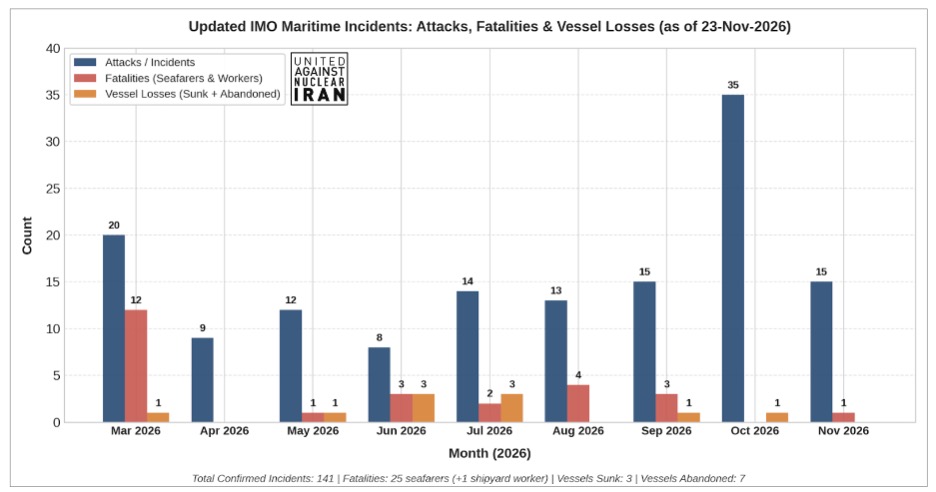
Since the start of the Iran War, the International Maritime Organization (IMO) has confirmed 141 maritime incidents involving commercial vessels across the Persian Gulf, Strait of Hormuz, and Gulf of Oman. According to the IMO, these incidents have resulted in 25 seafarer deaths. UK Maritime Trade Operations (UKMTO) has recorded more attacks that have yet to be verified by the IMO.
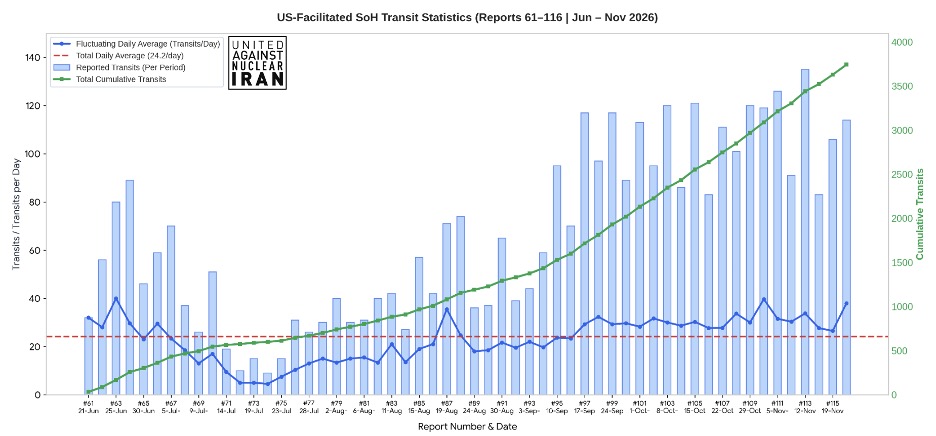
Despite heightened attacks on commercial shipping, tankers continue to transit the southern corridor of the Strait of Hormuz bidirectionally without broadcasting AIS location data, with many of these movements facilitated by U.S. forces. U.S.-facilitated transits through the Strait of Hormuz surged to an average of 38.0 vessels per day, with 114 transits recorded during the latest 72-hour period (November 19–21). This brings the month-to-date November total to 655 transits across 21 days, averaging 31.2 per day, and lifts the cumulative campaign total to 3,744 transits across 155 monitored days, an average of 24.2 per day.
Iranian Oil-Laden Tankers Departing the Gulf of Oman
Tankers laden with Iranian oil and petrochemicals are currently clustering in anchorages along the Iranian coastline due to the reinstatement of the blockade. Since the blockade resumed, approximately 11 small tankers carrying Iranian LPG and fuel oil have successfully passed the blockade line. However, UANI has not tracked any tanker laden with Iranian crude oil that has successfully departed the Gulf of Oman and avoided enforcement actions by U.S. forces since July 12, before the blockade was reinstated.
Iranian Oil-Laden Tankers
UANI has identified at least 57 tankers laden with Iranian oil—primarily crude, but also other petroleum products and LPG—currently operating along the Iranian coastline.
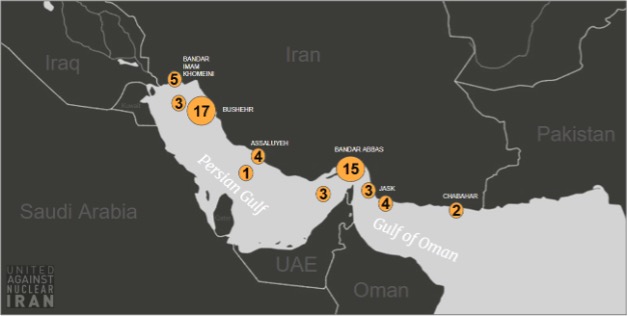
Positions of tankers laden with Iranian oil on November 24 (Credit: UANI)
Number of Iranian Loadings
Since the U.S. reinstated the blockade on July 14, UANI has tracked at least 64 Iranian oil and petrochemical loadings, only nine of which originated from Kharg Island, Iran. On November 24, satellite imagery showed three tankers berthed at Bandar-e Mahshahr, Iran, with at least one vessel observed loading Iranian fuel oil.
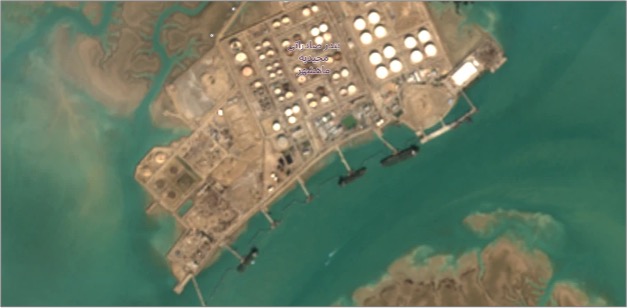
Three tankers berthed at Bandar-e Mahshahr on November 24 (Credit: ESA Copernicus)
Iran-Linked Tankers Globally
UANI has also monitored Iran-flagged tankers operating beyond the Persian Gulf, particularly in the waters near Malaysia. At least 22 tankers listed on UANI’s Ghost Armada are loitering in the EOPL anchorage, demonstrating that Ghost Fleet tankers continue to operate with impunity across Southeast Asia's sea lanes. Meanwhile, 18 tankers listed on UANI's Ghost Armada were anchored or loitering north of the EOPL anchorage with their AIS signals active. These tankers most likely departed the anchorage due to the purported recent enforcement actions of the Malaysian maritime authorities.
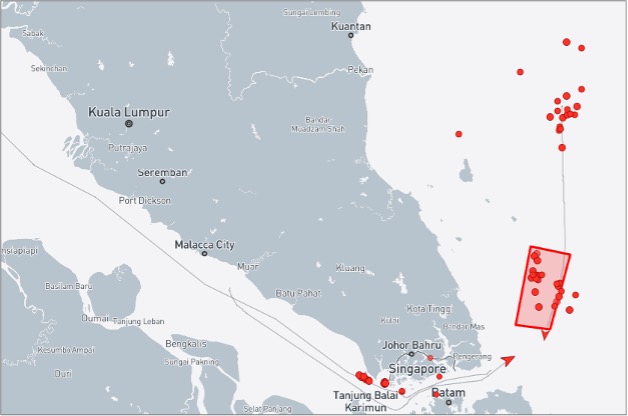
Ghost Armada tankers near Malaysia on November 24 (Credit: Marine Traffic)
Iran-flagged tankers, empty after conducting STS transfers in the EOPL, are now loitering at anchorages across the Indo-Pacific rather than transiting back to Iranian ports because of the blockade. DIONA (IMO 9569695) is loitering offshore Duqm, Oman, while 18 empty Iran-flagged tankers are currently loitering off Sri Lanka. These tankers are STREAM (IMO 9569633), HALTI (IMO 9212890), SEA CLIFF (IMO 9569657), HERO II (IMO 9362073), SILVIA I (IMO 9172052), SNOW (IMO 9569619), HELM (IMO 9357391), DUNE (IMO 9569712), DEEP SEA (IMO 9218492), DIAMOND II (IMO 9218478), DINO 1 (IMO 9569671), SONIA I (IMO 9357365), DORE (IMO 9357717), HERBY (IMO 9362059), FELICITY (IMO 9183934), HENNA (IMO 9212929), AMBER (IMO 9357406), and HUGE (IMO 9357183).
Two Iran-flagged tankers, DREAM II (IMO 9356593) and SEVIN (IMO 9357353), departed their Sri Lankan anchorages and transited the Six Degree Channel eastbound. On November 21, DREAM II was observed via satellite imagery operating off Banda Aceh, Indonesia, while dark to AIS tracking. That same day, SEVIN resumed broadcasting on AIS in the same vicinity. The reasoning behind the two unladen tankers departing Sri Lanka's coastline remains unclear. However, they are likely relocating to an alternate loitering area amid the blockade or positioning to receive logistics support or conduct an STS transfer.
Iran-Flagged Cargo Ships Globally
Despite ongoing pressure of OFAC sanctions and the constraints of the U.S. blockade, approximately 50 Iranian-flagged cargo ships continue to operate openly across sea lanes, ports, and anchorages throughout the Indo-Pacific region, Arabian Sea, Gulf of Aden, Mediterranean, Atlantic Ocean, and Baltic Sea.
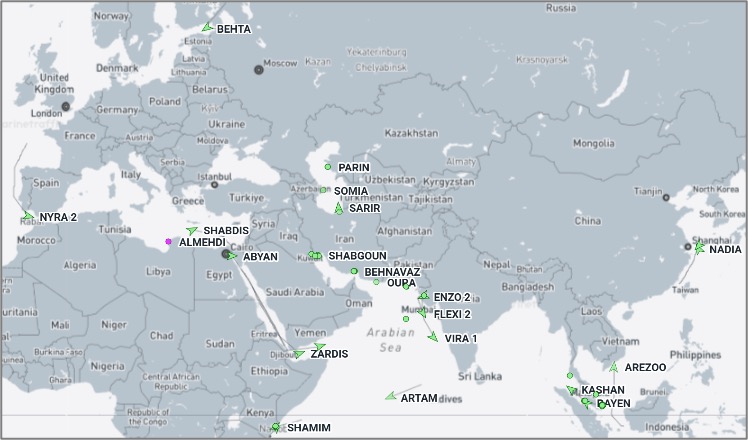
Iran-flagged cargo vessels across the region on November 24 (Credit: Marine Traffic)
At the Libyan coast, the Iran-flagged general cargo ship ALVAN (IMO 9165798), which has been anchored off Benghazi since November 17, pulled into Benghazi Port. ALVAN continues to broadcast a false identity via an MMSI number associated with a pleasure craft named ALMEHDI. It remains unconfirmed if ALVAN was struck during the recent attacks at Benghazi Port, but that now seems unlikely.
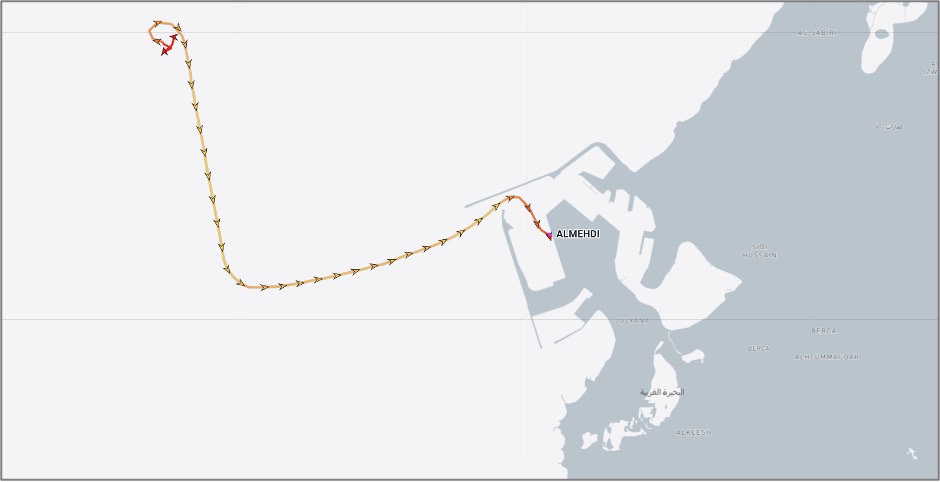
Iran-flagged cargo ship at Benghazi on November 24 (Credit: ESA Copernicus)
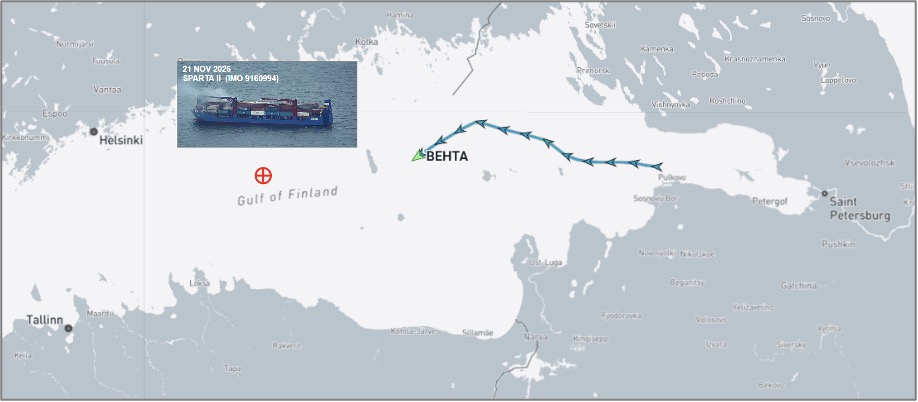
In the Gulf of Finland, the Iran-flagged container ship BEHTA (IMO 9349590) departed Port Bronka, near St. Petersburg, Russia. Its destination is Port Said, with an estimated arrival on December 6. BEHTA will sail past the location where the Russian cargo ship SPARTA II (IMO 9160994) was hit on November 21. The damaged vessel was subsequently towed back into Russian waters after it was rescued by Finnish Border Guard vessels.
In the Atlantic Ocean, the container ship NYRA 2 (IMO 9241487) approached the Gibraltar Strait, which it will transit on November 25, and is scheduled to arrive at Port Said on December 2.
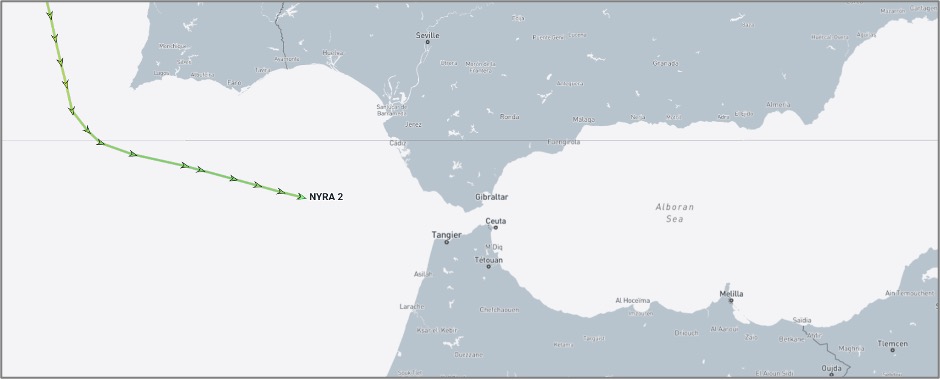
Iranian cargo ship near the Gibraltar Strait on November 24 (Credit: Marine Traffic)
In the Mediterranean, the Iran-flagged container ship SHABDIS (IMO 9349588) stopped about 100 km south of Crete and began to loiter. SHABDIS was sailing to Port Bronka, near St. Petersburg, Russia, with an estimated arrival on December 3. It could be loitering here following the recent attack on the Russian warship in Benghazi, Libya.
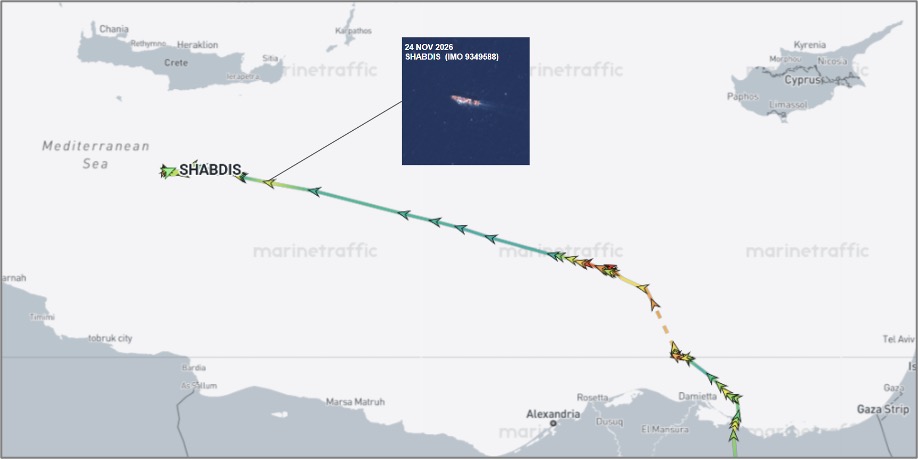
Iran-flagged cargo ship in the Mediterranean on November 24 (Credit: Marine Traffic & ESA Copernicus)
In the Gulf of Suez, ABYAN (IMO 9349667) anchored in the Suez Canal after arriving from Zhuhai, China. This vessel is likely to continue to a Russian port following the Suez Canal transit.
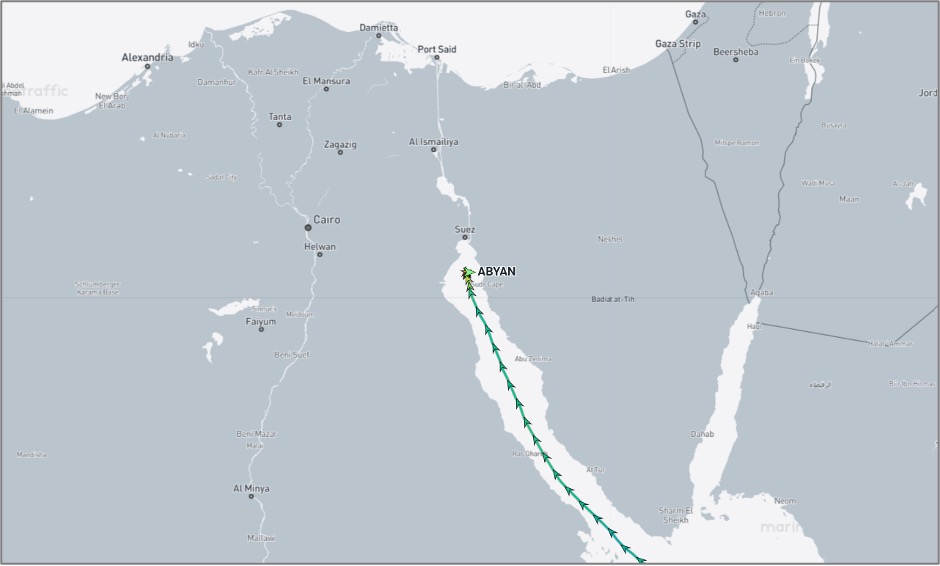
Iran-flagged cargo ship in the Gulf of Suez on November 24 (Credit: Marine Traffic)
In the Gulf of Aden, the Iran-flagged container ships ZARDIS (IMO 9349679) and BASHT (IMO 9346536) completed their transit of the Bab el-Mandeb and headed toward the Arabian Sea. ZARDIS is bound for Port Klang from Port Bronka, Russia, with an estimated arrival on December 3, and BASHT is bound for Shanghai from Libya with an estimated arrival on December 11.
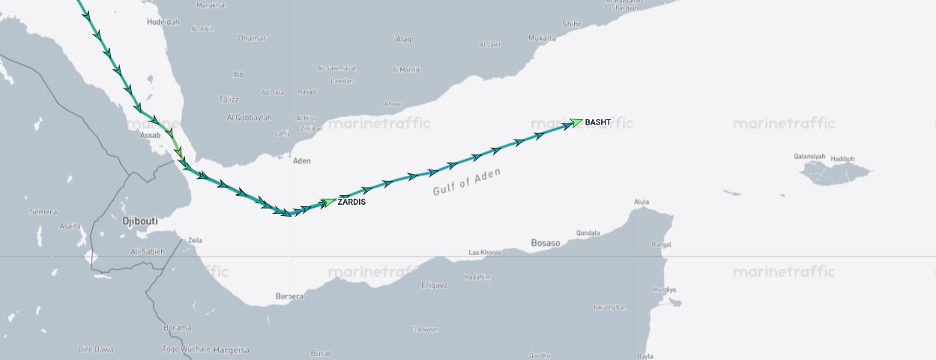
Iran-flagged cargo ship in the Gulf of Aden on November 24 (Credit: Marine Traffic)
In the Gulf of Kutch, the falsely flagged, OFAC-sanctioned container ship ENZO 2 (IMO 9236652) completed cargo operations at Kandla Container Terminal and departed. Its destination is unknown. ZYRA (IMO 9237084) and ALOR 2 (IMO 9228538) remain anchored outside Kandla.
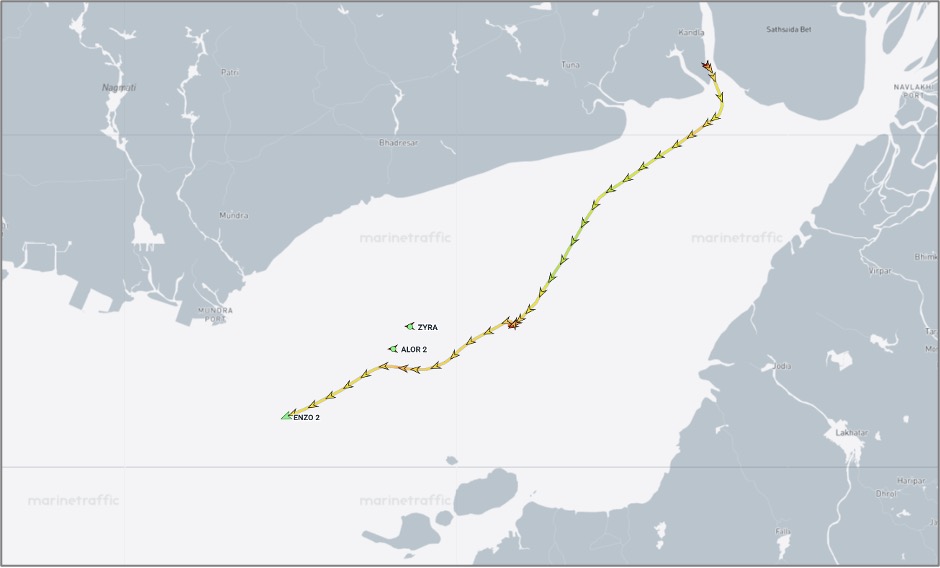
Iran-flagged cargo ships in the Gulf of Kutch on November 24 (Credit: Marine Traffic)
Near Port Klang, the container ships VELON 1 (IMO 9122473), SHIBA (IMO 9270646), and FLORA (IMO 9349576) remained anchored outside the port. KASHAN (IMO 9270696) departed Port Klang anchorage bound for Kandla, India, where it will arrive on December 2. The container ship RAMA 3 (IMO 9303754) arrived and anchored at Port Klang near the other Iran-linked vessels. RAMA 3 likely departed Bandar Abbas, Iran, on or about November 12, and therefore has most likely breached the blockade. All of these cargo ships will likely pull into Port Klang Container Terminal to conduct transshipment operations, despite the risk of secondary sanctions to the port operator and the shipping agents. The designated port agent for RAMA 3, VELON 1, and FLROA is Q-Express Line Sdn Bhd, and the agent for SHIBA is OrcaTrans Sdn Bhd.
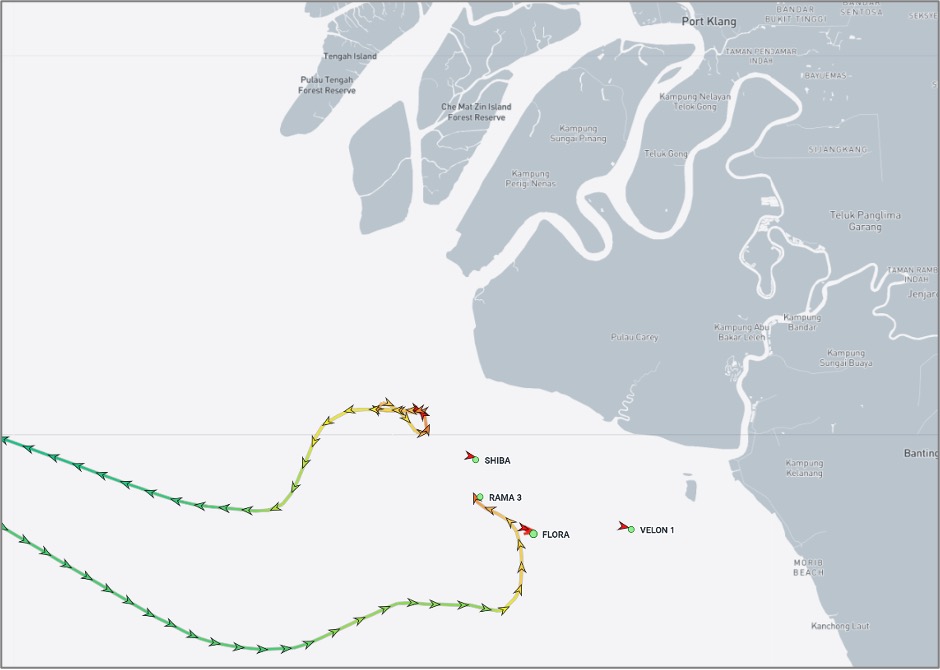
Iran-flagged cargo ships at Port Klang on November 24 (Credit: Marine Traffic)
At the Malaysian EOPL, 19 Iranian-flagged cargo ships remained in the anchorage: AMINA (IMO 9305192), ANDIA (IMO 9193197), ARDAVAN (IMO 9465863), ARIES (IMO 9369722), ARTABAZ (IMO 9283007), ARTENOS (IMO 9283021), ARTIN (IMO 9305221), ARZIN (IMO 9284142), BAHJAT (IMO 9405954), BARZIN (IMO 9820269), BEHDOKHT (IMO 9405978), DARYABAR (IMO 9369710), ELYANA (IMO 9165827), GANJ (IMO 9305219), GOLAFRUZ (IMO 9323833), PARISAN (IMO 9465851), PARNIA (IMO 9167265), PARSHAD (IMO 9387786), andRADIN (IMO 9820257). Most of these vessels will likely remain in the EOPL while the blockade is in force, receiving regular logistics support from Malaysian service providers, despite the risk of secondary sanctions from OFAC. The container ship RAYEN (IMO 9820245) departed the EOPL after loitering for 112 days and transited the Singapore Strait westbound into the Malacca Strait, bound for Chennai, India, with an estimated arrival on November 30.
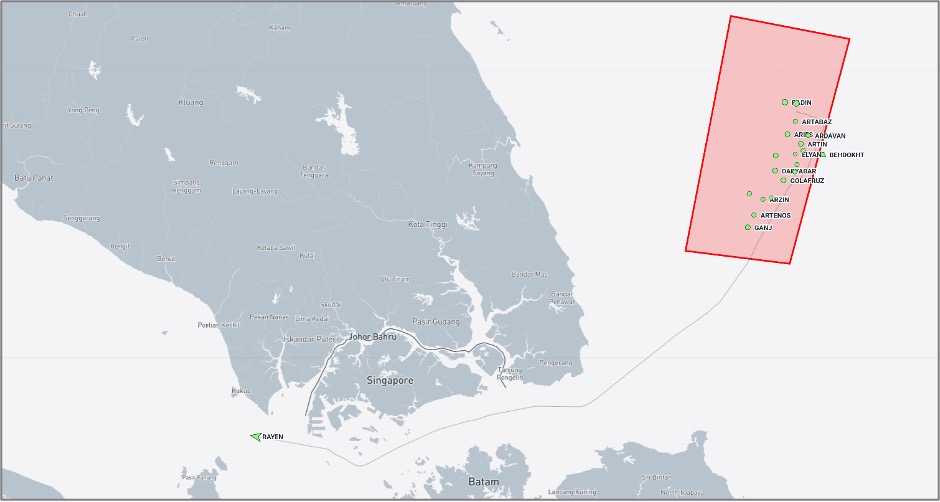
Iran-flagged cargo ships in the Singapore Strait and EOPL on November 24 (Credit: Marine Traffic)
In the South China Sea, the container ship AREZOO (IMO 9165786) approached Vung Tau, near Ho Chi Minh City, Vietnam, with an estimated arrival on November 25.
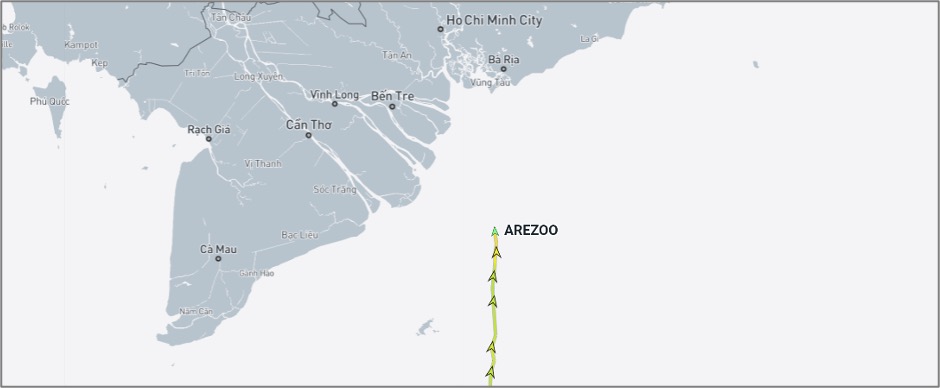
Iran-flagged cargo ship near Vietnam on November 24 (Credit: Marine Traffic)
Five Iranian-flagged cargo vessels are located in Kenyan waters. The container ship SHAMIN (IMO 9270658) is sailing to Lamu, where the cargo ships HAMOUNA (IMO 9820271), GOLSAN (IMO 9165815), and NESHAT (IMO 9167277) remained anchored inside the harbor near the container terminal. The container ship DAISY (IMO 9270684) is anchored just outside the port of Lamu after transiting from Kandla, India. Meanwhile, the container ship ARTAM (IMO 9284145), which had been anchored in the Maldives since October 9, got underway and is sailing to Lamu with an estimated arrival on November 29, becoming the sixth Iranian-flagged cargo ship to call on Kenya.
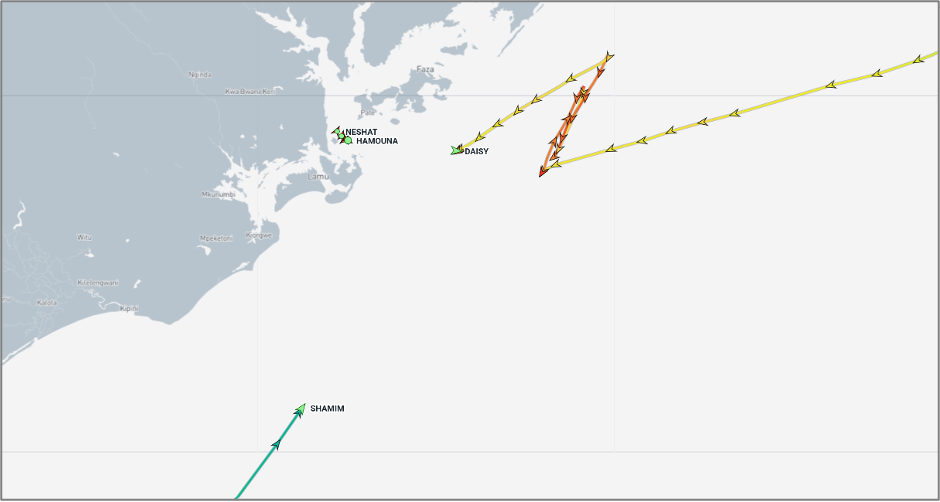
Iran-flagged cargo ships in Kenya on November 24 (Credit: Marine Traffic)
Receive Iran News in Your Inbox.
Eye on Iran is a news summary from United Against Nuclear Iran (UANI), a section 501(c)(3) organization. Eye on Iran is available to subscribers on a daily basis or weekly basis.