Iran Shipping Update – August 13, 2026
The security situation in the Strait of Hormuz remains highly volatile. Following the collapse of the June 17 Memorandum of Understanding (MoU) and the reinstatement of a U.S. blockade, Iran has targeted commercial shipping and Gulf States, while Tehran’s Yemeni Houthi partners threaten to expand the maritime conflict in the Red Sea.
U.S. Blockade and Sanctions
On July 14 at 4 p.m. ET, U.S. forces reimposed the blockade against vessels transiting to or from Iranian ports and coastal areas while supporting compliant traffic in regional waters. As of August 12, U.S. forces have redirected 59 commercial vessels trying to run the blockade, disabled 3 that didn't comply, and boarded 2 to ensure total compliance.
Houthi Blockade
On July 20, Yemen’s Iran-backed Houthis declared a naval blockade against Saudi Arabian ports.
Houthi threats and attacks against Saudi-linked shipping are already prompting some tankers, but not all, to reroute in the Red Sea. Rising insecurity in the Red Sea has caused a drop in tanker transits through Bab el-Mandeb of roughly 40% since the Houthis declared their blockade, according to data published by Joint Maritime Information Center (JMIC). Numerous tankers have been observed broadcasting “CHINESE OWNER” or “ARMED GUARD ON BOARD” as their destination during the transit of the Bab el-Mandeb, likely to help prevent being targeted.
In addition, the Houthis are reportedly considering charging most vessels to cross Bab el-Mandeb, with Chinese-flagged ships exempted under a separate safe-passage understanding already in place.
Status of the Strait of Hormuz
Since the start of the Iran War, the International Maritime organization (IMO) has reported 66 maritime incidents involving commercial vessels have been reported across the Persian Gulf, Strait of Hormuz, and Gulf of Oman.
Prior to the outbreak of the Iran War, about 138 vessels transited the Strait of Hormuz daily. Throughout the conflict, marine traffic data showed large clusters of loitering vessels on both sides of the Strait of Hormuz, with many ships refraining from transiting due to safety concerns. After the signing of the MoU, the Joint Maritime Information Center (JMIC) reported an increase in open transits through the Strait of Hormuz. On June 24, JMIC recorded 54 transits, the highest daily total since the outbreak of the conflict. As of August 12, JMIC has reported a total of 796 vessels transiting the Strait of Hormuz since the date of the signing of the MoU.
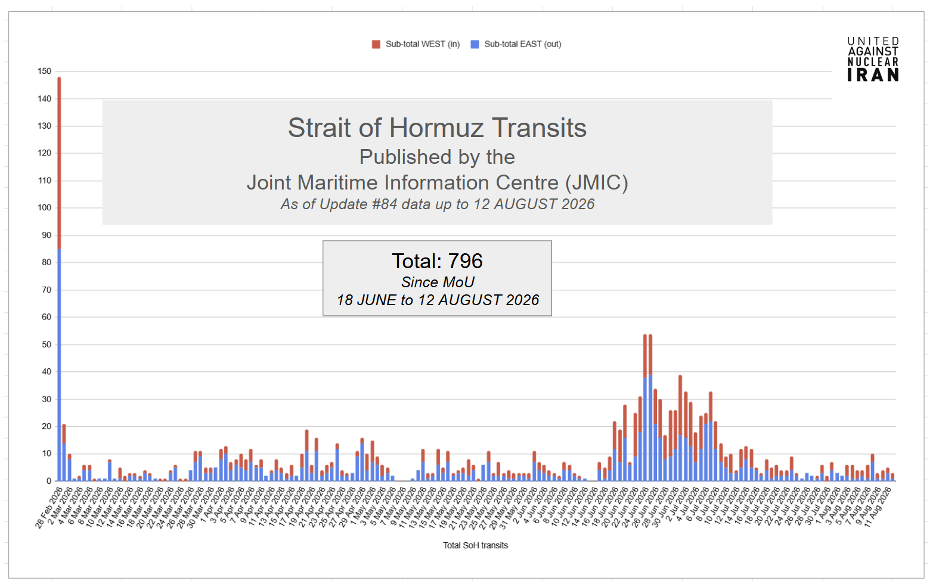
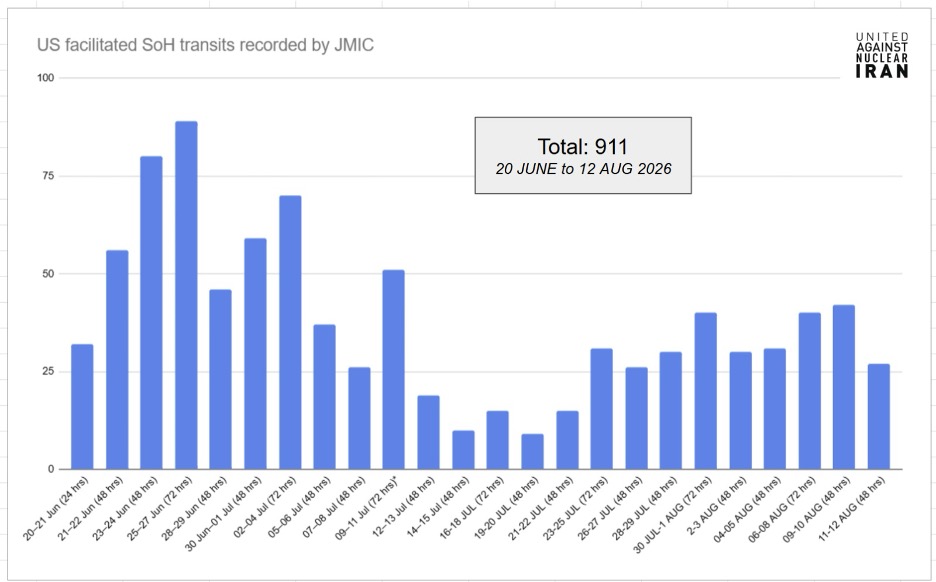
Open transits of commercial vessels through the southern corridor of the Strait of Hormuz declined following the IRGC strikes on commercial shipping starting July 7 but have not ceased entirely. Since the strikes, the traffic has been dominated by Iranian- and Chinese-linked vessels transiting via the northern corridor. Over the past week, an increasing number of vessels have transited the southern corridor without broadcasting AIS location data, with many of these movements facilitated by U.S. forces. According to the Joint Maritime Information Center (JMIC), 911 U.S.-facilitated transits of the Strait of Hormuz have occurred since the signing of the MoU.
Iranian Oil-Laden Tankers Departing the Gulf of Oman
Since the announcement of the MoU on June 14, UANI has tracked 66 tankers departing the Gulf of Oman laden with Iranian oil and petrochemicals. These exports represent approximately 80 million barrels of Iranian oil, generating an estimated revenue of over $6 billion for the IRGC, which continues to fund Iran’s missile and drone programs. These figures are estimates. The pricing and volumes associated with Chinese purchases of Iranian crude are not publicly disclosed, though such cargoes are widely assessed to be sold at a discount of around 10 to 12 dollars per barrel.
Tankers laden with Iranian oil and petrochemicals are currently clustering in anchorages along the Iranian coastline due to the U.S. blockade on Iranian ports. UANI has not tracked any tanker laden with Iranian crude oil that has departed the Gulf of Oman and avoided enforcement actions by U.S. forces since July 12, before the blockade was reinstated.
Iranian Oil-Laden Tankers
UANI has identified at least 55 tankers laden with Iranian oil — primarily crude, but also other petroleum products and LPG — currently operating along the Iranian coastline.
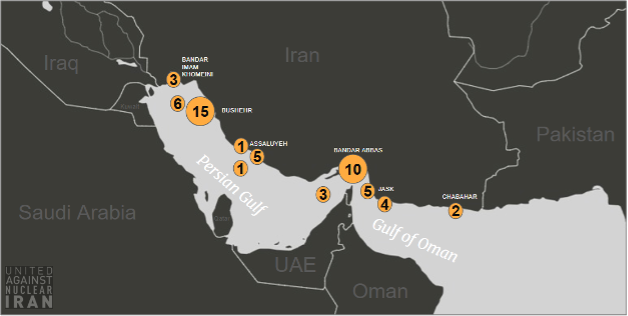
Positions of tankers laden with Iranian oil on August 13 (Credit: UANI)
Number of Iranian Loadings
Since the signing of the U.S.-Iran MoU on June 17, UANI has tracked at least 39 Iranian oil and petrochemical loadings, 13 of which originated from Kharg Island, Iran.
Satellite imagery from August 13 reveals a possible tanker loading from Kharg Island’s Azarpad Jetty. If confirmed, this marks the first loading activity UANI has observed at Kharg Island in two weeks.
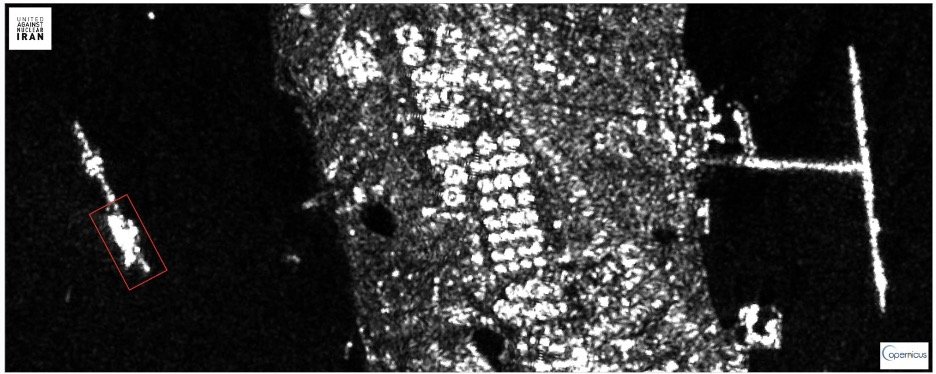
Possible tanker loading at Kharg Island on August 13 (Credit: ESA Copernicus)
Iran-flagged Tankers Globally
UANI has also monitored Iran-flagged tankers operating beyond the Persian Gulf. Since the signing of the MoU, 26 Iran-flagged tankers have reached the Singapore Strait bound for the EOPL anchorage off Johor, Malaysia. All these Iranian tankers are expected to conduct STS transfers in the EOPL, and 16 of these STS transfers have been observed in satellite imagery.
There are 10 Iran-flagged tankers currently in the EOPL: HUMANITY (IMO 9180281), DREAM II (IMO 9356593), STARLA (IMO 9569621), HILDA I (IMO 9357389), DAN (9357729), HALTI (IMO 9212890), HAPPINESS I (IMO 9212905), STREAM (IMO 9569633), HEDY (IMO 9212888) and DORENA (IMO 9569669). They have all previously passed the Singapore Strait and have since stopped broadcasting their location on AIS.
Meanwhile, SEA CLIFF (IMO 9569657), HERO II (IMO 9362073), SILVIA I (IMO 9172052), SNOW (IMO 9569619), HELM (IMO 9357391), DUNE (IMO 9569712), DEEP SEA (IMO 9218492), DIAMOND II (IMO 9218478), DINO 1 (IMO 9569671), SONIA I (IMO 9357365), DORE (IMO 9357717), HERBY (IMO 9362059), SEVIN (IMO 9357353), FELICITY (IMO 9183934), HENNA (IMO 9212929), AMBER (IMO 9357406) and DIONA (IMO 9569695) are the Iran-flagged tankers that have departed the EOPL in ballast after completing STS transfers.
SEA CLIFF has been loitering in ballast in the EOPL for over 2 months after conducting an STS transfer in early May. STARLA also left the EOPL empty, conducted another STS with the Iran-flagged tanker DEEP SEA in the Malacca Strait, and has since returned to the EOPL laden with Iranian crude, bringing the total to seventeen Iran-flagged tankers that have departed the EOPL empty since the signing of the MoU.
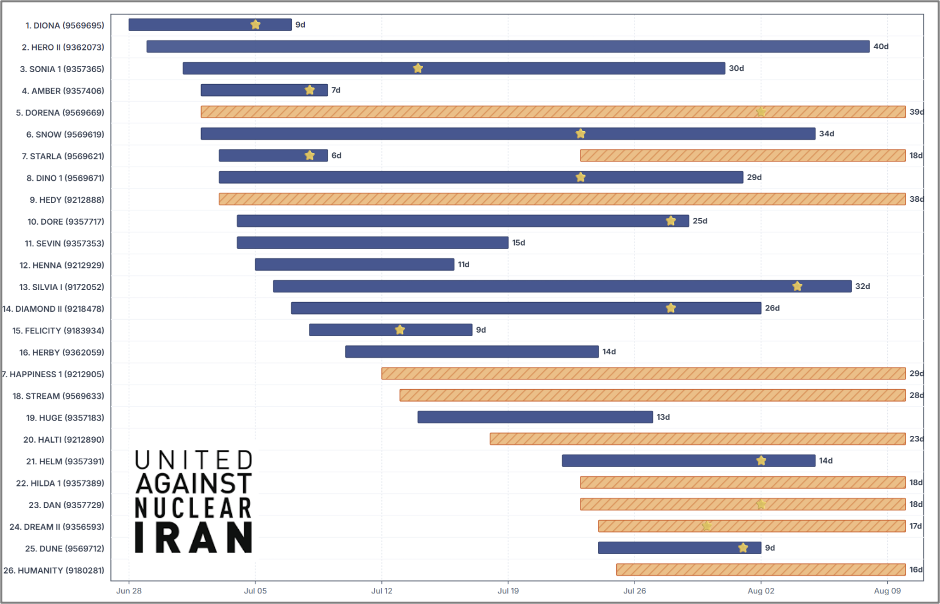
Iran-flagged HUGE (IMO 9357183) has also departed the EOPL anchorage. This tanker had been loitering unladen in the EOPL anchorage for over two weeks after conducting an STS transfer of Iranian crude south of Hong Kong in the South China Sea on July 9. It is most likely headed to the Galle anchorage to join the other Iran-flagged tankers in ballast.
These departing Iran-flagged tankers are now heading to anchorages across the Indo-Pacific rather than back to Iranian ports because of the U.S. blockade. DIONA was last observed loitering offshore Duqm, Oman in satellite imagery on August 4, while 14 empty Iran-flagged tankers are currently anchored of Galle, Sri Lanka. Namely, SNOW, HELM, DIAMOND II, DEEP SEA, DUNE, DINO I, SONIA I, HERBY, SEVIN, AMBER, HENNA, FELICITY, HUGE and DORE.
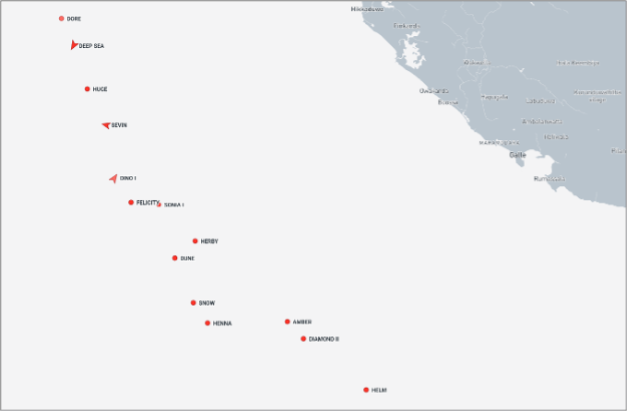
Empty Iran-flagged tankers near Galle, Sri Lanka on August 13 (Credit: Marine Traffic)
On August 13, at least 46 tankers listed on UANI's Ghost Armada were anchored or loitering near the EOPL area with their AIS signals active, demonstrating that Ghost Fleet tankers continue to operate with impunity across Southeast Asia's sea lanes.
U.S. Warship in the Malacca Strait
On August 13, the U.S. Navy aircraft carrier USS George Washington (CVN-73) and two escort vessels transited westbound through the Singapore Strait from the South China Sea toward the Malacca Strait. While the strike group's destination remains unconfirmed, the Japan-based carrier could potentially relieve USS Abraham Lincoln (CVN-72), which has been operating in the CENTCOM area for approximately 200 days and has been deployed from San Diego since November 2025. Notably, the ships of the George Washington strike group were transmitting on AIS during the transit and sailed in close proximity to the Malaysian EOPL anchorage area, where approximately 10 Iranian-flagged tankers, 10 Iranian-flagged cargo vessels, and 46 UANI Ghost Armada tankers are currently loitering and conducting ship-to-ship transfer activity. The transit highlights the unusual juxtaposition of a major U.S. naval strike group operating openly in one of the world's busiest waterways alongside a significant concentration of vessels linked to Iran's sanctions-evasion network.
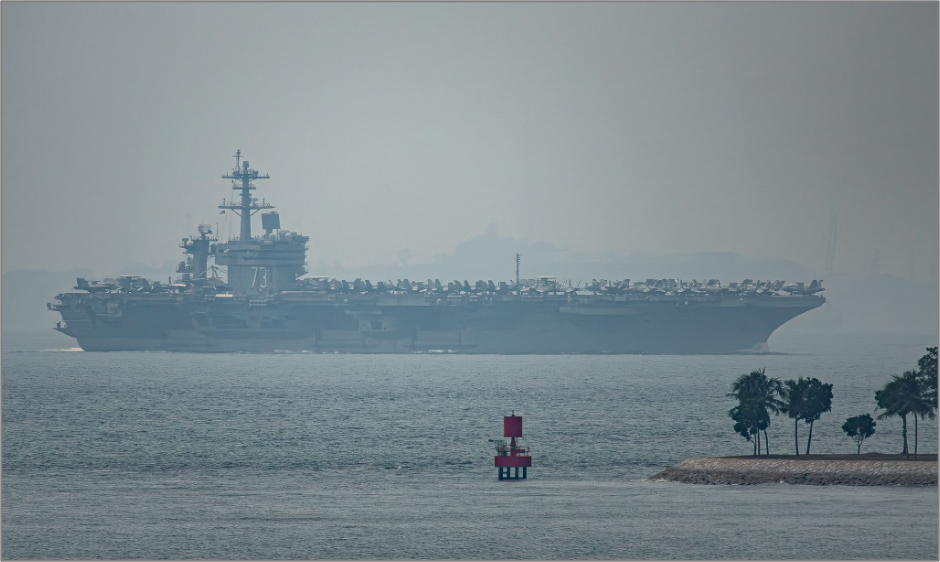
USS George Washington (CVN-73) in the Singapore Strait on August 13 (Credit: UANI)
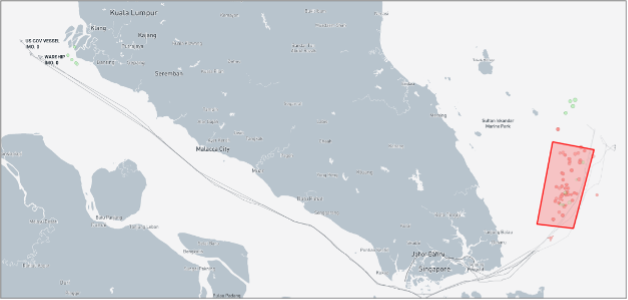
US Navy ships, Iran-flagged vessels and Iran-linked tankers near Malaysia on August 13
(Credit: Marine Traffic)
Iran-Flagged Cargo Ships Globally
Despite ongoing pressure of U.S. OFAC sanctions, and new constraints of the U.S. Blockade on Iranian ports, approximately 50 Iranian flagged cargo ships continue to operate openly across sea lanes, ports, and anchorages throughout the Indo-Pacific region, the Red Sea, the Mediterranean and Atlantic Ocean.
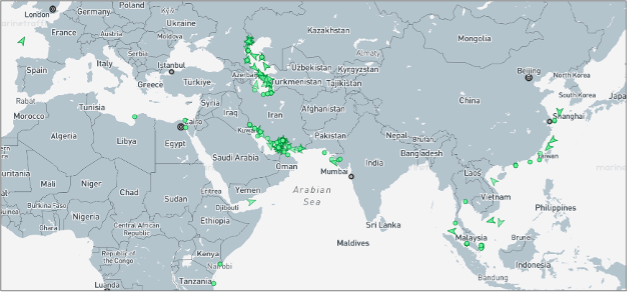
Iran-flagged cargo vessels across the region on August 13 (Credit: Marine Traffic)
In the Karachi OPL anchorage, the laden bulk carrier BATIS (IMO 9465760) continued to loiter at anchor. BATIS will likely continue loitering in the Karachi OPL due to the U.S. Blockade.
In the Gulf of Kutch, the container ships NYRA 2 (IMO 9241487) pulled into Kandla Port, India. The cargo ships SHAMIM (IMO 9270658) and VELON 1 (IMO 9122473) remained anchored nearby. VELON 1 and NYRA 2 are broadcasting on AIS under different flags, although listed in the official IMO GISIS database as registered under the Iranian flag. Meanwhile, ARTMAN (IMO 9405930) and ARTAM (IMO 9284154) are each anchored outside the entrance of the Gulf of Kutch.
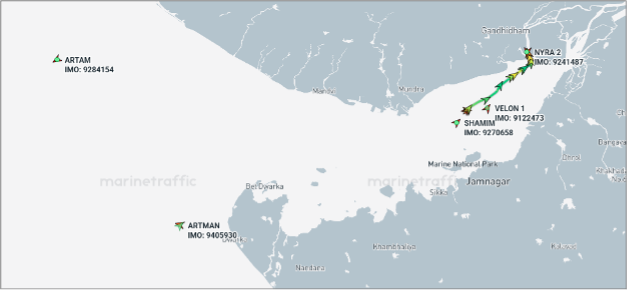
Iran-flagged cargo ships in the Gulf of Kutch on August 13 (Credit: Marine Traffic)
In the Andaman Sea, the bulk carrier DELNAVAZ (IMO 9387803) pulled into Phuket Deep Sea Port, Thailand.
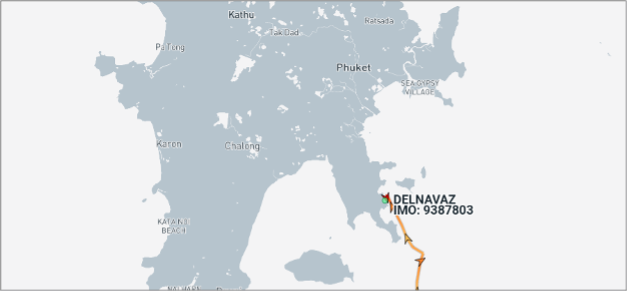
Iran-flagged cargo ship near Phuket on August 13 (Credit: Marine Traffic)
The container ship FLORA (IMO 9349576) departed the EOPL and is transiting north in the Malacca Strait.
At Port Klang, Malaysia, the container ship ENZO 2 (IMO 9236652) arrived at the Westports Holdings container terminal for cargo operations on August 13. Meanwhile at the anchorage, the container ships VIRA 1 (IMO 9088524), DAISY (IMO 9270684), SHIBA (IMO 9270646) and ARTABAZ (IMO 9283007) continued to sit an anchor. All five of these ships are sanctioned by U.S. Treasury OFAC, and companies that do business with them risk facing secondary sanctions.
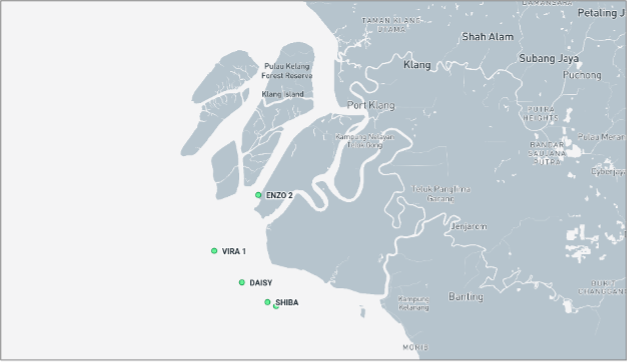
Iran-flagged cargo ships in the Malacca Strait on August 13 (Credit: Marine Traffic)
At the Malaysian EOPL anchorage, ten Iran-flagged cargo ships are anchored and loitering. The bulk cargo ship BAHJAT (IMO 9405954) arrived from China and joined the GOLAFRUZ (IMO 9323833), GANJ (IMO 9305219) andBEHDOKHT (IMO 9405978) which are all anchored just north of the EOPL. Meanwhile, in the EOPL, six cargo ships continued to loiter. The bulk cargo ship AMINA (IMO 9305192), general cargo ship PARNIA (IMO 9167265) and four container ships BASHT (IMO 9346536), ARZIN (IMO 9284142), HAMOUNA (IMO 9820271) and ZYRA (IMO 9237084),all remain anchored. These ships will likely remain in the EOPL while the U.S. blockade is still in force, receiving occasional logistics support, despite the risk of secondary sanctions from US Treasury OFAC.
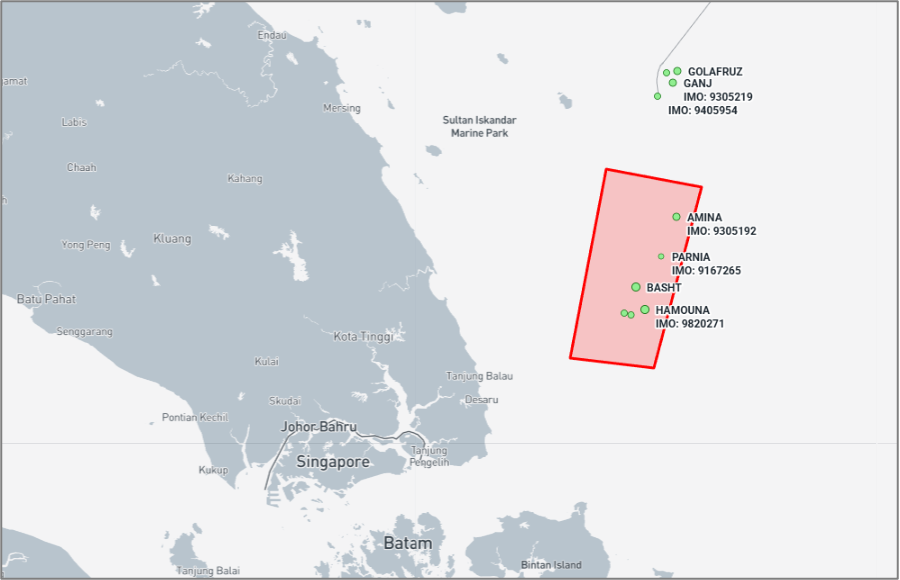
Iran-flagged cargo ships near the Malaysian EOPL on August 13 (Credit: Marine Traffic)
In the South China Sea, ANDIA (IMO 9193197) continued to sail south toward Singapore and will most likely stop at the Malaysian EOPL. The PARISAN (IMO 9465851) continued to sail towards the Gulf of Thailand on its way to Songkhla, Thailand, with an estimated arrival of August 19. The general cargo ship AREZOO (IMO 9165786) continued to sail north in the Gulf of Tonkin towards its destination at Haiphong, Vietnam.
In the Gulf of Thailand, the bulk cargo ship ARDAVAN (IMO 9465863) remained at Laem Chabang, Thailand and moored at the Siam Commercial Sea Port.
At Zhuhai, the container ships RAYEN (IMO 9820245), RADIN (IMO 9820257) and ARTENOS (IMO 9283021) remained anchored just south of the Gaolan Island in Zhuhai, China.
The containerships BARZIN (IMO 9820269) and KASHAN (IMO 9270696) arrived and anchored at Shanghai’s CJK anchorage, while the other three vessels ALOR 2 (IMO 9228538), ABYAN (IMO 9349667) and ZARDIS (IMO 9349679)continue to anchor and loiter near Taiwan.
Four Iran-flagged bulk carriers, PARSHAD (IMO 9387786), ARIES (IMO 9369722), ARTIN (IMO 9305221) and DARYABAR (IMO 9369710) continued sailing southward in the East China Sea and transiting southward toward the Singapore Strait. All four cargo ships will likely stop at the Malaysian EOPL.
In the Eastern Mediterranean Sea, the Iran-flagged general cargo ship ALVAN (IMO 9165798) remained anchored outside Benghazi, Libya. Libya is under certain UN sanctions, and an arms embargo, in accordance with United Nations Security Council Resolution 2819 (2026).
Near the Suez Canal, the general cargo ship AYSAN (IMO 9165803) remained anchored at Port Said at the north end of the Suez Canal after previously departing Misrata, Libya. The container ship FLEXI 2 (IMO 9246322) also remained anchored on the southern side of the Suez Canal. Meanwhile, the container ship BEHTA (IMO 9349590), sailed east in Gulf of Aden with its destination is listed as Shanghai, China. Outside the Gibraltar Strait, the container ship SHABDIS (IMO 9349588) sailed north across the Bay of Biscay, on its way to its destination at Bronka Port, in the Russian Baltic.
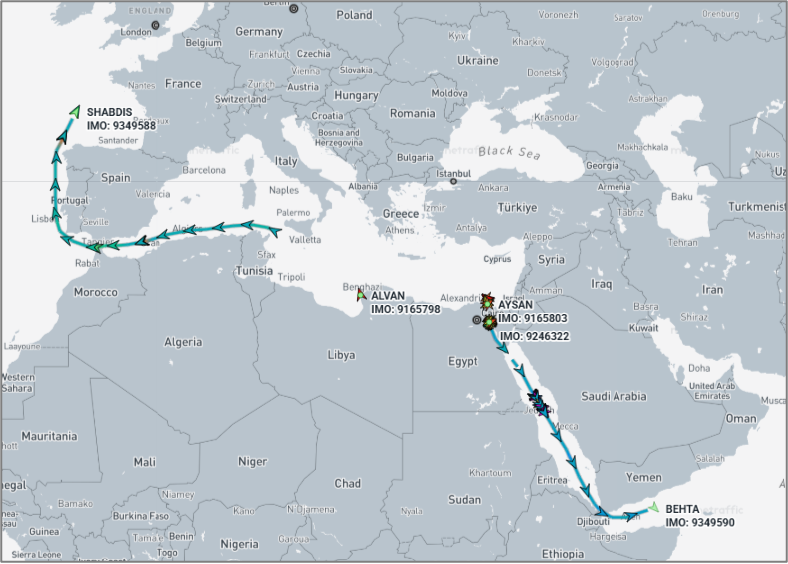
Iran-flagged cargo ships in the Atlantic, Mediterranean and Red Sea on August 13 (Credit: Marine Traffic)
Receive Iran News in Your Inbox.
Eye on Iran is a news summary from United Against Nuclear Iran (UANI), a section 501(c)(3) organization. Eye on Iran is available to subscribers on a daily basis or weekly basis.