March 2026 Iran Tanker Tracker
March 2026 Iran Tanker Tracker: Oil Exports Continue Despite War
On February 28, 2026, the United States launched Operation Epic Fury, in coordination with Israel, severely degrading Iran’s missile and drone capabilities, air force, military-industrial complex, as well as striking at command-and-control bases, nuclear sites and decapitating practically the entire senior leadership echelon of the regime, including Ayatollah Ali Khamenei. U.S. strikes have particularly targeted Iran's naval forces, hitting more than 155 vessels as of early April and eliminating the Islamic Revolutionary Guard Corps (IRGC) Navy Commander Alireza Tangsiri, who had been in charge of attacks on commercial vessels and efforts to prevent vessels from transiting the Strait of Hormuz.
Since mid-March, Iran has enforced a de facto closure of the Strait of Hormuz, the key chokepoint to the Persian Gulf through which 20% of the world’s energy passes. In spite of an announced two-week cessation of hostilities in early April, Iran continues to cut off the Strait to most vessels while operating an alleged “tollbooth” system to others permitted to transit.
Despite the conflict, Iran has continued to export crude, although at nearly half the quantity compared to last month. China still succeeded in importing in excess of one million barrels of Iranian oil per day during last the month.
March 2026 Oil Export Data
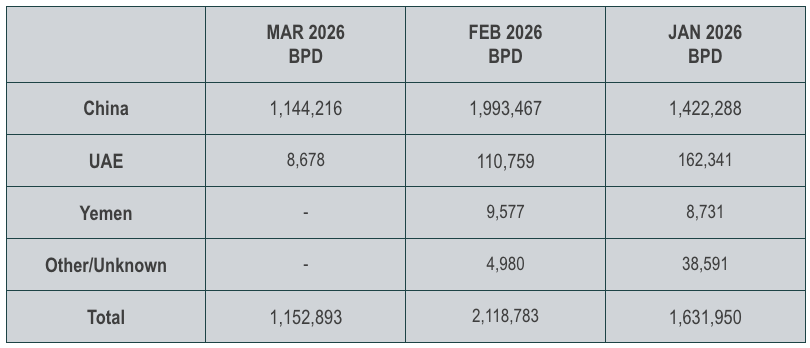
For the month of March 2026, UANI tracked a total of 35.7 million barrels (averaging 1.136 million barrels per day, or BPD) in physical exports out of Iran, a 45% volume drop from February and 29% from January due to wartime disruptions. The estimated value of oil exported in March 2026 is $3.63 billion, down 15% from February. The lower volume reflects operational disruptions of the war, but surging global oil prices mitigated much of the financial impact. Chinese pre-war stockpiling and afloat inventories cushioned the drop in oil exports, while also contributing to the sharp month-to-month differences. So far in 2026, Iran has exported 145.7 million barrels for an estimated value of $11.2 billion.
Nearly all recorded Iranian shipments this month were bound for China. Historically, roughly 10 percent of Iranian oil was re-exported through hubs in the United Arab Emirates, but that secondary trade has now collapsed amid Iran’s missile and drone strikes on Gulf states, including most prominently the UAE.
The Strait of Hormuz: Oil Trade and Shipping During Iran War
The Strait of Hormuz proved a critical flashpoint during Operation Epic Fury, as the regime intensified efforts to disrupt maritime traffic. During March, at least 24 commercial vessels were struck by Iranian forces or proxies. The escalating risk created severe congestion and instability across the Persian Gulf’s shipping lanes. Prior to hostilities, roughly 138 vessels transited the Strait daily; during the war, marine traffic data revealed growing clusters of loitering vessels on both sides, as many held back due to safety concerns.
Numerous OFAC-sanctioned and UANI-listed tankers — alongside some non-sanctioned, ostensibly legitimate vessels — transited the Strait intermittently, switching off AIS signals. They passed between Qeshm and Larak islands — the alleged “Iran Tollbooth”— before continuing, apparently receiving tacit clearance from the regime after security checks and, in some cases, substantial reported payments.
Meanwhile, some tankers and cargo vessels routed through Omani waters, hugging Oman’s coastline. Though far less used than the Iranian passage between Larak and Qeshm, this created parallel transit patterns through the Strait, with slightly higher overall traffic as maritime companies adapted to the volatile security environment.
While the international maritime community has been held hostage by Iran’s effective closure of the Strait of Hormuz, Tehran’s own oil trade has continued unimpeded. Even as regional tensions escalate and commercial vessels come under attack, Iranian-linked tankers keep transiting the Strait — some broadcasting AIS signals, others operating dark.
To read UANI’s statement on the situation regarding the Strait of Hormuz, click here.
Iranian Oil Loadings and Exports During Iran War
Since the onset of the Iran war, UANI has observed ongoing loadings of Iranian crude, fuel oil, and LPG from Kharg Island, Assaluyeh, Mahshahr and Jask.
At least 25 tankers loaded crude oil at Kharg Island—the hub for roughly 90 percent of Iran’s crude exports—this month. The fact that loading continued is noteworthy given U.S. strikes of Kharg’s military targets on March 14, and later, on April 7. The strikes focused solely on military infrastructure and had minimal impact—crude loadings resumed shortly afterward both times. Meanwhile, Israel struck Iran’s oil infrastructure more directly, targeting refineries and export hubs in Mahshahr, Assaluyeh and elsewhere in central Iran.
Malaysian STS Hotspot During Iran War
Almost all of Iran’s oil-laden tankers have again proceeded to the Eastern Outer Port Limits (EOPL) anchorage, roughly 70 kilometres off Malaysia, which remains a major ship-to-ship (STS) transfer hotspot for the ghost fleet. There, Iranian cargoes are offloaded to receiving vessels enroute to Chinese ports. Activity among the ghost fleet — older, falsely-flagged tankers of opaque ownership — remained high, with UANI tracking 43 STS operations involving Iranian oil captured via satellite imagery across March. Despite the Iran war, STS transfer activity continued at record levels in the EOPL.
Sanctions Waiver
On March 20, the U.S. Office of Foreign Assets Control (OFAC) issued General License U, a narrow 30-day waiver (expiring April 19) authorizing transactions for Iranian-origin crude oil and petroleum products already loaded on vessels by that date. The Trump administration framed this limited measure as a market-stabilizing step to alleviate surging global energy prices, aiming to unlock roughly 140 million barrels of previously stranded oil. UANI analysis suggests that this OFAC waiver is both short-term and tightly scoped, and should not be interpreted as broader relief from sanctions pressure on Tehran’s exports. To read UANI’s Statement on the waiver, see here.
U.S. Naval Buildup
The U.S. significantly expanded its naval presence in the Middle East region and the Gulf of Oman, with amphibious-ready groups (ARG) centered on USS Tripoli (LHA-7) and operating alongside two carrier strike groups, USS Gerald R. Ford (CVN-78) and USS Abraham Lincoln (CVN-68). The USS Boxer (LHD-4) ARG also deployed from San Diego and is en route to the region with additional embarked Marines. Supported by Marine Expeditionary Units (MEUs), these forces enable both defensive and offensive missions while placing sustained pressure on the Iranian regime. U.S. military presence will likely be maintained or reduced as needed to encourage negotiations — or scaled up to apply new pressure, if required. The influence of American “seapower” is on full display.
April Ceasefire Announcement
On April 7, President Trump announced a fragile two-week truce with Iran, just 90 minutes before the 8 pm deadline. The ceasefire was mediated through Pakistan, following Tehran's 10-point peace proposal that included commitments to de-escalate regional proxy activities and halt missile tests and is subject to the "complete, immediate, and safe opening" of the Strait of Hormuz, ending its effective wartime closure. There is a 14-day negotiation window — expiring April 21 — allowing both sides to finalize terms, with U.S. military and naval forces remaining deployed as a deterrent.
The ceasefire had an immediate impact on the stock markets and oil prices. Global oil prices dropped 13% after the announcement, with brent crude falling from $105 to $91 per barrel within hours, as traders anticipated restored flows through the world's most critical oil chokepoint.
The ceasefire announcement does not mean commercial shipping will immediately normalize through international traffic lanes in the Strait. Shipowners will await authoritative guidance from naval security channels, flag states, and marine war risk insurers before sending vessels back through. Once early risk-tolerant vessels complete safe passages, confidence will build quickly, drawing more traffic. Still, recovery of global shipping, especially petroleum supply chains, will take time to slowly recover after such a major disruption.
Conclusion
The April ceasefire remains fragile, with a real risk of snapback hostilities — including renewed attacks on commercial shipping and an effective re-closure of the Strait of Hormuz. Meanwhile, Iran appears well positioned to sustain crude exports during regional conflict which underscores Tehran's hardened export infrastructure and ability to maintain 'business as usual' oil flows to China.
In the case of sanctions relief and waivers, oil-importing nations must implement strict ringfencing measures with verifiable financial controls to ensure Iranian oil revenues never reach regime accounts.
Ultimately, UANI calls for sustained sanctions enforcement targeting the full spectrum of Iran's oil trade enablers — from ghost fleet tankers to STS facilitators to Chinese "teapot" refineries — and the permanent dismantling of the IRGC's maritime smuggling infrastructure. By cutting off war funding at its source, Tehran can be denied the resources to sustain missile and drone production as well as its proxy operations across the region.
Receive Iran News in Your Inbox.
Eye on Iran is a news summary from United Against Nuclear Iran (UANI), a section 501(c)(3) organization. Eye on Iran is available to subscribers on a daily basis or weekly basis.