Iran War Shipping Update - April 8, 2026
Since the onset of Operation Epic Fury, UANI has monitored a significant volume of Iranian oil at sea. Illicit Iranian oil sales are a major source of funding for the Islamic Revolutionary Guard Corps (IRGC), which is currently conducting military and terrorist operations targeting the U.S., Israel, Arab states in the Persian Gulf, and international shipping. In the weeks leading up to the conflict, Tehran sharply increased crude loadings and offshore stockpiling to cushion the impact of war on its oil trade. Amid ongoing hostilities, the Iranian regime’s Ghost Fleet continues to operate actively — loading cargo, transiting the Strait of Hormuz, and heading east toward its primary buyer, China. UANI’s regular shipping update will continue to monitor and report on the illicit maritime movements of the Iranian regime’s ghost fleet throughout the conflict.
To read UANI’s advisory urging oil purchasing countries to ensure strict domestic ringfencing of money used in purchase of Iranian oil, click here.
Status of the Strait of Hormuz
On April 7, President Trump announced a two-week ceasefire with Iran. Pakistan mediated the ceasefire following Tehran’s 10-point peace proposal which is subject to the “complete, immediate, and safe opening” of the Strait of Hormuz, effectively ending its wartime closure. Reports suggest, however, that Iran is already blocking vessels attempting to transit the Strait, with Iranian regime media blaming Israeli strikes in Lebanon.
A ceasefire will not immediately normalize shipping through the international traffic lanes in the Strait. Shipowners will await authoritative guidance from naval security channels, flag states, and marine war risk insurers before sending vessels back through. Once early risk-tolerant vessels complete safe passages, confidence will build quickly, drawing more traffic. Still, recovery of global shipping, especially petroleum supply chains, will take time to slowly recover after such a major disruption.
The Strait of Hormuz therefore remains a critical flashpoint in the Iran war. Since the start of the conflict, there have been at least 25 commercial vessels hit, plus four near misses.
The escalating risk has created severe congestion and instability across the Persian Gulf’s shipping lanes. Prior to the outbreak of hostilities, about 138 vessels transited the Strait of Hormuz daily. Since March 1, 2026, marine traffic data shows growing clusters of loitering vessels on both sides of the Strait of Hormuz, with many refraining from transiting due to safety concerns. On April 7, the Joint Maritime Information Center (JMIC) reported that 9 vessels openly transited the Strait of Hormuz.
Numerous OFAC-sanctioned and UANI-listed tankers — alongside some non-sanctioned, ostensibly legitimate vessels — have transited the Strait of Hormuz intermittently switching off their AIS signals. These tankers briefly loiter off Qeshm Island before continuing through the strait, where they appear to receive tacit clearance from the Iranian regime following security checks and, in some cases, reportedly substantial payments.
Meanwhile, some tankers and cargo vessels have transited via Omani waters, hugging Oman’s coastline. Although this route is far less used than the Iranian passage between Larak and Qeshm islands, the result is effectively two parallel transit patterns through the strait, with slightly higher overall traffic as maritime companies adapt to the evolving security environment.
Iranian Oil-Laden Tankers in the Persian Gulf
UANI has identified at least 24 tankers laden with Iranian oil — primarily crude — currently operating inside the Persian Gulf, west of the Strait of Hormuz.
Two floating storage tankers laden with Iranian cargoes in the Persian Gulf are currently transmitting AIS signals — a relatively unusual occurrence for Iranian oil-laden vessels.
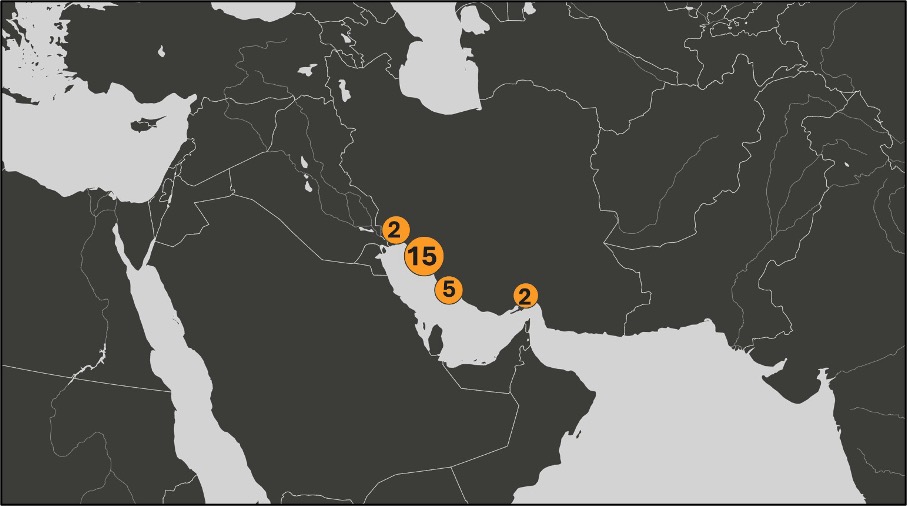
Map of Iranian oil laden tankers in the Persian Gulf on April 8
Iran-linked Vessels at Chabahar Port, Iran
Iran-linked tankers and cargo vessels are loitering and anchoring outside of the Persian Gulf at Chabahar Port, Iran. On April 6, there were at least 15 Iran-flagged tankers all observed by satellite imagery near Chabahar Port laden with Iranian crude.
Number of Iranian Loadings
Since the outbreak of the conflict, UANI has tracked at least 34 Iranian oil loadings, 22 of which originated from Kharg Island, Iran. These shipments represent approximately 44 million barrels of Iranian oil, generating an estimated revenue of over $3.5 billion for the IRGC, which continues to fund Iran’s active missile and drone programs central to the conflict. This figure is notably higher than usual given the sharp increase in oil prices, including Iranian crude.
Iran-oil Laden Tankers That Have Left the Persian Gulf
Since the start of the conflict, UANI has observed at least 32 ghost fleet tankers laden with Iranian oil that have left the Persian Gulf — some broadcasting their AIS signals and others operating clandestinely. These tankers are enroute to Malaysia to conduct ship-to-ship (STS) transfers with other ghost fleet vessels bound for China.
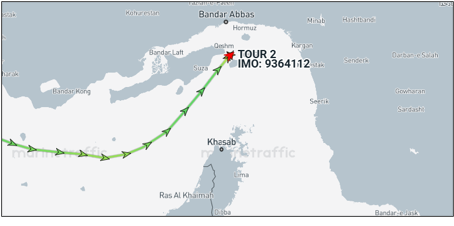
Iranian crude laden tanker passing the Strait of Hormuz broadcasting its AIS on April 8 (Credit: Marine Traffic)
Iran-flagged Tankers Globally
UANI has also monitored Iranian-flagged tankers operating beyond the Persian Gulf. Since the conflict began, at least 23 Iranian-flagged tankers have reached Southeast Asian waters bound for the Eastern Outer Port Limits (EOPL) anchorage off Johor, Malaysia. On April 8, HALTI (IMO 9212890) transited the Malacca Strait likely en route to the EOPL.
Meanwhile, at least 24 Iran-flagged tankers have begun returning and reporting empty to Iran from the Malaysian EOPL anchorage and Southeast Asian sea lanes, since the start of the conflict. On April 8, DORE (IMO 9357717) departed the EOPL reporting empty and transited the Singapore Strait.
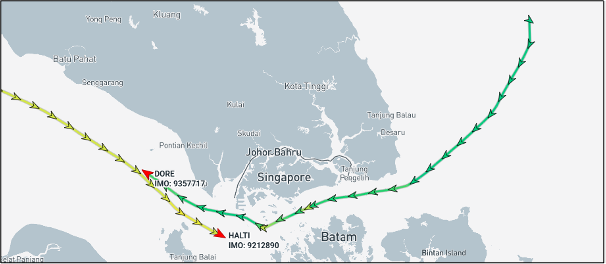
Two Iran flagged tankers transiting Southeast Asian sea lanes on April 8 (Credit: Marine Traffic)
Iran-Oil Laden Tankers off the Malaysian Coast
Since the start of the conflict, UANI has recorded 96 Iranian oil laden tankers in the EOPL anchorage, a ghost fleet hotspot approximately 70 km off Malaysia’s coast. All of these tankers have been spotted in satellite imagery.
On April 8, 37 tankers listed on UANI's Ghost Armada were anchored or loitering in the EOPL area with their AIS signals active. Despite the ongoing conflict, it is business as usual for the Iranian oil trade to China, where ghost fleet tankers continue to operate with impunity across Southeast Asia's sea lanes.
Iran-Flagged Cargo Ships Globally
The Iran flagged container ship BEHNAVAZ (IMO 9346548), sanctioned by OFAC, continued to sail the South China Sea on April 8, en route to Zuhai, China. Zuhai Port in China’s Gaolan Island, not far from Macau, has been identified in press reports, as linked to supplies of sodium perchlorate, a critical precursor for solid rocket fuel used in ballistic missiles. The port has had nine visits by seven OFAC sanctioned Iranian-flagged container ships since the start of the war.
The Iran-flagged bulk cargo ship, ARVIN (IMO 9193202), laden with an unknown cargo, transited the Malacca Strait on April 8. The vessel then stopped — and may have anchored for at least 24 hours — about 35 nautical miles offshore from Medan, Indonesia, for unknown reasons before getting underway again. According to its AIS signal, it is en route to the bulk cargo terminal at Dafeng, China.
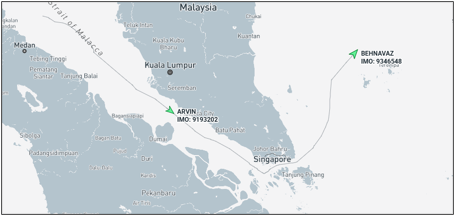
Two Iran flagged cargo vessels transiting the Southeast Asian sea lanes on April 8 (Credit: Marine Traffic)
Receive Iran News in Your Inbox.
Eye on Iran is a news summary from United Against Nuclear Iran (UANI), a section 501(c)(3) organization. Eye on Iran is available to subscribers on a daily basis or weekly basis.