Iran War Shipping Update - May 6, 2026
Since the start of the Iran War on February 28, Iran’s “Ghost Fleet” continues active operations—loading cargo, transiting the Strait of Hormuz, and sailing east toward China—though the U.S. blockade may now be restricting exports. UANI tracking shows ongoing illicit maritime activity. The U.S. blockade targets vessels entering and exiting Iranian ports and those carrying sanctioned or contraband oil, but does not apply to all Iran-linked ships. U.S. forces focus primarily on large VLCC tankers rather than smaller carriers. On May 4, the U.S. launched “Project Freedom,” designed to ensure freedom of navigation for commercial vessels through the Strait despite ongoing IRGC-Navy threats.
The U.S. blockade of Iranian ports targets vessels entering and exiting Iranian ports, as well as vessels carrying contraband and sanctionable oil cargoes. However, the scope of the blockade is not intended to cover all Iran-linked ships. While some of vessels passing the blockade may be transporting Iranian-origin cargoes, the majority are likely not. UANI has observed vessels departing the Persian Gulf carrying oil products from other countries—in some cases, the origin of their cargoes remains unknown. U.S. forces prioritize high-value VLCC tankers over smaller Handymax oil and LPG carriers due to risk-reward calculus. True effectiveness of the blockade lies in disrupting regime oil revenue to China, raising sanctions evasion costs, deterring large shipments, and pressuring Iran to reopen the Strait of Hormuz and accept American demands for a negotiated settlement.
To read UANI’s full statement on the FAQs and keys facts about the U.S. blockade, click here.
U.S. Blockade and Project Freedom
On April 7, President Trump announced a two-week ceasefire with Iran. Pakistan mediated ceasefire talks, which President Trump stated was contingent on the “complete, immediate, and safe opening” of the Strait of Hormuz, effectively ending its wartime closure. However, on April 12, after ceasefire talks with Iran ended without an agreement, President Trump announced that the U.S. would initiate a naval blockade of all Iranian ports and coastal areas effective April 13. U.S. Central Command posted that U.S. forces are “executing the mission to blockade ships entering and departing Iranian ports” on April 14. By blockading vessels calling on Iranian ports, including tankers carrying Iranian oil, the administration aims to cut off the Iranian regime’s major source of revenue. The blockade, now implemented, represents a significant escalation in U.S. enforcement strategy, with implications for global energy markets, regional stability, and the future calibration of U.S. sanctions policy.
President Donald Trump announced on April 21 that he would indefinitely extend the ceasefire until Iran responds to U.S. negotiating positions or until talks reach a dead end. On April 29, he stated he would maintain the naval blockade on Iran until the regime agrees to a deal addressing U.S. concerns about its nuclear program.
On May 4, President Trump announced a new maritime operation called “Project Freedom.” The stated goal is to help escort or “guide” commercial vessels stranded in or near the Strait of Hormuz after escalating conflict and de facto Iranian restrictions on shipping traffic. On May 5, President Trump announced a pause on Project Freedom, pending the outcome of negotiations with Iran.
See the UANI statement on the announcement of Project Freedom.
On May 6, U.S. CENTCOM posted that U.S. forces have directed 52 vessels to turn around or return to an Iranian port since the commencement of the blockade.
U.S. forces operating in the Gulf of Oman enforced blockade measures by disabling the Iranian flagged unladen oil tanker M/T HASNA (IMO 9212917) attempting to sail toward an Iranian port on May 6.
Status of the Strait of Hormuz
The Strait of Hormuz remains a critical flashpoint in the Iran War. Since the start of the conflict, 42 confirmed maritime incidents involving commercial vessels and offshore infrastructure have been reported across the Persian Gulf, Strait of Hormuz, and Gulf of Oman.
The escalating risk has created severe congestion and instability across the Persian Gulf’s shipping lanes. Prior to the outbreak of hostilities, about 138 vessels transited the Strait of Hormuz daily. Since March 1, 2026, marine traffic data shows growing clusters of loitering vessels on both sides of the Strait of Hormuz, with many refraining from transiting due to safety concerns.
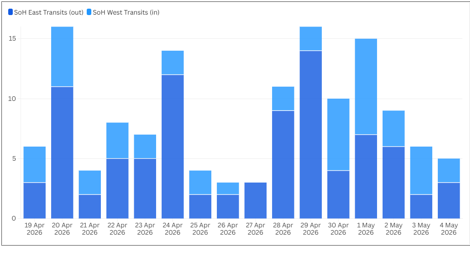
Strait of Hormuz (SoH) transits from April 19 to May 4 (Credit: JMIC)
Iranian Oil-Laden Tankers in the Persian Gulf
UANI has identified at least 40 tankers laden with Iranian oil — primarily crude — currently operating inside the Persian Gulf, west of the Strait of Hormuz.
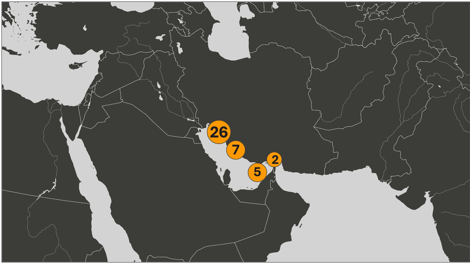
Map of Iranian oil laden tankers in the Persian Gulf on May 6
Iran-linked Vessels at Chabahar Port, Iran
Iran-linked tankers are loitering and anchoring outside of the Persian Gulf at Chabahar Port, Iran. On May 1, 12 Iran-flagged tankers, laden with Iranian oil, were observed in satellite imagery near Chabahar Port. Numerous Iran-flagged and Iranian oil-laden tankers that have attempted to cross the blockade departed from Chabahar Port, with eight of these twelve tankers returning to port in response to a variety of U.S. enforcement actions.
Number of Iranian Loadings
Since the outbreak of the conflict, UANI has tracked at least 69 Iranian oil loadings, 41 of which originated from Kharg Island, Iran. These shipments represent approximately 82 million barrels of Iranian oil, generating an estimated revenue of over $6 billion for the IRGC, which continues to fund Iran’s active missile and drone programs central to the conflict. This figure is notably higher than usual given the sharp increase in oil prices, including Iranian crude.
Satellite imagery from May 6 shows three tankers loading Iranian crude from Kharg Island, with a large oil slick observed to the west. Possible causes include Iran discharging excess oil due to storage limits, facility malfunctions or leaks from nearby tankers. The actual reason remains unconfirmed.
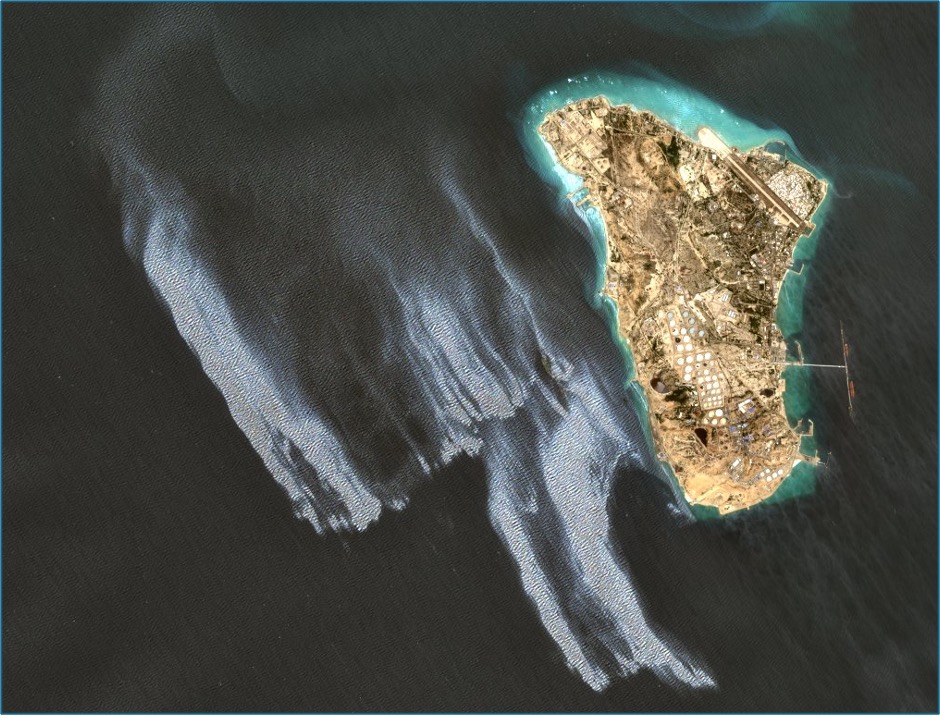
Oil slick west of Kharg Island, while three tankers load Iranian crude on May 6 (Credit: ESA Copernicus)
Iran-oil Laden Tankers That Have Left the Persian Gulf
Since the start of the conflict, UANI has observed at least 52 ghost fleet tankers laden with Iranian oil that have left the Persian Gulf — some broadcasting their AIS signals and others operating clandestinely. These tankers are enroute to Malaysia to conduct ship-to-ship (STS) transfers with other ghost fleet vessels bound for China.
Iran-flagged Tankers Globally
UANI has also monitored Iran-flagged tankers operating beyond the Persian Gulf. Since the conflict began, at least 32 Iran-flagged tankers have reached Southeast Asian waters bound for the Eastern Outer Port Limits (EOPL) anchorage off Johor, Malaysia.
Iran flagged tanker HUGE (IMO 9357183), laden with Iranian crude, transited towards the EOPL on May 6. HUGE had transited the Lombok Strait in Indonesia on May 3 with its AIS signal on. The tanker had previously loaded at Kharg Island on March 31, and departed from Chabahar on April 14, and was spotted near Galle, Sri Lanka on April 23.
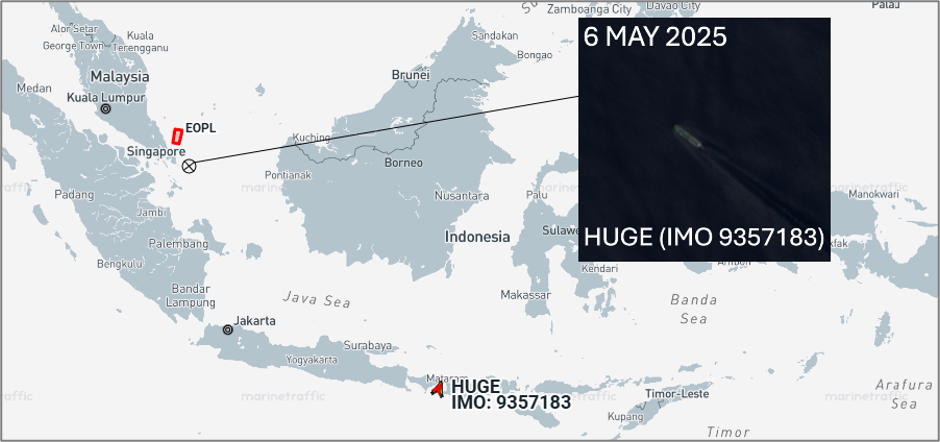
Iranian flagged tanker transiting Southeast Asian sea lanes on May 6 (Credit: Marine Traffic & ESA Copernicus)
On May 4, a second Iranian-flagged tanker, DERYA (9569700), also transited this sensitive strait. DERYA had previously appeared in the Gulf of Kutch, attempting to deliver Iranian oil at Sikka, India but departed on April 19. Both ships briefly broadcast on AIS while transiting the Lombok Strait and were also observed in satellite imagery. This marks a significant new operational pattern. These tankers likely departed Iran, laden with oil bound for China, after the imposition of the US blockade, and likely took an uneconomical route through the Indian Ocean and the Lombok Strait in order to avoid interdiction by US forces. It remains to be seen if DERYA also proceeds to the Malaysian EOPL for STS, or if it sails directly to China to deliver their cargo.
Meanwhile, at least 34 Iran-flagged tankers have begun returning and reporting empty to Iran from the Malaysian EOPL anchorage and Southeast Asian sea lanes, since the start of the conflict.
Iran-Oil Laden Tankers off the Malaysian Coast
From February 28, the start of the conflict, to today, UANI has recorded 130 tankers laden with Iranian oil in the EOPL anchorage, a ghost fleet hotspot approximately 70 km off Malaysia’s coast. All of these tankers have been spotted in satellite imagery.
On May 6, 34 tankers listed on UANI's Ghost Armada were anchored or loitering near the EOPL area with their AIS signals active. At least three STS transfers involving Iranian oil were observed in satellite imagery on May 6, demonstrating that Iranian-flagged and ghost fleet tankers continue to operate with impunity across Southeast Asia's sea lanes.
Iran-Flagged Cargo Ships Globally
On May 6, five Iranian flagged cargo vessels continued to anchor southwest of Karachi, Pakistan. ARIES (IMO 9369722), MAHNAM (IMO 9213387), DELRUBA (IMO 9305207), WARTA (IMO 9465849), and PARNIA (IMO 9167265) were openly broadcasting on AIS, while anchored. All five of these Iran flagged cargo vessels are OFAC sanctioned.
PARNIAarrived, paused for about 10 hours near the other four ships, then maneuvered and anchored about 40km offshore from Karachi, Pakistan. It had previously departed Zanzibar, Tanzania on April 14, then stopped, turned around near Oman on April 22, and then drifted for about 12 days, before sailing toward Pakistan.
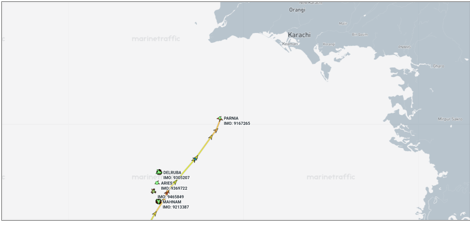
Iran flagged cargo ship heading toward Karachi, Pakistan on May 6 (Credit: Marine Traffic)
The Iran flagged container ship ARTABAZ (IMO 9283007) began sailing northwest again, after a lengthy period of drifting in the Arabian Sea, inside the Indian Exclusive Economic Zone (EEZ), since April 19. ARTABAZ departed Mumbai on April 19, after unknown cargo operations. Its destination is unknown but it likely intending to return to Bandar Abbas.
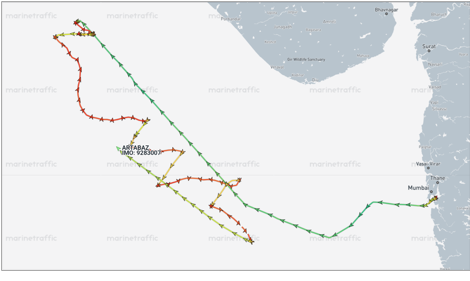
Iran flagged container ship drifting in Arabian Sea on May 6 (Credit: Marine Traffic)
The Iran-flagged, OFAC-sanctioned container ships AZARGOUN (IMO 9283019), AREZOO (IMO 9165786), and RADIN (IMO 9820257), remain anchored outside Port Klang, Malaysia. AREZOO has been anchored here since April 16. AZARGOUN has been anchored since May 1, but today it conducted a short maneuver for unknown reasons. RADIN arrived on May 5, from Zhuhai on Gaolan Island, China, where it departed on April 25, after unknown cargo operations. This pattern of operations matches the recent operations of the TOUSKA (IMO 9328900), which was subsequently seized by US Naval Forces in the Arabian Sea, for attempting to breach the US blockade.
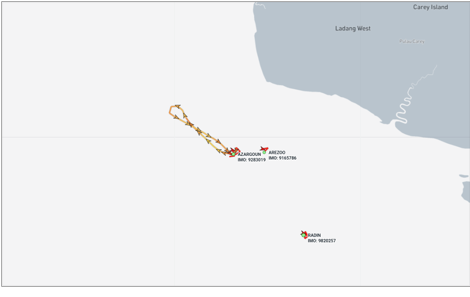
Iran flagged container ships near Port Klang, Malaysia on May 6 (Credit: Marine Traffic)
The Iran-flagged, OFAC-sanctioned bulk cargo ship KIAZAND (IMO 9465758) remained in port Songkhla, Thailand, conducting unknown cargo operations, after arriving on May 3. It previously departed Xiamen, China, on April 26, and departed Bandar Abbas on March 23. The Iran-flagged, OFAC-sanctioned ship WARTA (IMO 9465849) had also previously visited Songkhla March 15-18 and is now anchored with other Iranian-flagged container ships in the Arabian Sea, offshore of Karachi, Pakistan.
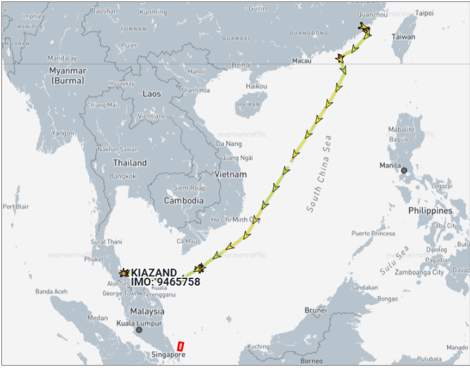
Iran flagged container ship at Songkhla, Thailand, on May 6 (Credit: Marine Traffic)
On May 6, the Iran-flagged bulk cargo ship ARVIN (IMO 9193202) joined the cargo ship MIAMI PRIDE (IMO 9274941), at anchor in the Malaysian Eastern Out of Port Limits (EOPL) anchorage area. ARVIN, currently laden according to its AIS broadcast, departed Dafeng, China on April 26, after unknown cargo operations. Meanwhile, MIAMI PRIDE departed Kuantan Port on May 4, after unknown cargo operations.
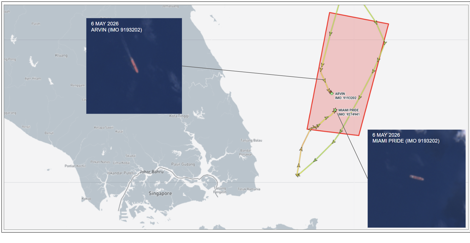
Iran flagged bulk cargo ship at Malaysian EOPL, on May 6 (Credit: Marine Traffic, ESA Copernicus)
The Iran-flagged, OFAC-sanctioned bulk cargo ships OURA (IMO 9387815) and BATIS (IMO 9465760) both remain in port Dafeng, China, conducting unknown cargo operations. OURA arrived in Dafeng terminal on May 4, after departing Bandar Abbas, laden with unknown cargo, on April 9, and transiting the Singapore Strait on April 23. BATIS, also laden, arrived at the anchorage near Dafeng on May 4, after departing Bandar Abbas on April 3, and transiting the Singapore Strait on April 21. Both ships appeared to pause near Galle, Sri Lanka for brief logistics support: BATIS on April 13, and OURA on April 17. OURA, which departed Iran after BATIS, overtook BATIS north of Taiwan in the East China Sea on May 1.
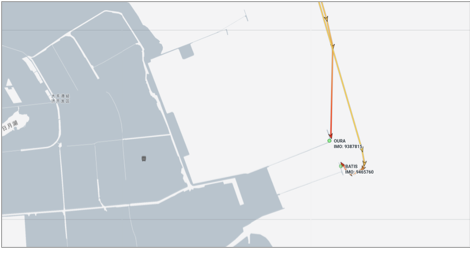
Iran flagged container ships near Dafeng, China, on May 6 (Credit: Marine Traffic)
Receive Iran News in Your Inbox.
Eye on Iran is a news summary from United Against Nuclear Iran (UANI), a section 501(c)(3) organization. Eye on Iran is available to subscribers on a daily basis or weekly basis.