Iran War Shipping Update - April 14, 2026
U.S. Blockade
On April 7, President Trump announced a two-week ceasefire with Iran. Pakistan mediated ceasefire talks following Tehran’s 10-point peace proposal, which President Trump stated was contingent on the “complete, immediate, and safe opening” of the Strait of Hormuz, effectively ending its wartime closure. However, on April 12, after ceasefire talks with Iran ended without an agreement, President Trump announced that the U.S. would initiate a naval blockade of all Iranian ports and coastal areas effective April 13. By blockading vessels calling on Iranian ports, including tankers carrying Iranian oil, the administration aims to cut off the Iranian regime’s major source of revenue. The blockade, now implemented, represents a significant escalation in U.S. enforcement strategy, with implications for global energy markets, regional stability, and the future calibration of American sanctions policy.
UANI has observed 15 transits of the Strait of Hormuz, seven inbound and eight outbound, since the U.S. initiated its naval blockade.
On April 14, U.S. Central Command reported that no ships from Iranian ports made it past the blockade, with 6 merchant vessels complying with the direction from U.S. forces to turn around.
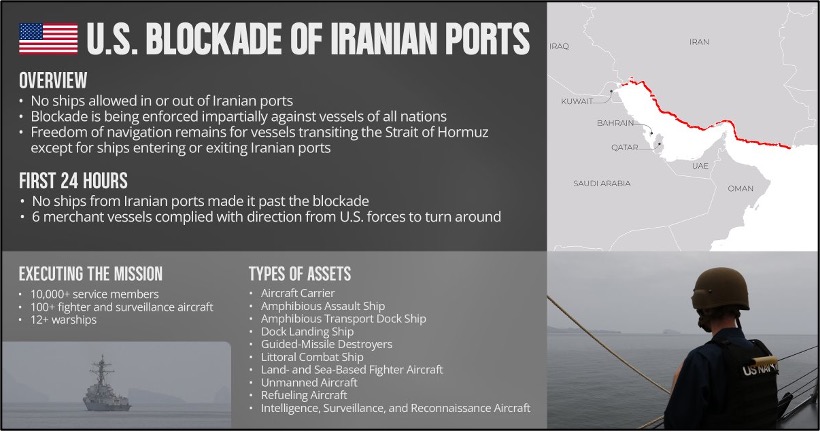
U.S. Central Command published this U.S. blockade update on April 14
(Credit: U.S. Central Command/X)
UANI has observed at least four vessels turn back toward the Persian Gulf for unconfirmed reasons on April 14. These vessels appear to be reporting their location on AIS, though GPS jamming and potential spoofing makes confirmation difficult.
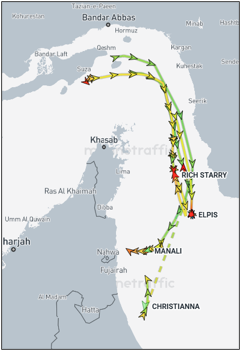
Four vessels turning back towards the Persian Gulf for unconfirmed reasons on April 14
(Credit: Marine Traffic)
The tanker RACE (IMO 9387140) — also reportedly attempting to transit the Strait of Hormuz — is a known dead vessel. This may indicate a zombie tanker using RACE's identity to transit the strait and bypass the U.S. blockade. According to its AIS, which it has now turned off, the tanker is destined for the Indian port Pipavav.
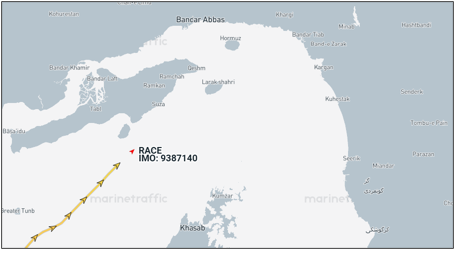
Tanker transiting the Strait of Hormuz on April 14 (Credit: Marine Traffic)
Status of the Strait of Hormuz
The Strait of Hormuz therefore remains a critical flashpoint in the Iran war. Since the start of the conflict, there have been at least 25 commercial vessels hit, plus four near misses.
The escalating risk has created severe congestion and instability across the Persian Gulf’s shipping lanes. Prior to the outbreak of hostilities, about 138 vessels transited the Strait of Hormuz daily. Since March 1, 2026, marine traffic data shows growing clusters of loitering vessels on both sides of the Strait of Hormuz, with many refraining from transiting due to safety concerns.
On April 8, an unconfirmed map issued by the Islamic Revolutionary Guard Corps (IRGC) outlined a proposed Hormuz traffic separation scheme requiring vessels to coordinate with the IRGC Navy. The latest purported guidance from Iran also warns of anti-ship mines in the main traffic lane, while the IRGC continues to vet traffic based on geopolitical affiliation.
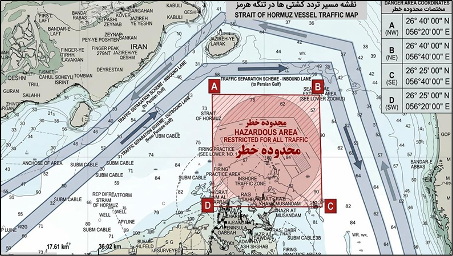
Iran’s formal notice of the Strait of Hormuz transit routes published on April 8
(Source: Iran’s National Security Commission)
OFAC-sanctioned and UANI-listed tankers — alongside some non-sanctioned, ostensibly legitimate vessels — have transited the Strait of Hormuz intermittently switching off their AIS signals. Many have passed the waterway between Larak and Qeshm islands before continuing through the strait, while a handful of others sailed via Omani waters along Oman’s coastline, creating two parallel transit patterns as shipping adapted to the evolving security environment. So far, there have been no openly transiting vessels through international shipping lanes since the conflict began, raising real questions of when usual patterns will resume as the fragile ceasefire holds.
Numerous vessels that have a history of transporting non-Iranian cargoes from the Persian Gulf are now diverting due to heightened security risks and shipping disruptions in the Strait of Hormuz from the Iran war, causing many to seek alternative cargoes in U.S. ports, such as Galveston.
Iranian Oil-Laden Tankers in the Persian Gulf
UANI has identified at least 34 tankers laden with Iranian oil — primarily crude — currently operating inside the Persian Gulf, west of the Strait of Hormuz.
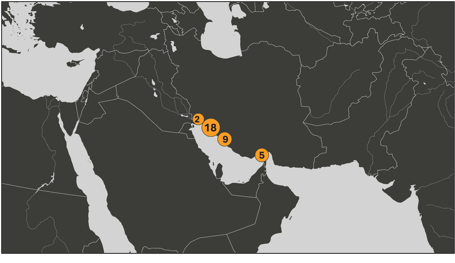
Map of Iranian oil laden tankers in the Persian Gulf on April 14
OFAC-sanctioned and UANI-listed tankers — alongside some non-sanctioned, ostensibly legitimate vessels — have transited the Strait of Hormuz intermittently switching off their AIS signals. Many have passed the waterway between Larak and Qeshm islands before continuing through the strait, while a handful of others sailed via Omani waters along Oman’s coastline, creating two parallel transit patterns as shipping adapted to the evolving security environment. So far, there have been no openly transiting vessels through international shipping lanes since the conflict began, raising real questions of when usual patterns will resume as the fragile ceasefire holds.
Numerous vessels that have a history of transporting non-Iranian cargoes from the Persian Gulf are now diverting due to heightened security risks and shipping disruptions in the Strait of Hormuz from the Iran war, causing many to seek alternative cargoes in U.S. ports, such as Galveston.
Iranian Oil-Laden Tankers in the Persian Gulf
UANI has identified at least 34 tankers laden with Iranian oil — primarily crude — currently operating inside the Persian Gulf, west of the Strait of Hormuz.
Iran-linked Vessels at Chabahar Port, Iran
Iran-linked tankers and cargo vessels are loitering and anchoring outside of the Persian Gulf at Chabahar Port, Iran. On April 11, there were at least 12 Iran-flagged tankers and 10 cargo ships all observed by satellite imagery near Chabahar Port laden with Iranian crude.
Number of Iranian Loadings
Since the outbreak of the conflict, UANI has tracked at least 45 Iranian oil loadings, 26 of which originated from Kharg Island, Iran. These shipments represent approximately 55 million barrels of Iranian oil, generating an estimated revenue of over $4.5 billion for the IRGC, which continues to fund Iran’s active missile and drone programs central to the conflict. This figure is notably higher than usual given the sharp increase in oil prices, including Iranian crude.
Iran-oil Laden Tankers That Have Left the Persian Gulf
Since the start of the conflict, UANI has observed at least 37 ghost fleet tankers laden with Iranian oil that have left the Persian Gulf — some broadcasting their AIS signals and others operating clandestinely. These tankers are enroute to Malaysia to conduct ship-to-ship (STS) transfers with other ghost fleet vessels bound for China.
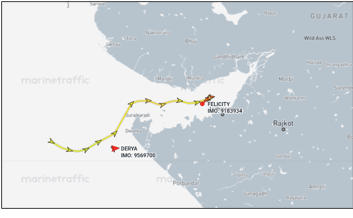
Iran flagged tankers near Gujarat, India, on April 14 (Credit: Marine Traffic)
The Iran-flagged tanker DERYA (IMO 9569700) appeared on AIS in Indian territorial waters, near Jamnagar, India on April 14, openly broadcasting AIS. It is reporting that it is laden with a deep draft of 20 meters. The Iran-flagged tanker FELICITY (IMO 9183934) remains anchored at Jamnagar, India on April 14, also openly broadcasting AIS, after arriving on April 12.
Iran-flagged Tankers Globally
UANI has also monitored Iranian-flagged tankers operating beyond the Persian Gulf. Since the conflict began, at least 23 Iranian-flagged tankers have reached Southeast Asian waters bound for the Eastern Outer Port Limits (EOPL) anchorage off Johor, Malaysia. The Iran-flagged tanker TOUR 2 (9364112) openly sailed in the Western Indian Ocean with AIS on, transiting through the Indian Laccadive Sea on April 14, and is estimated to reach the Malaysian EOPL anchorage on May 5. On April 14, the Iran-flagged tanker DAN (IMO 9357729), laden with Iranian Crude Oil from Kharg Island, transited the Malacca Strait eastbound. It is estimated to arrive at the Malaysian EOPL on April 16, where it will then conduct a clandestine Ship-to-Ship (STS) transfer to another tanker bound for China.
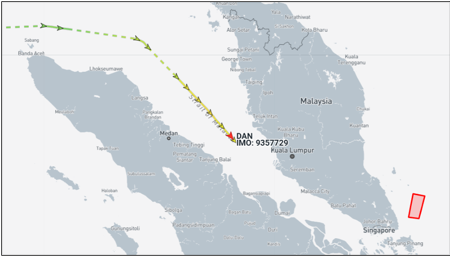
Iran flagged tanker transiting the Malacca Strait, on April 14 (Credit: Marine Traffic)
Meanwhile, at least 30 Iran-flagged tankers have begun returning and reporting empty to Iran from the Malaysian EOPL anchorage and Southeast Asian sea lanes, since the start of the conflict.
Iran-Oil Laden Tankers off the Malaysian Coast
Since the start of the conflict, UANI has recorded 103 Iranian oil laden tankers in the EOPL anchorage, a ghost fleet hotspot approximately 70 km off Malaysia’s coast. All of these tankers have been spotted in satellite imagery.
On April 14, 26 tankers listed on UANI's Ghost Armada were anchored or loitering in the EOPL area with their AIS signals active. Despite the ongoing conflict, it is business as usual for the Iranian oil trade to China, where ghost fleet tankers continue to operate with impunity across Southeast Asia's sea lanes.
Iran-Flagged Cargo Ships Globally
Two Iran flagged OFAC-sanctioned container ships BEHNAVAZ (IMO 9346548) and BETHA (IMO 9349590) remain at the anchorage outside Zuhai, China. Zuhai Port in China’s Gaolan Island, has been identified in press reports, as linked to supplies of sodium perchlorate, a critical precursor for solid rocket fuel used in ballistic missiles. The port has had nine visits by seven OFAC sanctioned Iranian-flagged container ships since the start of the war.
Two Iran flagged container ships at anchor near Zuhai, China, on April 14 (Credit: Marine Traffic)
The Iran-flagged bulk cargo ship WARTA (IMO 9465849), laden with an unknown cargo, continued to transit in the Gulf of Thailand, now in the Malaysian Exclusive Economic Zone (EEZ), after departing the anchorage near Sri Racha, Thailand on April 12. According to its AIS signal, its destination is Bandar Imam Khomeini (BIK), Iran, with an estimated arrival time of May 3.
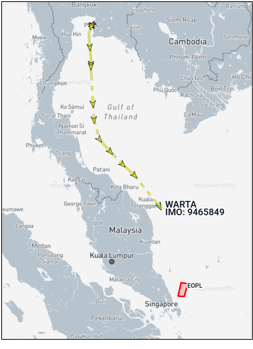
Iran flagged bulk carrier transiting the Gulf of Thailand, April 12-14 (Credit: Marine Traffic)
The Iran-flagged container ship ARTENOS (IMO 9283021), laden with an unknown cargo, departed Mumbai, India on April 14, after one day of unknown operations. Like all Iran Shipping Lines (IRISL) containers ships, ARTENOSis sanctioned by US OFAC.
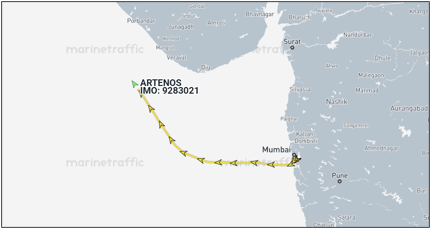
Iran flagged container ship departing Mumbai, India, April 14 (Credit: Marine Traffic)
Receive Iran News in Your Inbox.
Eye on Iran is a news summary from United Against Nuclear Iran (UANI), a section 501(c)(3) organization. Eye on Iran is available to subscribers on a daily basis or weekly basis.