Iran Shipping Update – August 21, 2026
President Trump has announced an unprecedentedly sweeping “Economic D-Day” operation against the Iranian regime. The security situation in the Strait of Hormuz remains highly volatile. Iran continues to target commercial shipping and Gulf States, while Tehran’s Yemeni Houthi partners continue to threaten an expansion of the maritime conflict into the Red Sea.
U.S. Blockade and Sanctions
On July 14, U.S. forces reimposed the blockade against vessels transiting to or from Iranian ports and coastal areas while supporting compliant traffic in regional waters. As of August 20, U.S. forces have redirected 67 commercial vessels trying to run the blockade, disabled three that didn't comply, and boarded two to ensure total compliance.
President Trump announced on Wednesday a new economic pressure campaign against the Iranian regime, with U.S. Treasury Secretary Scott Bessent emphasizing that it is meant to collapse the regime. The language is sweeping in its reach.
Secretary Bessent also warned countries with ties to Iran, which should concern countries in South and Southeast Asia, as well as China, where Iranian-flagged and Iranian-linked ships routinely sail, anchor, visit ports, and conduct cargo operations with impunity.
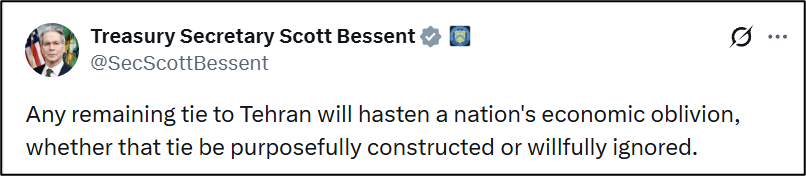
There will be a press conference by the treasury secretary on Monday, August 24, which will likely feature more OFAC actions and other measures announced.
Houthi Blockade
On July 20, Yemen’s Iran-backed Houthis declared a naval blockade against Saudi Arabian ports.
On August 17, a cargo vessel was targeted and struck by multiple unknown projectiles roughly 40 nautical miles southeast of Al Mukha, Yemen. While no crew members were aboard during the strike, local authorities report that the extensive damage sustained has resulted in the ship being declared a total constructive loss.
Houthi threats and attacks against Saudi-linked shipping are already prompting some tankers, but not all, to reroute in the Red Sea. Rising insecurity in the Red Sea has caused an initial drop in tanker transits through Bab el-Mandeb since the Houthis declared their blockade, but transits have been slowly rising over the past week, according to data published by Joint Maritime Information Center (JMIC). Numerous tankers have been observed broadcasting “CHINESE OWNER” or “ARMED GUARD ON BOARD” as their destination during the transit of the Bab el-Mandeb, likely to help prevent being targeted.
In addition, the Houthis are reportedly considering charging most vessels to cross Bab el-Mandeb, with Chinese-flagged ships exempted under a separate safe-passage understanding already in place.
Status of the Strait of Hormuz
Since the start of the Iran War, 70 maritime incidents involving commercial vessels have been reported across the Persian Gulf, Strait of Hormuz, and Gulf of Oman.
The two latest maritime incidents on August 18, immediately following the expiration of the MoU, were Iranian attacks on two separate vessels in the Strait of Hormuz. The attacks resulted in one seafarer casualty, bringing the total number of seafarer casualties to 19, according to the International Maritime Organization.
Prior to the outbreak of the Iran War, about 138 vessels transited the Strait of Hormuz daily. Throughout the conflict, marine traffic data showed large clusters of loitering vessels on both sides of the Strait of Hormuz, with many ships refraining from transiting due to safety concerns. After the signing of the MoU, the JMIC reported an increase in open transits through the Strait of Hormuz. On June 24, JMIC recorded 54 transits, the highest daily total since the outbreak of the conflict. As of August 19, JMIC has reported a total of 818 vessels transiting the Strait of Hormuz since the date of the signing of the MoU.
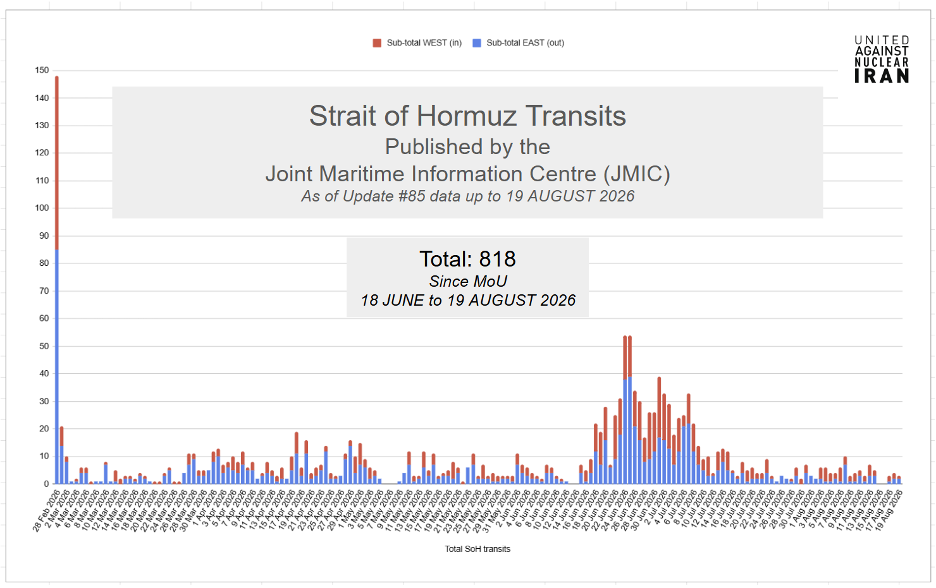
Open transits of commercial vessels through the southern corridor of the Strait of Hormuz declined following the IRGC strikes on commercial shipping starting July 7 but have not ceased entirely. Since the strikes, the traffic has been dominated by Iranian- and Chinese-linked vessels transiting via the northern corridor. Over the past week, an increasing number of vessels have transited the southern corridor without broadcasting AIS location data, with many of these movements facilitated by U.S. forces.
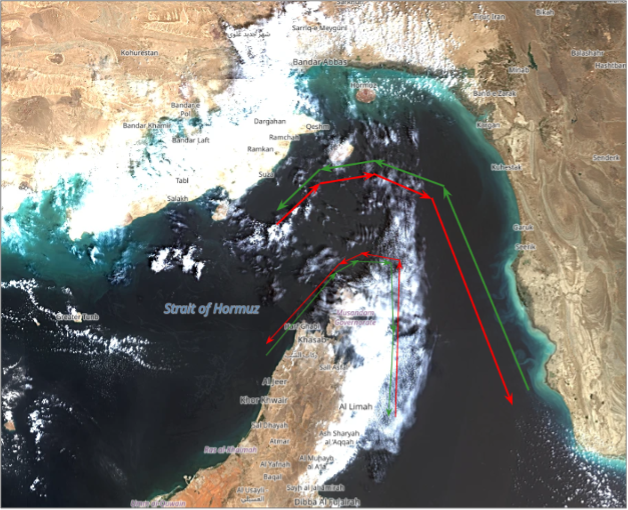
Strait of Hormuz corridors on August 20 (Credit: ESA Copernicus)
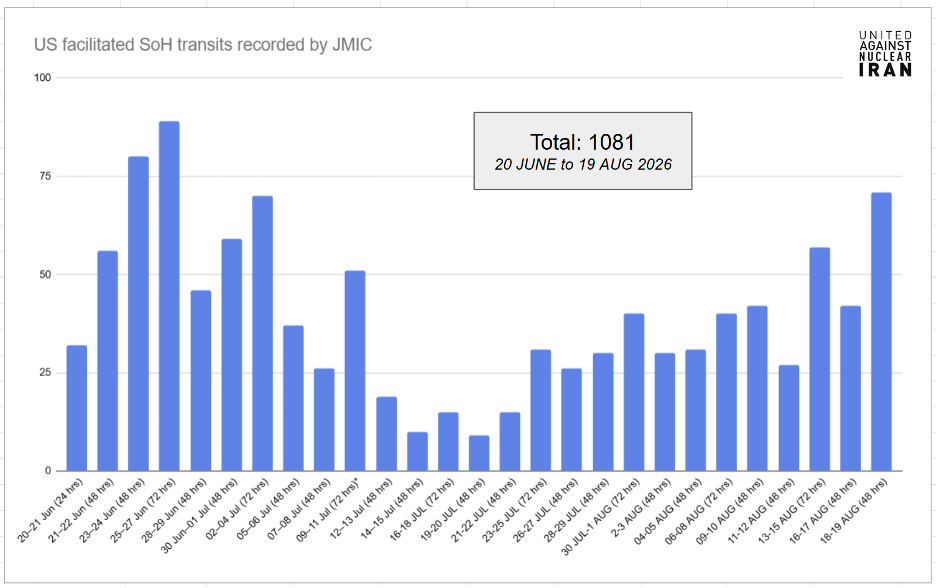
JMIC reported 71 "U.S. facilitated" transits over the 48-hour period of August 18–19, for a total of 1081 facilitated transits since June 20. Over the last month (July 19–August 19), these facilitated transits increased from ~4.5 per day to ~35.5 per day.
Iranian Oil-Laden Tankers Departing the Gulf of Oman
Since the announcement of the MoU on June 14, UANI has tracked 67 tankers departing the Gulf of Oman laden with Iranian oil and petrochemicals. These exports represent approximately 80 million barrels of Iranian oil, generating estimated revenue of over $6 billion for the IRGC, which continues to fund Iran’s missile and drone programs. The pricing and volumes associated with Chinese purchases of Iranian crude are not publicly disclosed, though such cargoes are widely assessed to be sold at a discount of around 10 to 12 dollars per barrel.
Tankers laden with Iranian oil and petrochemicals are currently clustering in anchorages along the Iranian coastline due to the U.S. blockade on Iranian ports. Since the reinstatement of the blockade, around only five handymax-size tankers carrying Iranian LPG have successfully passed the blockade line. However, UANI has not tracked any tanker laden with Iranian crude oil that has successfully departed the Gulf of Oman and avoided enforcement actions by U.S. forces since July 12, before the blockade was reinstated.
Iranian Oil-Laden Tankers
UANI has identified at least 51 tankers laden with Iranian oil—primarily crude, but also other petroleum products and LPG—currently operating along the Iranian coastline.
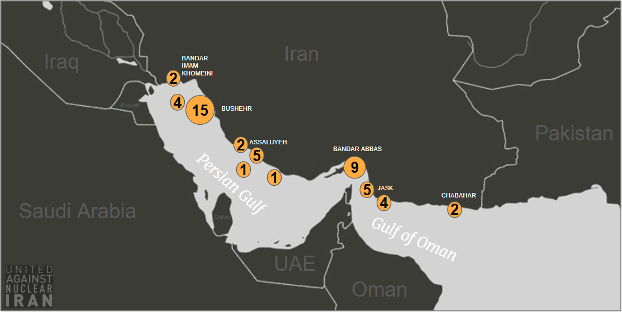
Positions of tankers laden with Iranian oil on August 21 (Credit: UANI)
Number of Iranian Loadings
Since the signing of the U.S.–Iran MoU on June 17, UANI has tracked at least 43 Iranian oil and petrochemical loadings, 14 of which originated from Kharg Island, Iran.
Iran-flagged Tankers Globally
UANI has also monitored Iran-flagged tankers operating beyond the Persian Gulf. Since the signing of the now-expired MoU, 26 Iran-flagged tankers have reached the Singapore Strait bound for the EOPL anchorage off Johor, Malaysia. All these Iranian tankers are expected to conduct STS transfers in the EOPL.
There are 7 Iran-flagged tankers currently in the EOPL: HUMANITY (IMO 9180281), STARLA (IMO 9569621), HILDA I (IMO 9357389), DAN (IMO 9357729), HAPPINESS I (IMO 9212905), HEDY (IMO 9212888) and DORENA (IMO 9569669). They have all previously passed the Singapore Strait and have since stopped broadcasting their location on AIS.
DREAM II (IMO 9356593), STREAM (IMO 9569633), HALTI (IMO 9212890), SEA CLIFF (IMO 9569657), HERO II (IMO 9362073), SILVIA I (IMO 9172052), SNOW (IMO 9569619), HELM (IMO 9357391), DUNE (IMO 9569712), DEEP SEA (IMO 9218492), DIAMOND II (IMO 9218478), DINO 1 (IMO 9569671), SONIA I (IMO 9357365), DORE (IMO 9357717), HERBY (IMO 9362059), SEVIN (IMO 9357353), FELICITY (IMO 9183934), HENNA (IMO 9212929), AMBER (IMO 9357406) and DIONA (IMO 9569695) have all departed the EOPL in ballast after completing STS transfers.
SEA CLIFF has been loitering in ballast in the EOPL for over two months after conducting an STS transfer in early May. STARLA also left the EOPL empty, conducted another STS with the Iran-flagged tanker DEEP SEA in the Malacca Strait, and has since returned to the EOPL laden with Iranian crude, bringing the total to 17 Iran-flagged tankers that have departed the EOPL empty since the signing of the MoU.
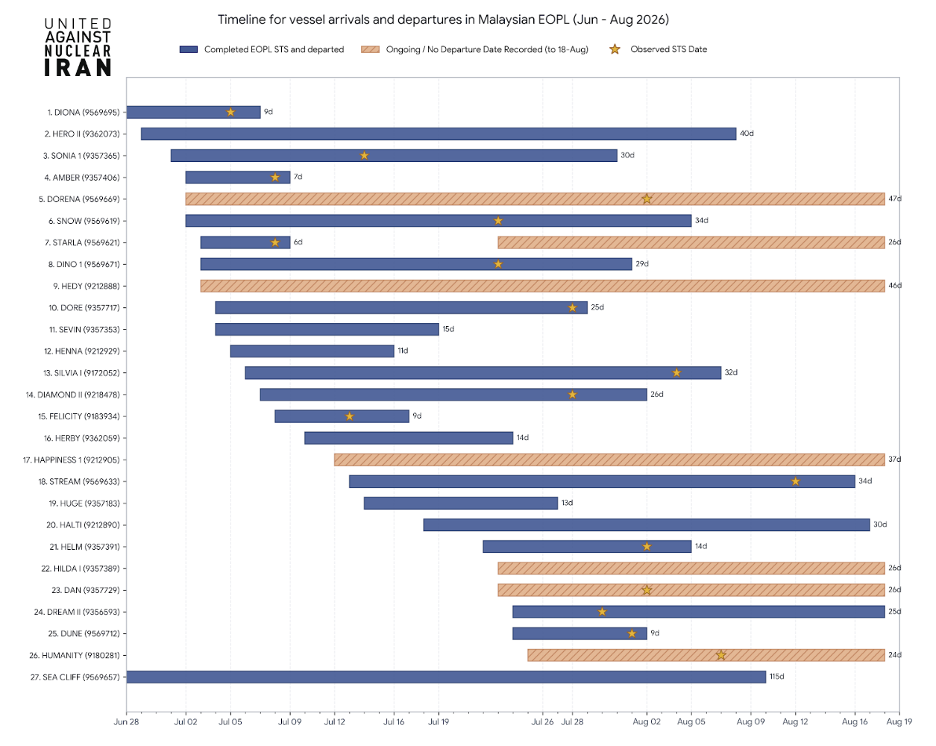
Iran-flagged HUGE (IMO 9357183) has also departed the EOPL anchorage. This tanker had been loitering unladen in the EOPL anchorage for over two weeks after conducting an STS transfer of Iranian crude south of Hong Kong in the South China Sea on July 9. It is now at Galle anchorage with the other Iran-flagged tankers in ballast.
These departing Iran-flagged tankers are now heading to anchorages across the Indo-Pacific rather than back to Iranian ports because of the U.S. blockade. DIONA is loitering offshore Duqm, Oman, while 18 empty Iran-flagged tankers are currently anchored of Galle, Sri Lanka. Namely, HERO II, SILVIA I, SEA CLIFF, SNOW, HELM, DIAMOND II, DEEP SEA, DUNE, DINO I, SONIA I, HERBY, SEVIN, AMBER, HENNA, FELICITY, HUGE and DORE. Today, STREAM arrived and anchored with the others.
On August 21, at least 48 tankers listed on UANI's Ghost Armada were anchored or loitering near the EOPL area with their AIS signals active, demonstrating that Ghost Fleet tankers continue to operate with impunity across Southeast Asia's sea lanes.
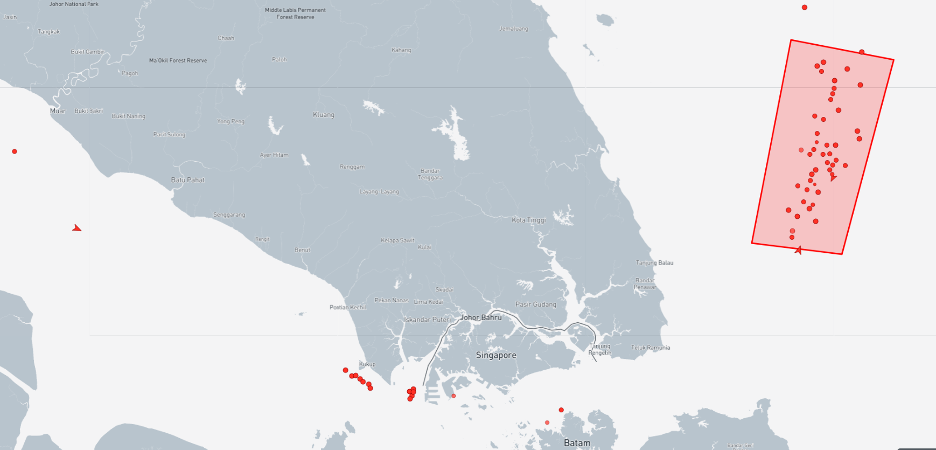
UANI Ghost Armada tankers broadcasting on AIS in EOPL on August 21 (Credit: Marine Traffic)
Iran-Flagged Cargo Ships Globally
Despite ongoing pressure of U.S. OFAC sanctions, and new constraints of the U.S. blockade on Iranian ports, approximately 50 Iranian flagged cargo ships continue to operate openly across sea lanes, ports, and anchorages throughout the Indo-Pacific region, the Red Sea, the Mediterranean, and the Atlantic Ocean.
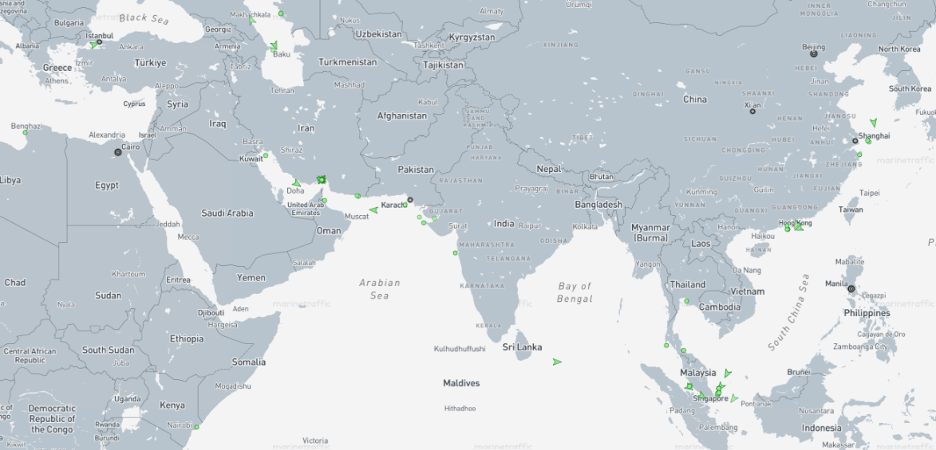
Iran-flagged cargo vessels across the region on August 21 (Credit: Marine Traffic)
In the Gulf of Oman, the OFAC-sanctioned and falsely-flagged container ship RAMA 3 (IMO 9303754) stopped loitering and began to sail west toward the U.S. blockade line. RAMA 3 had likely conducted a dark rendezvous—and a potential MMSI number swap—with the Liberia-flagged container ship YES (IMO 9307009), also known as the YOGI. RAMA 3's last port visit was to the port of Zhuhai, China in late July. RAMA 3 was in port next to the Iranian-flagged cargo ship HOUMUNA (IMO 9820271) for possible transhipment operations on July 28-29. It is possible that U.S. naval forces may attempt to stop and inspect RAMA 3 for designated contraband cargo.
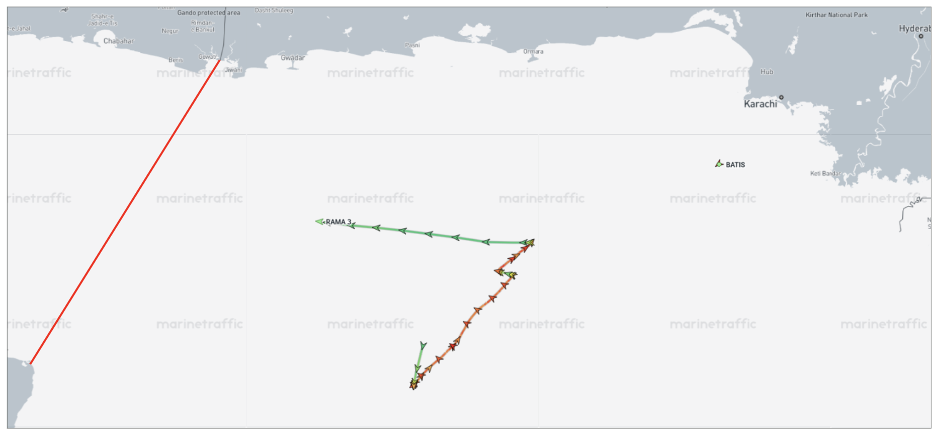
Iran-linked cargo ship RAMA 3, in the Gulf of Oman on August 21 (Credit: Marine Traffic)
In the Karachi OPL anchorage, the laden bulk carrier BATIS (IMO 9465760) continued to loiter at anchor. BATIS will likely continue loitering in the Karachi OPL due to the U.S. Blockade.
In the Gulf of Kutch, the container ship VELON 1 (IMO 9122473) remained anchored near Kandla. VELON 1 is broadcasting on AIS under different flags, although listed in the official IMO GISIS database as registered under the Iranian flag. Meanwhile, ARTMAN (IMO 9405930) and ARTAM (IMO 9284154) both continued to anchor outside the entrance of the Gulf of Kutch. The container ship SHAMIM (IMO 9270658) remained anchored outside of Mumbai. The container ship FLORA (IMO 9349576) continued demonstrating unusual manoeuvres, and while sailing west in the Arabian Sea, but turned around today and headed back toward Mumbai, which was its stated destination on AIS since it appeared on AIS in the Bay of Bengal on August 14.
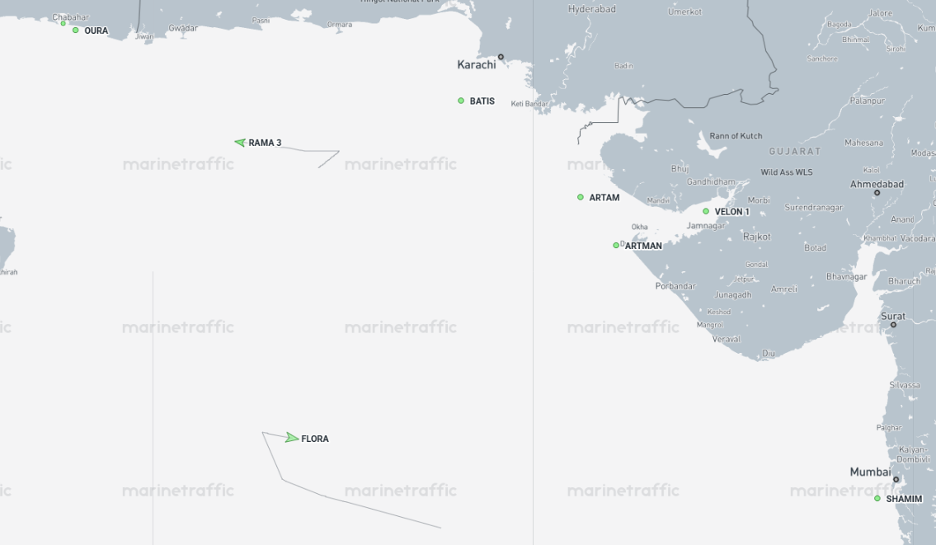
Iran-flagged cargo ships in the Gulf of Oman, in the Gulf of Kutch, and near Mumbai on August 21
(Credit: Marine Traffic)
In the Laccadive Sea along the west coast of India, the container ship ZYRA (IMO 9237084) sailed north to its destination at Mumbai. Although on AIS, it is now claiming to be Comoros flag, it had recently changed its MMSI number while in transit, and according to IMO GISIS database, it is officially registered under the Iranian flag.
The container ship NYRA 2 (IMO 9241487) departed the anchorage near Galle, Sri Lanka, and sailed east in the Bay of Bengal toward the Malacca Strait and its destination at the Malaysian EOPL.
The container ship DAISY (IMO 9270684) continued to sail across the Bay of Bengal to the northeast, on its way to its next destination at Chennai, India. Its signal is not received on AIS, but it is expected to reappear when it reaches the vicinity of Chennai, on about August 23.
At Port Klang, Malaysia, the container ship ARTABAZ (IMO 9283007) pulled into the Westports Holdings container terminal today for cargo operations. The container ship VIRA 1 (IMO 9088524), continued to loiter at the anchorage. The container ship SHIBA (IMO 9270646) departed the anchorage today and sailed south in the Malacca Strait to its destination at the Malaysian EOPL.
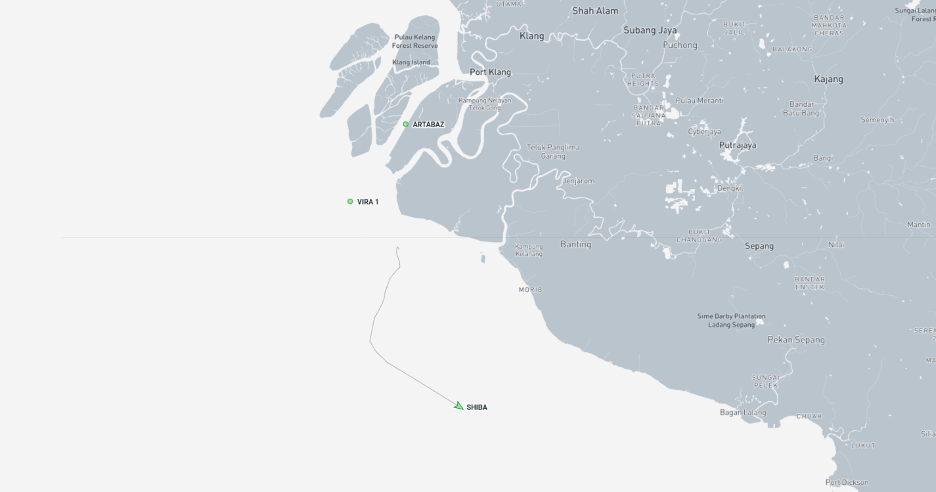
Iran-flagged cargo ships at Port Klang on August 21 (Credit: Marine Traffic)
The container ship BEHTA (IMO 9349590) continued sailing south in the Malacca Strait, on its way to Shanghai, China from its previous port visit at Bronka, Russia in the Baltic. It may stop in the Malaysian EOPL after transiting the Singapore Strait.
At the Malaysian EOPL, 11 cargo ships loitered in and near the EOPL. Just north of the EOPL, the bulk carrier ARTIN (IMO 9305221) arrived and joined four other ships anchored there: ANDIA (IMO 9193197), GOLAFRUZ (IMO 9323833), GANJ (IMO 9305219) and BEHDOKHT (IMO 9405978). Meanwhile, in the EOPL, the bulk carrier BAHJAT (IMO 9405954) repositioned and anchored inside the EOPL with the other five cargo ships that continued to loiter there: the bulk cargo ship AMINA (IMO 9305192), general cargo ship PARNIA (IMO 9167265) and three container ships BASHT (IMO 9346536), ARZIN (IMO 9284142) and HAMOUNA (IMO 9820271). All these ships will likely remain in the EOPL while the U.S. blockade is still in force, receiving occasional logistics support, despite the risk of secondary sanctions from U.S. Treasury OFAC.
Meanwhile, the general cargo ship AREZOO (IMO 9165786) continued sailing south not far from the EOPL, toward the Java Sea on the way to its next destination at Surabaya, Indonesia.
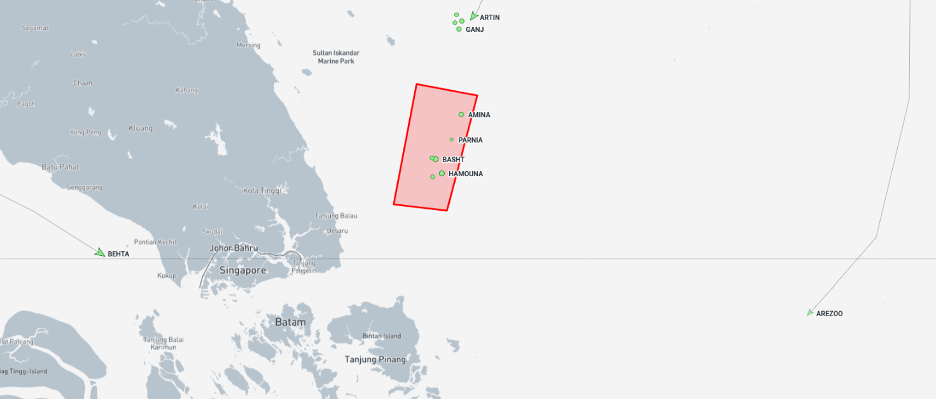
Iran-flagged cargo ships near the EOPL on August 21 (Credit: Marine Traffic)
The container ship ARIES (IMO 9369722) continued to transit south in the South China Sea and will likely arrive and stop at the Malaysian EOPL tomorrow.
Three Iranian cargo ships were in three different ports across Thailand. The bulk cargo ship ARDAVAN (IMO 9465863)remained at Laem Chabang, Thailand, moored at the Siam Commercial Sea Port. The bulk cargo ship PARISAN (IMO 9465851) continued to moor at Songkhla Port, Thailand. And the bulk carrier DELNAVAZ (IMO 9387803) remained in port at the Phuket Deep Sea Port, Thailand. All of these ships are sanctioned by OFAC and the port operators risk facing secondary sanctions. The ship agent for PARISAN in Songkhla, Sapid Shipping Co, is itself sanctioned by OFAC, as a subsidiary of Islamic Republic of Iran Shipping Lines (IRISL). IRISL was also sanctioned by the United Nations Security Council (UNSC), under Resolution 1929 (2010), for nuclear proliferation and arms smuggling.
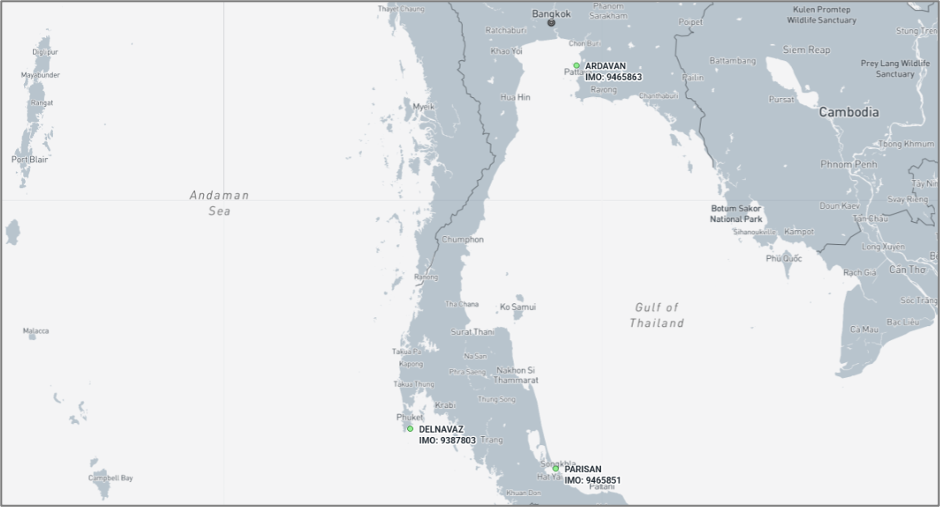
Iran-flagged cargo ships in Thai ports on August 21 (Credit: Marine Traffic)
At Zhuhai, China, the container ship ARTENOS (IMO 9283021) completed cargo ops and returned to the anchorage, where RAYEN (IMO 9820245) and RADIN (IMO 9820257) remained anchored just south of the Gaolan Island. Meanwhile, the container ship ENZO 2 (IMO 9236652) arrived and immediately entered port, replacing ARTENOS at the same berth. ENZO2 previously departed Port Klang on August 13.
Near Hong Kong, the container ship ALOR 2 (IMO 9228538) remained anchored near Hong Kong close to Tamkan Island. The container ship BARZIN (IMO 9820269) is enroute from Shanghai to Zhuhai via the Taiwan Strait, arriving on August 22.
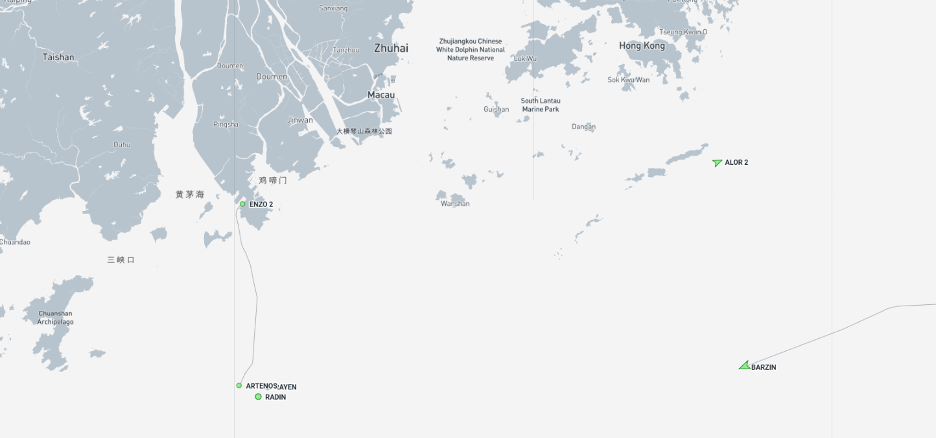
Iran-flagged cargo ship near Zhuhai and Hong Kong on August 21 (Credit: Marine Traffic)
At the CJK anchorage near Shanghai, the container ships ABYAN (IMO 9349667) and KASHAN (IMO 9270696) remained anchored.
In the East China Sea, the bulk carrier DARYABAR (IMO 9369710) sailed south toward Shanghai, but will likely continue to the Malaysian EOPL.
At Liuheng Island, near Ningbo, China, the bulk cargo ship PARSHAD (IMO 9387786) remained in the Longshan Shipyard, where it will likely spend several days or weeks.
In the Gulf of Suez, the general cargo ship AYSAN (IMO 9165803) began to transit south to the Red Sea. Its new destination on AIS is listed at Taicang port in Shanghai, China with an estimate arrival of September 20.
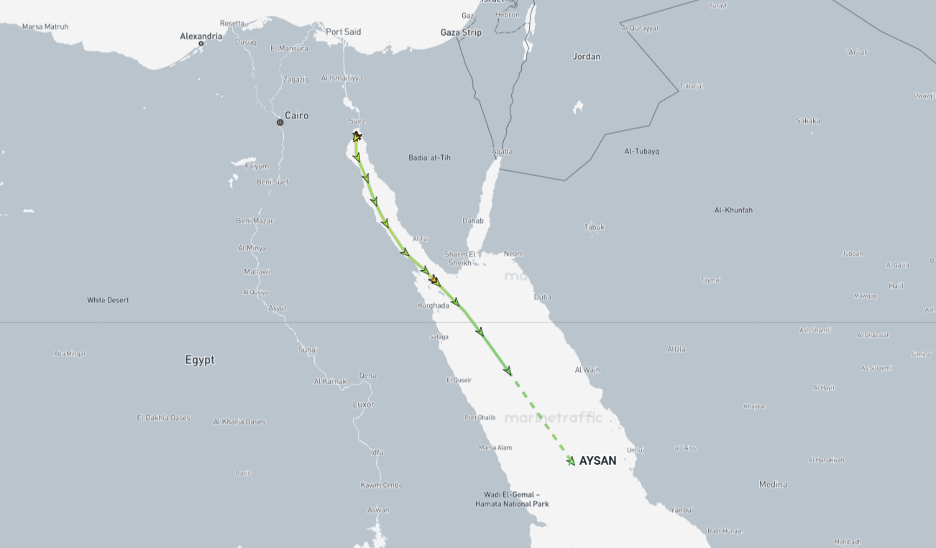
Iran-flagged cargo ship in the Suez Gulf on August 20 (Credit: Marine Traffic)
In the Eastern Mediterranean Sea, the Iran-flagged general cargo ship ALVAN (IMO 9165798) remained anchored outside Benghazi, Libya. Libya is under certain UN sanctions, and an arms embargo, in accordance with UNSC Resolution 2819 (2026).
In the Turkish Straits, the container ship FLEXI 2 (IMO 9246322) transited the Dardanelles and approached the Bosphorus. Its destination is listed on AIS as Novorossiysk, Russia, in the northern Black Sea. FLEXI 2 will have to submit advance transit notifications to Turkish authorities before entering the Bosphorus and completing the transit of the Turkish Straits. Under the Turkish Straits Reporting System (TÜBRAP), vessels must file a Sailing Plan report at least 24 hours before arrival at the straits. The report provides Turkish Vessel Traffic Services (TSVTS) with key information including the vessel's identity, dimensions, cargo, draft, and estimated time of arrival, allowing authorities to plan and organize traffic through the congested Bosporus and Dardanelles.
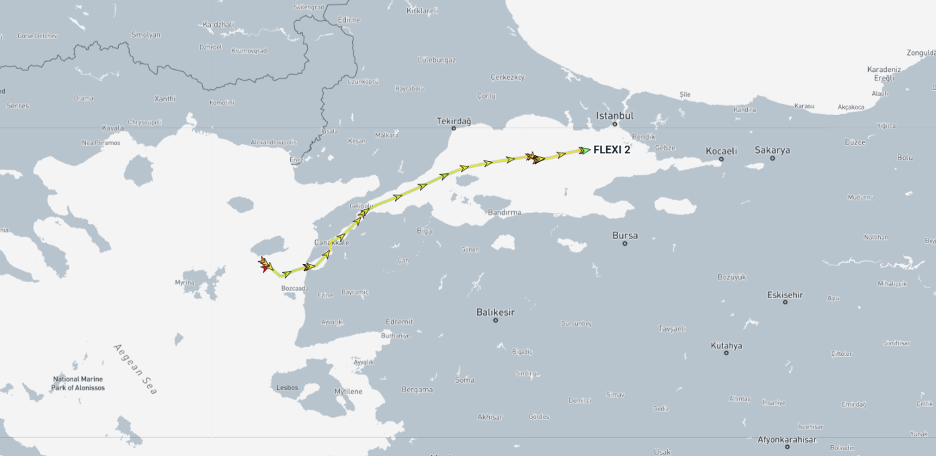
Iran-flagged cargo ship in the Turkish Straits on August 21 (Credit: Marine Traffic)
The container ship SHABDIS (IMO 9349588) likely continued cargo ops in port at Bronka container terminal. It was spotted in port on satellite imagery yesterday, conducting cargo operations. SHABDIS is expected to reappear on AIS after completing cargo operations and departing the port to begin its transit back to the Suez Canal and other ports beyond.
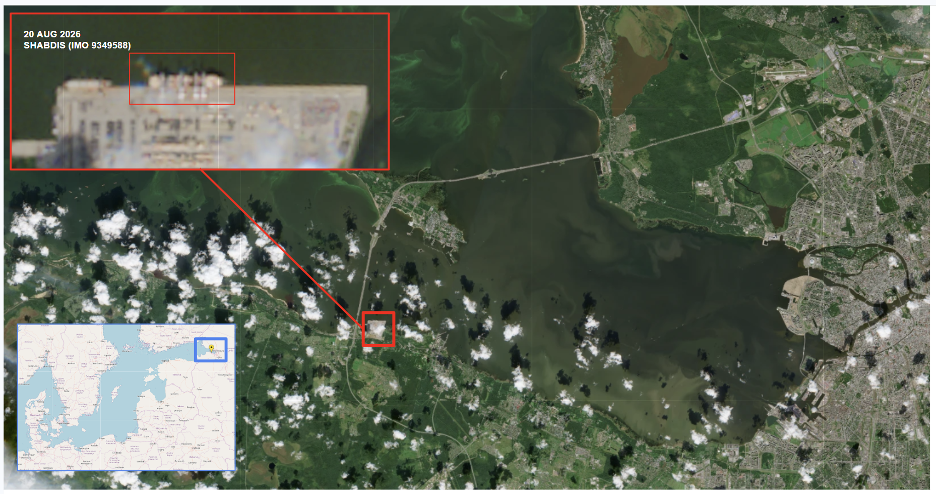
Iran-flagged cargo ship in Russian Baltic port on August 20 (Credit: ESA Copernicus)
Receive Iran News in Your Inbox.
Eye on Iran is a news summary from United Against Nuclear Iran (UANI), a section 501(c)(3) organization. Eye on Iran is available to subscribers on a daily basis or weekly basis.