Iran War Shipping Update—March 16, 2026
Since the onset of Operation Epic Fury, UANI has monitored a significant volume of Iranian oil at sea. Illicit Iranian oil sales are a major source of funding for the Islamic Revolutionary Guard Corps (IRGC), which is currently conducting military and terrorist operations targeting the U.S., Israel, Arab states in the Persian Gulf, and international shipping. In the weeks leading up to the conflict, Tehran sharply increased crude loadings and offshore stockpiling to cushion the impact of war on its oil trade. Amid ongoing hostilities, the Iranian regime’s Ghost Fleet continues to operate actively — loading cargo, transiting the Strait of Hormuz, and heading east toward its primary buyer, China. UANI’s regular shipping update will continue to monitor and report on the illicit maritime movements of the Iranian regime’s ghost fleet throughout the conflict.
Status of Kharg Island
On March 14, U.S. forces conducted a targeted strike on military assets located on Kharg Island — Iran’s principal oil export hub through which nearly 90 percent of its crude exports transit. The strike, part of a new phase in U.S. military operations against Iran, specifically targeted IRGC controlled military installations but avoided damaging the island’s oil infrastructure. Satellite imagery indicates all 55 crude storage tanks remain intact. Despite the strike, UANI has monitored continued activity at Kharg. On the morning of March 14, at least two tankers were loading an estimated 2.7 million barrels of crude, suggesting Iran’s oil exports from Kharg remain largely uninterrupted.
Should Kharg operations face further disruption, exports may partially shift east to Jask Port, a smaller terminal located beyond the Strait of Hormuz with significantly lower capacity. However, UANI assesses that both Iran-flagged and falsely-flagged, stateless tankers will likely continue to operate from Kharg unless broader U.S. or coalition measures directly target Iran’s oil export infrastructure and network of tankers.
Status of the Strait of Hormuz
The Strait of Hormuz remains a critical flashpoint in the ongoing Iran war, as the Iranian regime intensifies efforts to disrupt maritime traffic. Since the start of the conflict, at least 20 commercial vessels have been hit. In addition, the IRGC is reportedly attempting to line the strait with naval mines. Although U.S. forces have destroyed more than 30 Iranian mine-laying vessels, Iran has adapted by deploying smaller boats to continue the operation.
The escalating risk has created severe congestion and instability across the Persian Gulf’s shipping lanes. Prior to the outbreak of hostilities, about 138 vessels transited the Strait of Hormuz daily. Since March 1, 2025, marine traffic data shows growing clusters of loitering vessels on both sides of the Strait of Hormuz, with many refraining from transiting due to safety concerns. By March 15, just two cargo vessels and one tanker were reported to openly transit eastbound out of the Persian Gulf. The tanker KARACHI, which was carrying Abu Dhabi’s Das crude, transited the chokepoint yesterday while broadcasting its AIS signal. As the first non-Iranian tanker transiting the strait with its AIS signal on, it hugged Iranian territorial waters rather than remaining in international lanes, suggesting it may have obtained some form of tacit approval from Tehran — a pattern to watch closely in the coming days.
In response to the effective near closure of the waterway, President Donald Trump has publicly called on U.S. allies and other major energy importers to deploy naval forces to help secure the Strait of Hormuz and keep global energy flows moving. He has named countries such as China, Japan, South Korea, France, and the United Kingdom as potential contributors and indicated that the United States is prepared to coordinate a broader maritime coalition to ensure the strait remains open, safe, and free for commercial shipping.
Iranian Oil Laden Tankers in the Persian Gulf
UANI has identified at least 25 tankers laden with Iranian oil — primarily crude — currently operating in the Persian Gulf, west of the Strait of Hormuz.
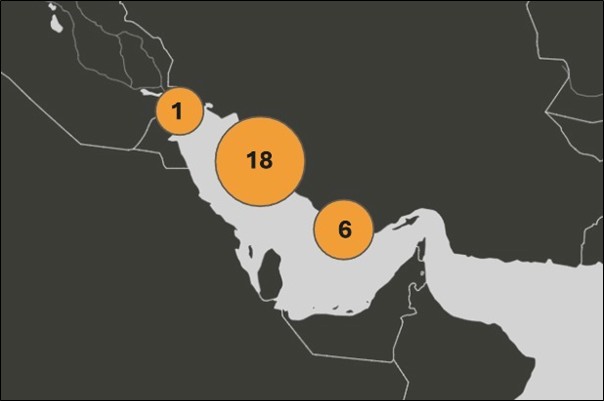
Map of Iranian oil laden tankers in the Persian Gulf on March 16
Number of Iranian Loadings
Since the outbreak of the conflict, UANI has tracked at least 14 Iranian oil loadings, 10 of which originated from Kharg Island. These shipments represent approximately 18 million barrels of Iranian oil, generating an estimated revenue of over $1 billion for the IRGC, which continues to fund Iran’s active missile and drone programs central to the conflict.
Iran-oil Laden Tankers That have Left the Persian Gulf
Since the start of the conflict, UANI has observed at least seven dark fleet tankers that have left the Persian Gulf — some broadcasting their AIS signals and others operating clandestinely — likely enroute to Malaysia to conduct ship-to-ship (STS) transfers with other Ghost Fleet vessels bound for China.
On March 15, the Very Large Crude Carrier (VLCC) NORA (IMO 9237539) transited the Strait of Hormuz while laden with approximately 1.9 million barrels of Iranian crude, with its AIS signal briefly inactive (as shown by the dotted track) during the passage.
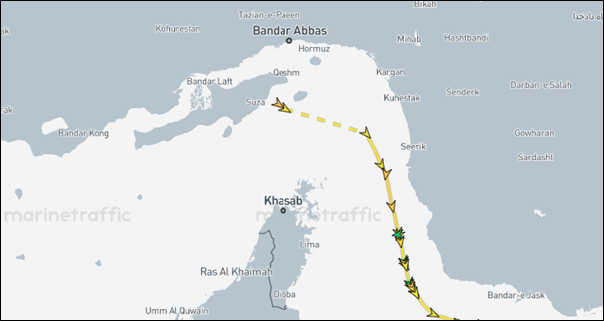
Map of NORA transiting the Persian Gulf on March 15 (Credit: Marine Traffic)
Iran-flagged Tankers Globally
UANI has observed at least 20 Iranian-flagged tankers well outside of the Persian Gulf area, all spotted in satellite imagery near the Malaysian EOPL anchorage. Since the start of the conflict, eleven tankers have begun to return from the Southeast Asian waters through the Indian Ocean towards Iran. Eleven tankers were observed transiting through the Malacca and Singapore Straits toward the anchorages off Malaysia. One March 15, two Iranian-flagged tankers transited the Singapore Strait eastbound, laden with Iranian oil, while two others transited westbound to return to Iran for their next cargo.
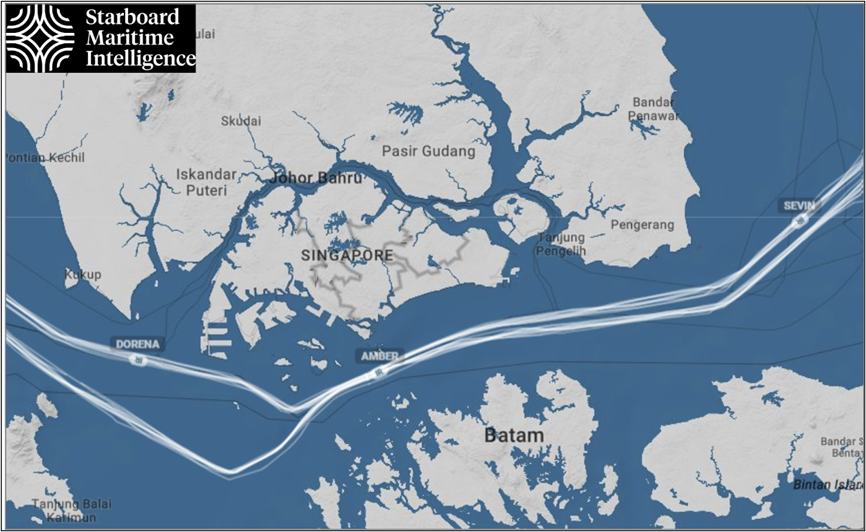
Map of Iranian-Flagged Tankers Transiting the Singapore Strait on March 15 (Credit: Starboard Maritime Intelligence)
Iran-Oil Laden Tankers off the Malaysian Coast
Since the start of the conflict, UANI has recorded 54 Iranian oil laden tankers in the East Outer Port Limits (EOPL) area, a ghost fleet hotspot approximately 70 km off Malaysia’s coast. On March 14, UANI monitored 5 ship-to-ship transfers of Iranian crude in this zone. The five discharging vessels originally loaded in Iran in late February, just before conflict’s outbreak, with all cargoes destined for China.
Receive Iran News in Your Inbox.
Eye on Iran is a news summary from United Against Nuclear Iran (UANI), a section 501(c)(3) organization. Eye on Iran is available to subscribers on a daily basis or weekly basis.