Iran War Shipping Update – June 4, 2026
Since the outbreak of the Iran War on February 28, Iran’s “Ghost Fleet” has continued operating across key maritime routes and continued to load oil. However, since the U.S. blockade initiated on April 13, oil exports have dropped dramatically. UANI observed zero crude shipments passing the blockade during the month of May, representing a 90% drop from the previous month.
To read UAN’s May 2026 Tanker Tracker, click here.
To read UANI’s statement on FAQs and keys facts about the U.S. blockade, click here.
On June 4, U.S. CENTCOM posted that U.S. forces have redirected 127 commercial ships and disabled 6 ships to prevent them from entering or leaving Iranian ports, as well as allowing 36 vessels supporting humanitarian aid to pass since the commencement of the blockade.
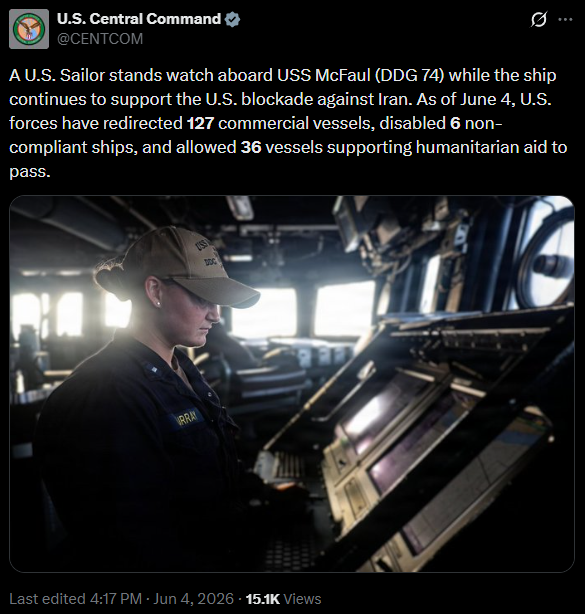
U.S. CENTCOM update on the U.S. blockade on June 3 (Credit: U.S. CENTCOM/X)
Status of the Strait of Hormuz
The Strait of Hormuz remains a critical flashpoint in the Iran War. Since the start of the conflict, 45 confirmed maritime incidents involving commercial vessels and offshore infrastructure have been reported across the Persian Gulf, Strait of Hormuz, and Gulf of Oman.
The enduring risk has created severe congestion and instability across the Persian Gulf’s shipping lanes. Prior to the outbreak of hostilities, about 138 vessels transited the Strait of Hormuz daily. Since March 1, 2026, marine traffic data shows growing clusters of loitering vessels on both sides of the Strait of Hormuz, with many refraining from transiting due to safety concerns.
IRGC efforts to restrict Freedom of Navigation
The IRGC’s newly announced so-called “Persian Gulf Strait Authority” (PGSA) published a proposed scheme for controlling and restricting freedom of navigation through the international strait. Such measures are in direct contradiction to UNCLOS Article 44, “Duties of States bordering straits,” which states:
“States bordering straits shall not hamper transit passage and shall give appropriate publicity to any danger to navigation or overflight within or over the strait of which they have knowledge. There shall be no suspension of transit passage.”
Any attempt to impose unilateral restrictions on transit passage through an international strait undermines the internationally recognized navigational rights guaranteed under UNCLOS.
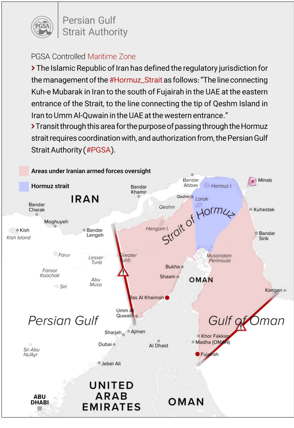
IRGC PGSA tweet on May 21 (Credit: X)
The U.S. Department of the Treasury’s Office of Foreign Assets Control (OFAC) took action and designated Iran’s so-called Persian Gulf Strait Authority (PGSA) on May 27.
Iranian Oil-Laden Tankers Inside the U.S. Blockade
UANI has identified at least 69 tankers laden with Iranian oil — primarily crude, but also other petroleum products and LPG — currently operating inside the U.S. blockade line which can be drawn from the Iranian-Pakistan border to the most eastern point of Oman.
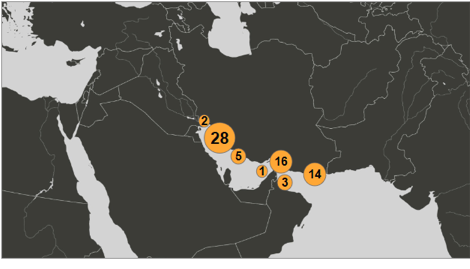
Map of Iranian oil laden tankers inside the U.S. blockade on June 4
Iran-linked Vessels at Kharg Island, Iran
Satellite imagery from May 31 indicates an accumulation of tankers at the Kharg Island anchorage, idle offshore. 22 tankers were spotted in the anchorage area, at least 14 of which are laden with Iranian hydrocarbons which are highlighted in red in the map below. The buildup of tankers anchored here suggests increasing disruption to Iran’s crude export flows due to the ongoing US blockade, particularly shipments destined for China’s independent “teapot” refineries.
Number of Iranian Loadings
Since the outbreak of the conflict, UANI has tracked at least 85 Iranian oil loadings, 45 of which originated from Kharg Island, Iran. These shipments represent approximately 88 million barrels of Iranian oil, generating an estimated revenue of over $7 billion for the IRGC, which continues to fund Iran’s active missile and drone programs central to the conflict. This figure is notably higher than usual given the sharp increase in oil prices, including Iranian crude.
Iran-linked Vessels at Chabahar Port, Iran
Iran-linked vessels are loitering and anchoring outside of the Persian Gulf at Chabahar Port, Iran. On June 2, 14 tankers, including 11 Iran-flagged tankers and three dark fleet vessels, all laden with Iranian oil, as well as 15 cargo vessels, the majority of which are Iran-flagged, were observed in satellite imagery near Chabahar Port. The red squares indicate laden tankers, and the green squares indicate cargo ships. Many of the Iran-flagged and Iranian oil-laden tankers that have attempted to cross the blockade departed from Chabahar Port, with at least eleven of these returning to port in response to a variety of U.S. enforcement actions. Several of the tankers in this anchorage have shifted locations since late May for unknown reasons, which could indicate an attempt to sail out and test the U.S. blockade before returning in response to enforcement actions.
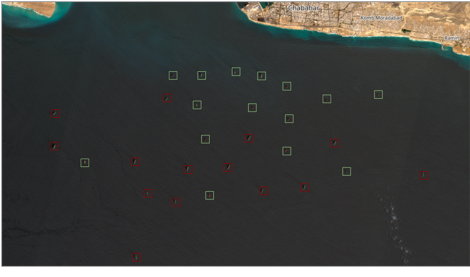
Iran linked vessels anchored near Chabahar on June 2 (Credit: ESA Copernicus)
Iran-linked Tankers at Jask Port, Iran
There is a growing cluster of tankers just east of Jask, Iran. On June 3, eight tankers were observed in the anchorage, six of them laden with Iranian crude. Four of those six laden tankers had moved from an anchorage inside the Persian Gulf near the Greater and Lesser Tunb islands between May 29 and June 3, despite having remained anchored there for more than a month. The red squares indicate laden tankers and white indicates unladen tankers.
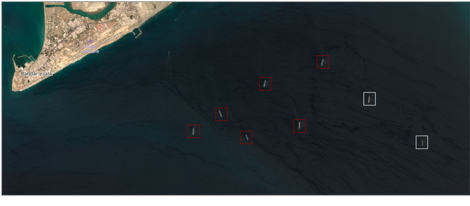
Iran linked tankers anchored near Jask, Iran on June 3 (ESA: Copernicus)
Iran-linked Vessels near Sri Lanka
Iran-linked tankers have been anchoring about 20 km offshore from Galle, Sri Lanka, likely for logistical support from local service providers but also in response to pressure from the U.S. blockade. On June 3, three Iran-flagged tankers, all unladen, plus three ghost fleet tankers, one of which carrying Iranian crude which is indicated by the red highlight in the map below, were anchored near Galle. One Iran-flagged tanker that had previously been anchored near Galle on May 29 has since departed the anchorage.
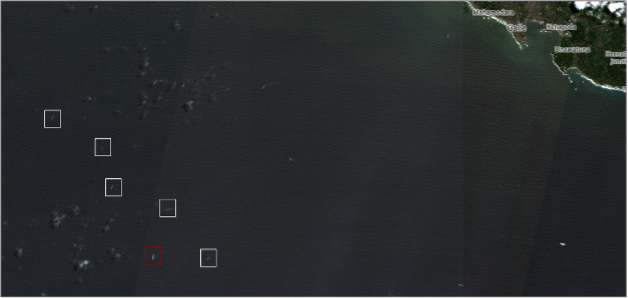
Tankers anchored near Galle, Sri Lanka on June 3 (Credit: ESA Copernicus)
Iran-flagged Tankers Globally
UANI has also monitored Iran-flagged tankers operating beyond the Persian Gulf. Since the conflict began, at least 32 Iran-flagged tankers have reached Southeast Asian waters bound for the Eastern Outer Port Limits (EOPL) anchorage off Johor, Malaysia.
Meanwhile, at least 39 Iran-flagged tankers, reporting empty, have begun attempts to return to Iran and from the Malaysian EOPL anchorage and Southeast Asian sea lanes, since the start of the conflict.
Iran-Oil Laden Tankers off the Malaysian Coast
From February 28, the start of the conflict, to today, UANI has recorded 69 STS transfers of Iranian crude oil and 5 STS transfers of LPG in the EOPL anchorage, a ghost fleet hotspot approximately 70 km off Malaysia’s coast. All of these transshipments have been spotted in satellite imagery.
On June 4, 43 tankers listed on UANI's Ghost Armada were anchored or loitering near the EOPL area with their AIS signals active, demonstrating that ghost fleet tankers continue to operate with impunity across Southeast Asia's sea lanes.
Iran-Flagged Cargo Ships Globally
Despite ongoing pressure of US OFAC sanctions, approximately 40 Iranian flagged vessels continue to operate openly across sea lanes, ports, and anchorages throughout the Indo-Pacific region. Enhanced pressure from the enforcement of the US blockade on Iran and disrupted access to Iranian ports appears to be affecting vessel schedules and operations on a large scale which has contributed to increased instances of ships pausing and waiting in clusters at anchorages across the region. A new pattern of cargo ships coming from Russian and Libyan ports to Southeast Asia is emerging. There is a growing risk of Iranian flagged cargo ships carrying contraband cargo in violation of US blockade.
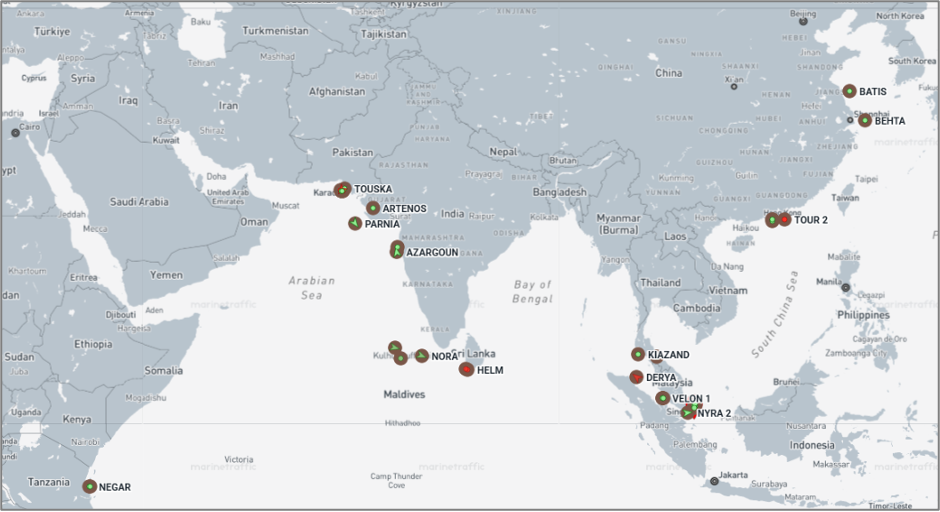
Iran-flagged vessels across the Indo-Pacific on June 4 (Credit: Marine Traffic)
Multiple Iranian flagged tankers and cargo vessels continued to anchor offshore of Karachi, Pakistan. The cargo ships ARIES (IMO 9369722), MAHNAM (IMO 9213387), DELRUBA (IMO 9305207) and WARTA (IMO 9465849) were broadcasting on AIS while anchored about 60km offshore in the Pakistani Exclusive Economic Zone (EEZ). The tankers STREAM (IMO 9569633), HERBY (IMO 9362059), SOBAR (IMO 9221970) and SARAK (IMO 9226968) are also anchored nearby. The container ship TOUSKA (IMO 9328900) remained anchored just 16 km outside Karachi port, inside Pakistani territorial waters. All of these Iran-flagged vessels are OFAC sanctioned. At least 10 other non-Iranian flagged Ghost Armada tankers are also anchored in the Pakistan EEZ.
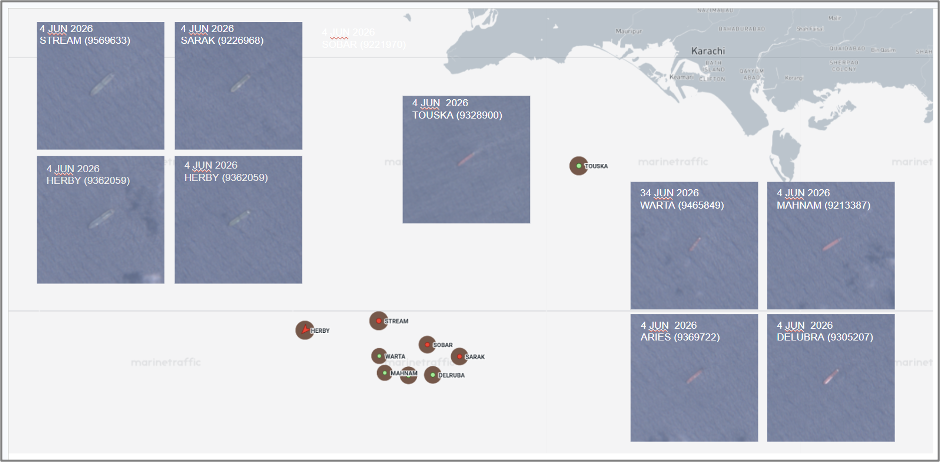
Iran-flagged cargo vessels near Karachi, Pakistan on June 4 (Credit: Marine Traffic and ESA Copernicus)
The OFAC-sanctioned, Iran-flagged container ship ARTENOS (IMO 9283021) remained anchored in the Gulf of Kutch, offshore of Kandla, India.
The general cargo ship PARNIA (IMO 9167265) continued sailing south in the Arabian Sea, now in the Indian Exclusive Economic Zone (EEZ). It is reporting its destination to be Sri Lanka, with an estimated arrival of June 9, in a partially laden status.
The Iran-flagged cargo ship ENZO 2 (IMO 9236652) remained anchored outside Mumbai, while the Iranian container ship AZARGOUN (IMO 9283019) pulled into the Nhava Sheva Port container terminal today.
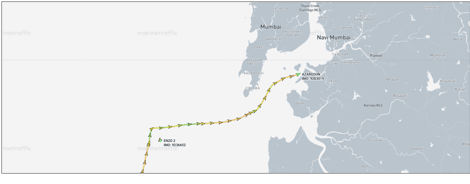
Iran-flagged container ships in Indian waters on June 4 (Credit: Marine Traffic and ESA Copernicus)
The Iran-flagged container ships NORA (IMO 9259408) andALOR 2 (IMO 9228538) continued sailing west toward Sri Lanka. Both ships previously departed Misrata, Libya and are reporting their destinations as Port Klang, Malaysia, with estimated arrival of 8 June and Singapore on 11 June, respectively
The Iran-flagged container ships ARTABAZ (IMO 9283007) was anchored near Uligan Island in the northern most atoll of the Maldives. The ship was previously drifting between India’s Minicoy Island and northern maritime boundary of the Maldives, while reporting “Not Under Command” on AIS. It was last spotted in satellite imagery on June 2.
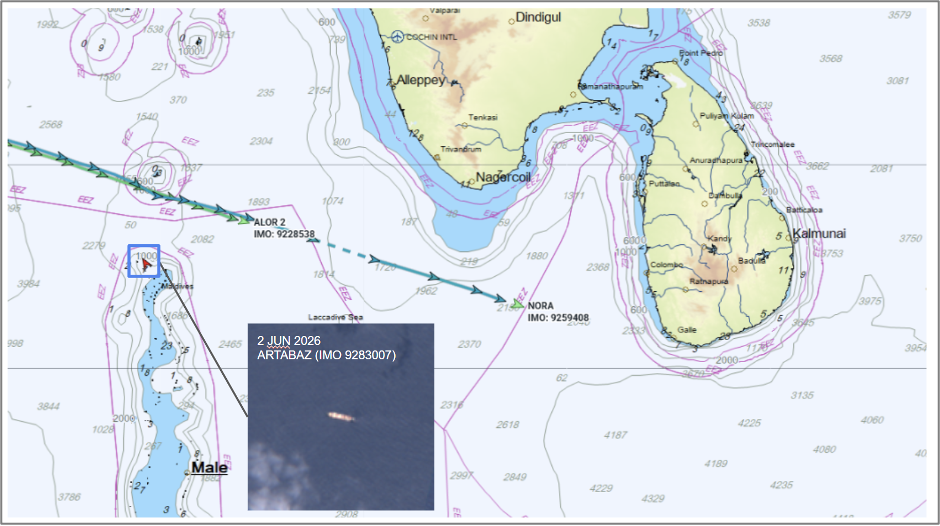
Iran-flagged container ships near the Maldives and Sri Lanka on June 4 (Credit: Marine Traffic and ESA Copernicus)
The Iran-flagged bulk cargo ship KIAZAND (IMO 9465758), continued to sit at anchor, approximately 35km south of Phuket, just outside Thai territorial waters. The Iranian-flagged bulk cargo ship ROSHAK (IMO 9405966) is anchored near Songkhla Port, on the Gulf of Thailand. Both ships are OFAC sanctioned.
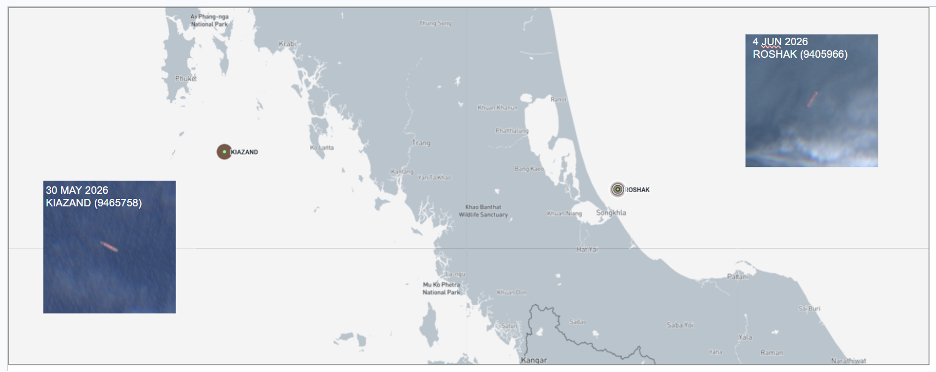
Iran-flagged container ships near Thailand on June 4 (Credit: Marine Traffic and ESA Copernicus)
The Iran-flagged general cargo ship AREZOO (IMO 9165786) and container ship RADIN (IMO 9820257) continued to remain anchored outside Port Klang, Malaysia, in the Malacca Strait.
On June 4, the Iran-flagged container ship VELON 1 (IMO 9122473) entered Port Klang’s Westport Kelang Multi Terminal for cargo operations. The container ship has previously anchored in the Malaysian EOPL on June 1, for about 24 hours, for unknown operations, before transiting back to Port Klang. VELON 1 departed the Russian Black Sea port of Port of Novorossiysk on April 23, before transiting via the Bosphorus and Suez Canal and crossing the Red Sea and Indian Ocean. It is possible that it is unloading cargo from Russia into Malaysia.
All of these Iran-flagged cargo ships are OFAC-sanctioned, so it is possible that the commercial port operator at Port Klang is openly disregarding the risk of U.S. OFAC secondary sanctions.
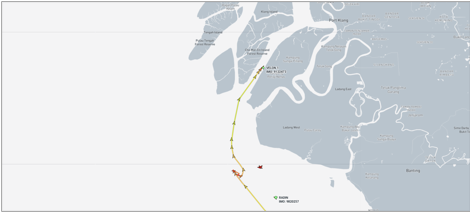
Iran-flagged cargo ships at Port Klang, Malaysia, on June 4 (Credit: Marine Traffic)
Six OFAC-sanctioned, Iran-flagged cargo ships remain anchored in the Malaysian EOPL anchorage area, openly broadcasting on AIS. The cluster of vessels include five bulk cargo ships ARVIN (IMO 9193202), MIAMI PRIDE (IMO 9274941), BASKAR (IMO 9405942), ANDIA (IMO 9193197), BAHJAT (IMO 9405954) and container ship OURA (IMO 9387815).
On June 4, the Iran-flagged container ship NYRA 2 (IMO 9241487) transited the Singapore Strait, eastbound, and arrived at the Malaysian EOPL, where it anchored. This vessel departed Misrata, Libya, on May 17.
These vessels are all OFAC sanctioned and are all likely waiting in the EOPL due to the U.S. blockade.
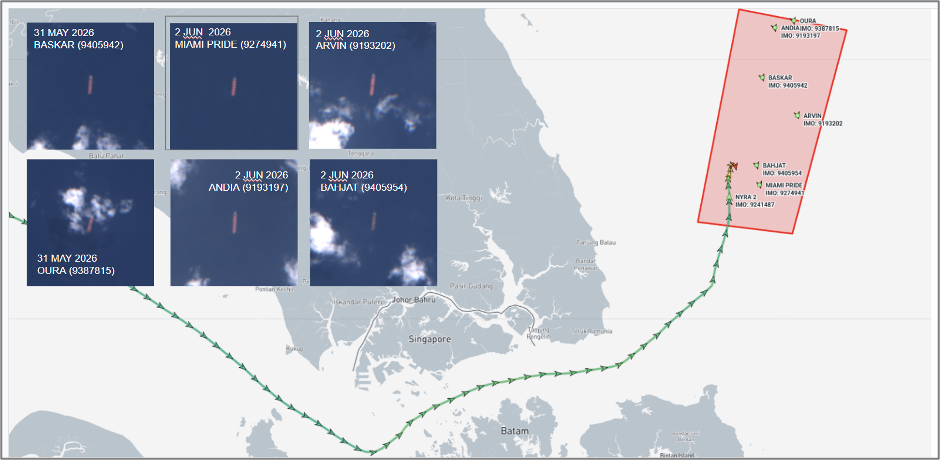
Iran-flagged cargo ships at Malaysian EOPL on June 4 (Credit: Marine Traffic and ESA Copernicus)
The three Iran-flagged container ships SHABDIS (IMO 9349588), SHABGOUN (IMO 9346524) and BEHNAVAZ (IMO 9346548) remained anchored in the vicinity of Zhuhai, China. BEHNAVAZ completed cargo operations in Zhuhai port on May 26 and returned to the anchorage on May 30. Zhuhai Port at Gaolan Island has been identified in media reports as a source of precursor chemicals for rocket fuel.
Meanwhile, the Iranian flagged tanker TOUR 2 (IMO 9364112), also known as KARIZ, remained anchored about 70 km south of Hong Kong.
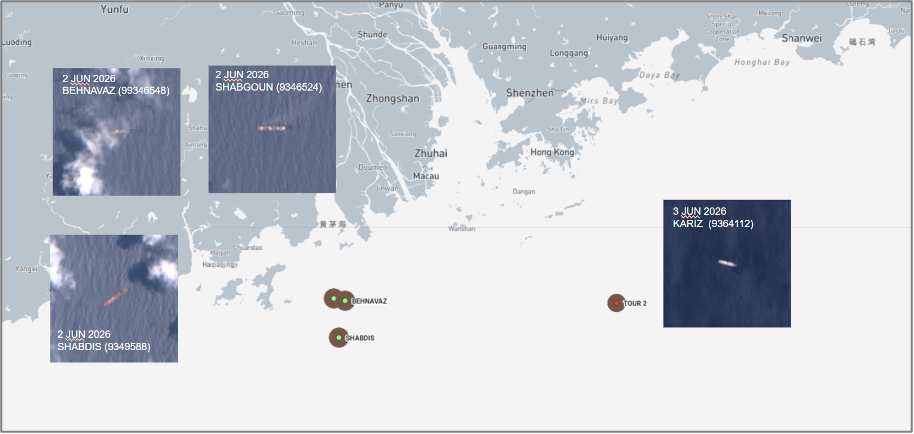
Iran-flagged container ships at Zhuhai, and tankers south of Hong Kong China, on June 4 (Credit: Marine Traffic and ESA Copernicus)
Iran-flagged container ship BEHTA (IMO 9349590) remained anchored off Shanghai at the Changjiangkou (CJK) anchorage and the Iran-flagged bulk cargo ship BATIS (IMO 9465760) remained anchored 80km off Yangcheng in the Yellow Sea.
Receive Iran News in Your Inbox.
Eye on Iran is a news summary from United Against Nuclear Iran (UANI), a section 501(c)(3) organization. Eye on Iran is available to subscribers on a daily basis or weekly basis.