Iran Is Violating Most of its MOU Commitments
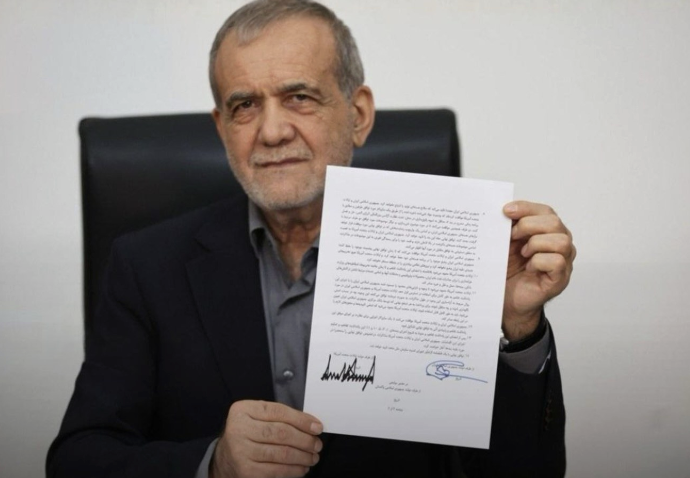
Iran's President Masoud Pezeshkian with the signed Memorandum of Understanding.
On June 17, 2026, the Trump administration and the Iranian regime signed the Islamabad Memorandum of Understanding, which declared the conflict between them over and set the stage for further negotiations toward a “final deal.” As this analysis will lay out, the Islamic Republic has violated pledges in four paragraphs in the agreement.
Use or Threat of Force
In paragraph one of the MOU, the U.S., Iran, and “their allies in the current war . . . declare the immediate and permanent termination of military operations on all fronts, including in Lebanon, and undertake from now on not to initiate any war or any military operation against each other, and to refrain from the threat or use of force against each other, and ensuring the territorial integrity and sovereignty of Lebanon.” Note the Lebanon reference. The regime has demanded that any end to the U.S.–Iran conflict also terminate Israel’s battle against Lebanese Hezbollah, an Iranian terror proxy. In fact, Iranian Foreign Minister Abbas Araghchi claimed that Iran and Hezbollah together comprise one party to the MOU, with the U.S. and Israel being the other side. (Israeli Prime Minister Benjamin Netanyahu, however, emphasized that his country is not a party to the agreement.) Consequently, all Hezbollah violations of the MOU should be treated as Iranian violations as well.
On June 17—the very day that Iran and the U.S. inked the MOU—a Hezbollah explosive device killed one Israeli soldier and wounded seven others in southern Lebanon. Also on that day, the terrorist group fired multiple rockets at Israeli servicemembers and a suspected Hezbollah drone flew over an area of southern Lebanon in which Israeli troops are operating. Hezbollah likewise attacked Israeli soldiers on each of the following three days, firing anti-tank missiles, drones, and rockets, and using an improvised explosive device. Hezbollah strikes killed five Israelis on June 19.
The Islamic Republic also violated paragraph one on June 27 and 28 by attacking Bahrain (both days) and Kuwait (on the 28th). While the Islamic Revolutionary Guard Corps claimed that it had attacked U.S. military bases on those occasions, there are no reports of such installations being hit. An Iranian strike did damage a residential building close to Bahrain’s international airport.
Finally, regime officials have contravened paragraph one by thrice threatening U.S. leaders with violence. On June 26, Hassan Rahimpour Azghadi, a member of Iran’s Supreme Council of the Cultural Revolution, said at a rally that his government should state that it will assassinate President Trump and should prepare supporters of the regime in America to activate cells to target U.S. government officials. On June 27, the majority of members of Iran’s Assembly of Experts published a statement calling for those responsible for the assassination of Supreme Leader Ali Khamenei, including Trump and Israeli Prime Minister Netanyahu, to be punished, adding that persons who have access to them are under a religious obligation to take their lives. And on July 1, Supreme National Security Council Secretary Mohammad Bagher Zolghadr stated that those responsible for the death of Supreme Leader Ali Khamenei and “the oppressed martyrs of Iran” will “receive their just deserts at the hands of ‘righteous elements.’”
Interference with Freedom of Navigation
In paragraph five of the MOU, Iran shall “make arrangements using its best efforts for the safe passage of commercial vessels with no charge for 60 days only from the Persian Gulf to the Sea of Oman, and vice versa. The traffic of commercial vessels will immediately start, and considering the need for removing the technical and military obstacles and de-mining by the Islamic Republic of Iran, will be instated within 30 days.” However, since signing the agreement, Tehran has demonstrated that it intends to control the Strait completely and believes that “safe passage” means passage on its terms alone, with all other passage subject to Iranian violence and threats thereof.
On June 20, just three days after inking the MOU, the Iranian military’s Khatam al-Anbiya Central Headquarters (KACHQ) announced that “the Strait of Hormuz will be closed to maritime traffic.” The KACHQ claimed that Iran had closed the Strait in response to America’s “bad faith” and American and Israeli noncompliance with paragraph one. However, the MOU does not condition the opening of the Strait on the implementation of other memorandum provisions.
Both before and after the June 20 closure announcement, the Islamic Republic attempted to dictate the rules for transiting the Strait. On June 19, the regime’s newly created Persian Gulf Strait Authority (PGSA) published a document stating that “No vessel is permitted to pass through the Strait of Hormuz without a valid passage permit issued by the PGSA” and that “All vessels must hold a valid insurance policy approved by the PGSA,” although “At present, this insurance is provided free of charge to the vessel owner, with all expenses covered by the Islamic Republic of Iran.” This document lays the groundwork for imposition of insurance charges on vessels after the mandated charge-free 60-day period ends. The PGSA issued a similar announcement on June 25.
After the International Maritime Organization (IMO) promoted a new route through the Strait that Iran had not approved, the regime repeatedly insisted that all ships take its preferred route or face consequences. On June 24, the IRGC Navy said in a statement that “Navigation outside [Iran-designated] routes is highly dangerous and prohibited” and “[v]iolators will be dealt with.” The IRGC also said that the IMO-announced route “is unacceptable and completely dangerous.” The Guards also sent a threatening radio message to one tanker using that route, warning, “You are in range of my missiles and maybe [I] fire on you.”
On June 25, the IRGC escalated to force, attacking a Singapore-owned and -flagged cargo ship, the Ever Lonely, in the Strait of Hormuz. Two days later, the Panama-flagged and Greek-owned tanker Kiku was struck by a drone off Oman.
While the regime has not attacked vessels since June 27, the IRGC Navy issued another warning on June 29 to use only Iran’s designated route. Further, on July 2, the KACHQ threatened that “[a]ny failure to comply, deviation from the designated route, or disregard for the navigation protocols of the Islamic Republic of Iran in the Strait of Hormuz will be met with an immediate and forceful response from the armed forces, endangering the security of the violating vessels.” For good measure, the KACHQ threatened that any U.S. “attempt . . . to interfere in security matters” or “any disruptive action in the Strait of Hormuz will be met with a rapid and decisive reaction."
Refusal to Permit Verification of Nuclear Commitments
In paragraph eight, the regime “reaffirms that it shall not procure or develop nuclear weapons” and “agreed,” together with the U.S., “to resolve the disposition of stockpiled enriched material pursuant to a mechanism that will be mutually agreed upon in accordance with the schedule mentioned in paragraph seven with the minimum methodology to be down-blending on site under the supervision of the [International Atomic Energy Agency].” Importantly, the paragraph also says that the U.S. and Iran” acknowledge the critical importance of the nuclear issues above mentioned and express their intention to immediately address these issues in the negotiations in order to achieve mutual agreement on them.”
Further, in paragraph nine, the Islamic Republic committed to “maintain the current status quo of its nuclear program” in exchange for the Trump administration’s pledge not to issue new sanctions on Iran or deploy further forces to the Middle East.
Iran’s compliance with its commitments in these paragraphs cannot be verified without complete access to its nuclear facilities and enriched uranium stockpile by the IAEA, as well as down-blending of that stockpile by the IAEA unless Iran agrees to a stronger arrangement, such as the removal of the stockpile from Iran by the U.S.
However, the regime has categorically rejected engaging with and providing access to the IAEA. On June 24, Deputy Foreign Minister Kazem " posted on X that Tehran had rejected a meeting request from IAEA Director General Rafael Grossi and that “There is also no program for access to the attacked facilities and nuclear materials. These issues will solely be examined and resolved within the framework of the final agreement and as a result of [America’s] practical action in terminating all sanctions.” Iran’s position makes it impossible to determine whether it is complying with paragraph eight and ignores or outright reneges on the Islamic Republic’s commitment in paragraph nine.
Finally, while about one-fourth of the 60-day negotiating period has passed, Tehran has sought to evade discussing the nuclear issues, which paragraph nine says should be addressed “immediately.” The regime has said that it intends to negotiate first over the unfreezing of its assets and the status of the Strait of Hormuz. Further, Iranian diplomats are now playing games by refusing direct high-level meetings with their American counterparts, instead speaking with mediators from Qatar and Pakistan. This tactic will further delay nuclear discussions, instead buying time for Iran to earn more revenue from oil sales that the Trump administration has suspended sanctions on.
Conclusion
Iran’s repeated noncompliance with its MOU obligations should give pause to U.S. officials hopeful that in exchange for financial incentives, the regime will turn over a new leaf and behave like any normal, responsible state. The Islamic Republic remains a radical, revolutionary, anti-American power. U.S. policy towards the regime should reflect the way Tehran actually behaves, not the promises it makes.
Alan Goldsmith is UANI's Director of Outreach and Human Rights Research.
Receive Iran News in Your Inbox.
Eye on Iran is a news summary from United Against Nuclear Iran (UANI), a section 501(c)(3) organization. Eye on Iran is available to subscribers on a daily basis or weekly basis.