Inside the Ghost Armada Oil Trade that Led to the Seizure of M SOPHIA and OLINA
As part of a series of operations by U.S. naval forces last week, the tankers M SOPHIA (IMO: 9289477) and OLINA (IMO: 9282479) were boarded and seized on January 7 and January 9 respectively, marking a major development in U.S. efforts to dismantle the global dark fleet. The seizure of these vessels is part of a broader U.S. naval blockade designed to sever the illicit financial lifelines of sanctioned regimes. While both were ultimately targeted for their roles in the Russian oil trade, evidence reveals their roots in the Iranian and Venezuelan markets.
Tankers Across the Global Dark Fleet
M SOPHIA operates as a stateless vessel, without a flag and national protections. Similarly, OLINA functions under a false Timor-Leste flag—a claim rendered absurd by the fact that the Timor-Leste government does not maintain an international ship registry. By operating with forged documentation under a non-existent registry, OLINA can also be considered stateless. This status not only exemplifies the shadowy tactics of the Ghost Armada but also grants the international community the clear legal authority to board and seize the vessel on the high seas under established maritime conventions.
OLINA has been designated under multiple national sanctions regimes, including those of the United Kingdom, United States, Canada, the European Union, Switzerland, Australia, and New Zealand. While specifically sanctioned for its involvement in the Russian oil trade, the vessel also has a history of transporting Iranian petroleum. As a result, it has been blacklisted on UANI’s Ghost Armada since March 2025. While M SOPHIA was sanctioned by the United Kingdom, United States and Canada for transporting Russian oil, it also maintains a long history of carrying Venezuelan crude—with which it was reportedly laden at the time of seizure—and last year conducted a ship-to-ship (STS) transfer in the Riau Archipelago offshore Malaysia, where it received Iranian crude. OLINA has likewise received Iranian crude via STS transfers in the same Malaysian hotspot. Both vessels clearly illustrate the interconnected and fluid nature of dark fleets, where vessels routinely crossover between Iranian, Russian, and Venezuelan illicit oil trades. Photo evidence below documents M SOPHIA and OLINA’s participation in the Iranian oil trade through an evasive sequence of STS operations.
Evidence of M SOPHIA Transporting Iranian Crude
On January 18, 2025, satellite imagery catches PUYANG (IMO: 9174220) loading 1.9m barrels of Iranian crude at Kharg Island.
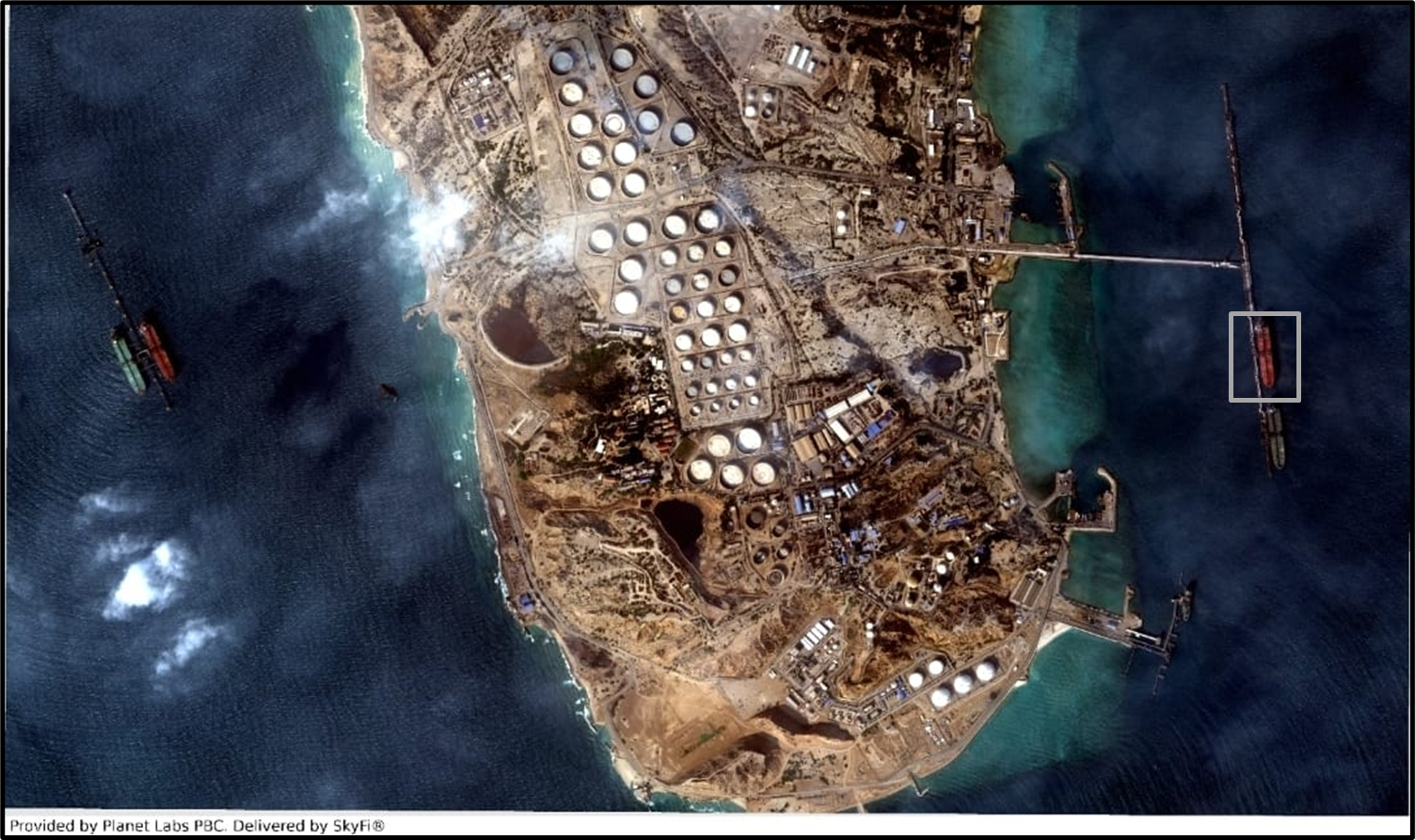
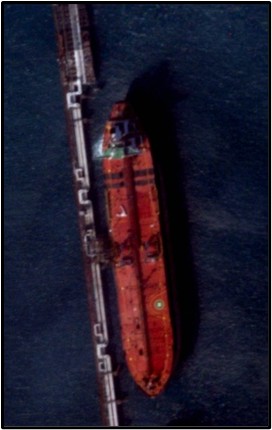
Satellite images of PUYANG loading of the T-Jetty at Kharg Island, Iran (Provided by Planet Labs PBC, Delivered by SkyFi)
On March 30, 2025, satellite imagery indicates that THALIA III (IMO: 9259197) received Iranian crude from PUYANG via an STS transfer in the Riau Archipelago, at 2.135° N, 104.726° E.
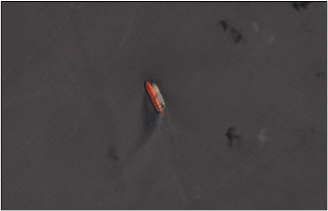
Satellite image of STS between PUYANG and THALIA III (Copernicus)
On April 28, 2025, satellite imagery shows that NATALINA 7 (IMO: 9310147) received Iranian crude from THALIA III via an STS transfer in the Riau Archipelago, at 2.056° N, 104.723° E.
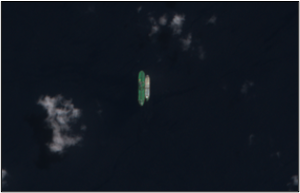
Satellite image of STS between THALIA III and NATALINA 7 (Copernicus)
On May 1, 2025, satellite imagery indicates that M SOPHIA received Iranian crude from NATALINA 7 via an STS transfer in the Riau Archipelago, at 2.056° N, 104.725° E.
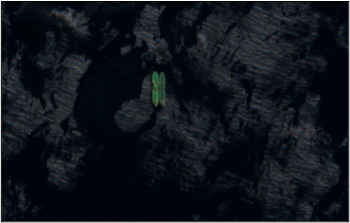
Satellite image of STS between NATALINA 7 and M SOPHIA (Copernicus)
Evidence of OLINA Transporting Iranian Crude
On February 28, 2025, satellite imagery catches the Iran-flagged tanker SINOPA (IMO: 9172038) approaching Bandar-e-Jask, Iran.
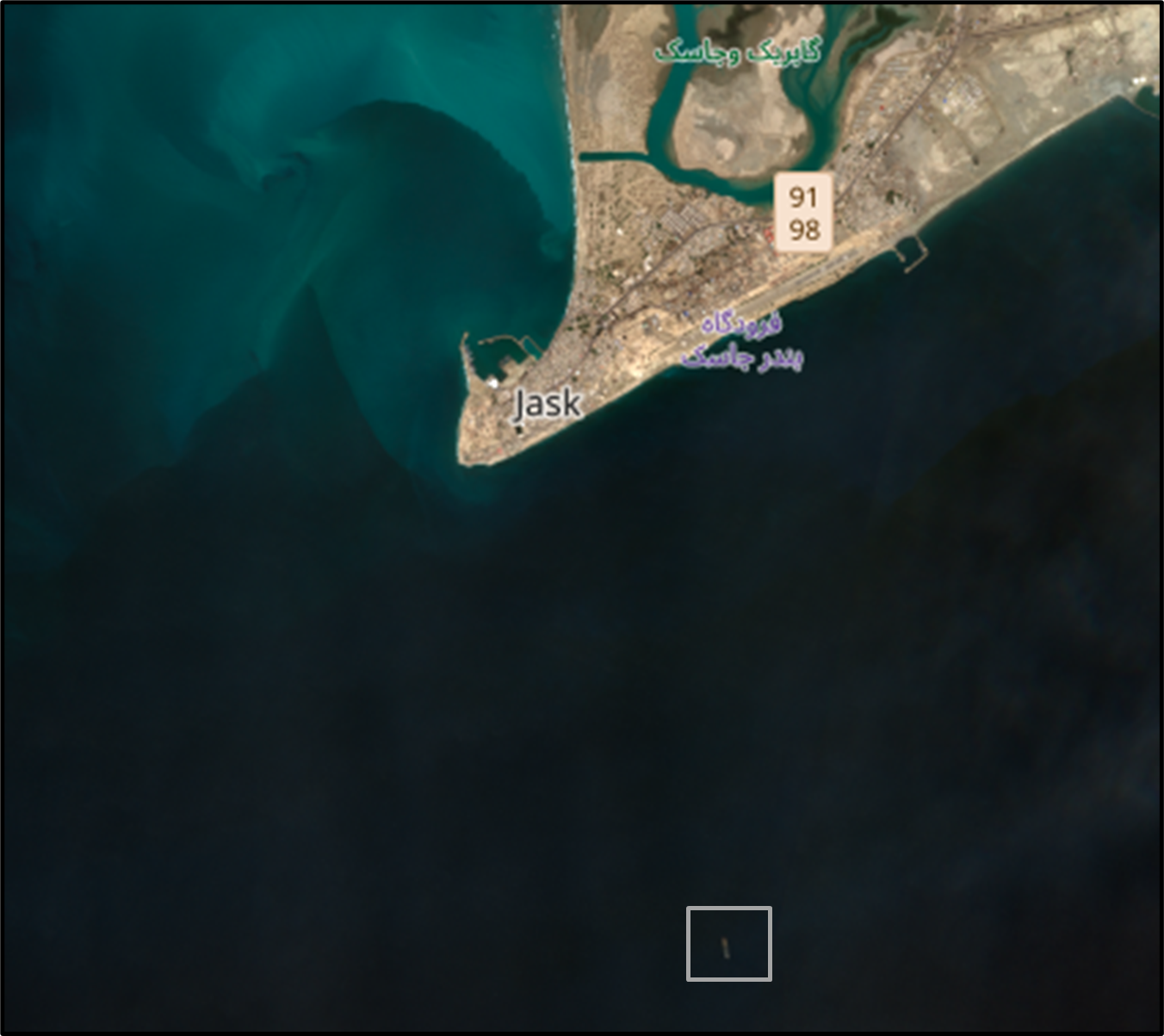
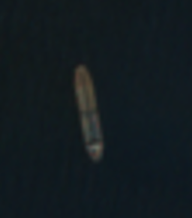
Satellite imagery of SINOPA approaching Bandar-e-Jask (Copernicus)
On March 30, 2025, satellite imagery shows OLINA receiving Iranian crude via STS from SINOPA in the Riau Archipelago, at 2.053° N, 104.694° E.
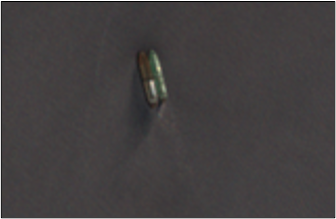
Satellite image of STS between SINOPA and M SOPHIA (Copernicus)
All vessels mentioned in these timelines, except for M SOPHIA, are listed on UANI’s Ghost Armada.
A Stark Warning to the Dark Fleets
The combination of the seizure of M SOPHIA and OLINA as well as BELLA 1 (IMO: 9230880) serves as a stark U.S. warning to dark fleets: evasion tactics will not outpace accountability for sanctions violations.
While M SOPHIA and OLINA were specifically sanctioned for their involvement in the Russian oil trade, dark fleet vessels reflagging to Russia will also not be shielded from facing U.S. justice, as evidenced by the seizure of the BELLA 1, also known as MARINERA, after it attempted this evasion tactic. UANI identified the BELLA 1 as part of Iran’s Ghost Armada in 2021, with the U.S. Treasury Department sanctioning it in 2024.
The U.S. is now pursuing global enforcement against sanctions evasion through seizures and naval measures well beyond its home waters. U.S. forces tracked and seized the BELLA 1/MARINERA after it crossed the Atlantic toward UK waters, proving that American interdiction efforts fear no distance. This serves as a stark warning to all dark fleet operators everywhere: nowhere on the high seas is beyond the reach of U.S. maritime enforcement.
UANI welcomes this bold strategy to dismantle the dark fleet and its global enablers, and we continue to closely track the oil tankers in the Caribbean attempting to breach the U.S. blockade off the coast of Venezuela.
Receive Iran News in Your Inbox.
Eye on Iran is a news summary from United Against Nuclear Iran (UANI), a section 501(c)(3) organization. Eye on Iran is available to subscribers on a daily basis or weekly basis.