Iran Shipping Update – November 23, 2026
The maritime security environment across the region remains highly volatile. Increased Iranian attacks continue to threaten commercial shipping in the Strait of Hormuz, while U.S. naval forces enforce a maritime blockade that has significantly constrained Iran's ability to export oil. At the same time, Iran-linked tankers and cargo vessels continue to operate across other regions, highlighting the global reach of Iran's maritime networks and the challenges of enforcing international sanctions. Meanwhile, Houthi threats and attacks pose a renewed risk to commercial shipping in the Red Sea.
For UANI’s recommendations for U.S. sanctions on Iran following “Economic D-Day,” read here.
Top Lines
Despite the Iranian regime's false narrative claiming that convoys of up to 14 tankers laden with Iranian crude oil are attempting to breach the blockade, most of the laden tankers tracked by UANI remain in their anchorages along Iran’s coastline.
Over the weekend, two tankers were observed loading Iranian fuel oil and LPG at Bandar-e Mahshahr, while another very small Handymax loaded Iranian naphtha from Kharg Island’s petrochemical jetty.
Unconfirmed reports indicate that an Iran-flagged cargo ship was struck in an anchorage offshore Benghazi, Libya, in addition to the Russian warship that was sunk in port.
Status of the Strait of Hormuz
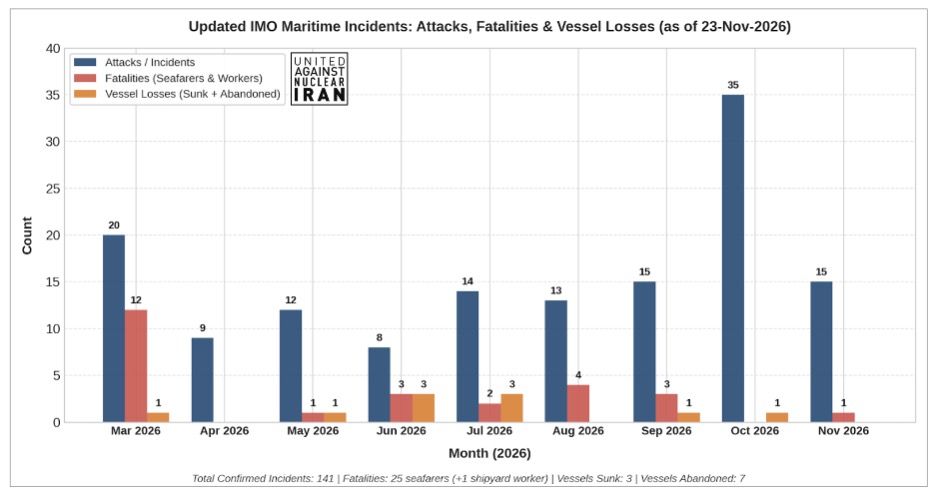
Since the start of the Iran War, the International Maritime Organization (IMO) has confirmed 141 maritime incidents involving commercial vessels across the Persian Gulf, Strait of Hormuz, and Gulf of Oman. According to the IMO, these incidents have resulted in 25 seafarer deaths. UK Maritime Trade Operations (UKMTO) has recorded more attacks that have yet to be verified by the IMO.
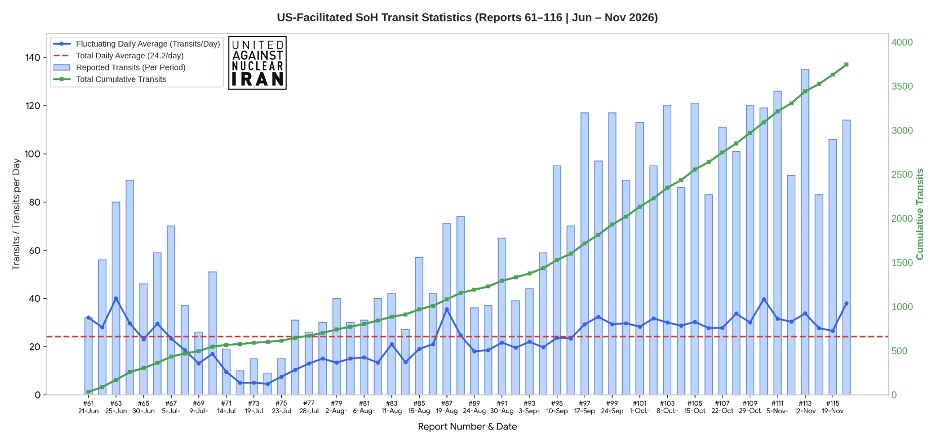
Despite heightened attacks on commercial shipping, tankers continue to transit the southern corridor of the Strait of Hormuz bidirectionally without broadcasting AIS location data, with many of these movements facilitated by U.S. forces. US-facilitated transits through the Strait of Hormuz surged to an average of 38.0 vessels per day, with 114 transits recorded during the latest 72-hour period (November 19–21). This brings the month-to-date November total to 655 transits across 21 days, averaging 31.2 per day, and lifts the cumulative campaign total to 3,744 transits across 155 monitored days, an average of 24.2 per day.
Iranian Oil-Laden Tankers Departing the Gulf of Oman
Tankers laden with Iranian oil and petrochemicals are currently clustering in anchorages along the Iranian coastline due to the reinstatement of the blockade. Since the blockade resumed, approximately 11 small tankers carrying Iranian LPG have successfully passed the blockade line. However, UANI has not tracked any tanker laden with Iranian crude oil that has successfully departed the Gulf of Oman and avoided enforcement actions by U.S. forces since July 12, before the blockade was reinstated.
Iranian Oil-Laden Tankers
UANI has identified at least 59 tankers laden with Iranian oil—primarily crude, but also other petroleum products and LPG—currently operating along the Iranian coastline.
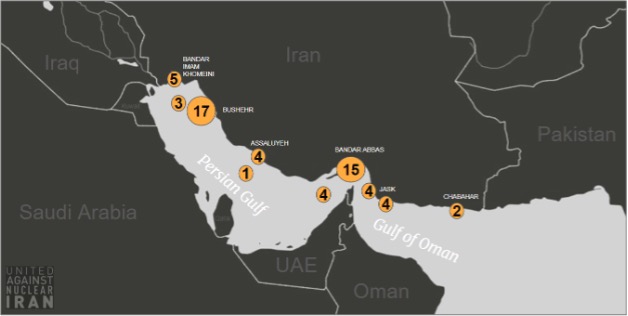
Positions of tankers laden with Iranian oil on November 23 (Credit: UANI)
Despite the Iranian regime's false narrative claiming that convoys of up to 14 tankers laden with Iranian crude oil are attempting to breach the blockade, most of the laden tankers tracked by UANI remain in their anchorages. As of November 22, 10 tankers laden with Iranian oil were loitering east of Kharg Island, while a very small Handymax was observed loading Iranian liquefied petroleum gas (LPG) off Kharg’s petrochemical jetty—the first tanker UANI has observed loading at Kharg Island since September. Additionally, six other tankers laden with Iranian oil remained positioned south of Kharg Island.
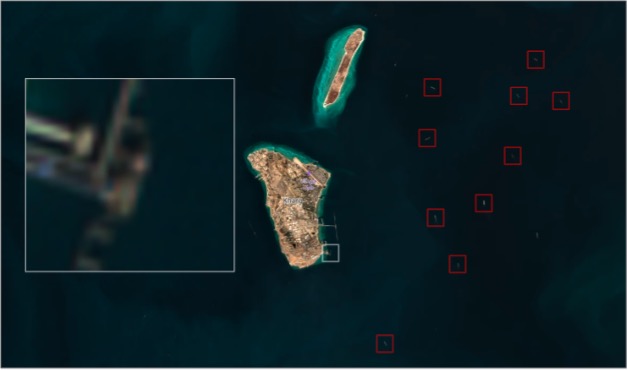
Laden tankers near Kharg Island, Iran, on November 22 (Credit: ESA Copernicus)
Number of Iranian Loadings
Since the U.S. reinstated the blockade on July 14, UANI has tracked at least 64 Iranian oil and petrochemical loadings, only nine of which originated from Kharg Island, Iran.
Iran-Linked Tankers Globally
UANI has also monitored Iran-flagged tankers operating beyond the Persian Gulf, particularly in the waters near Malaysia. At least 24 tankers listed on UANI’s Ghost Armada are loitering in the EOPL anchorage, demonstrating that Ghost Fleet tankers continue to operate with impunity across Southeast Asia's sea lanes. Meanwhile, 18 tankers listed on UANI's Ghost Armada were anchored or loitering north of the EOPL anchorage with their AIS signals active. These tankers most likely departed the anchorage due to the purported recent enforcement actions of the Malaysian maritime authorities.
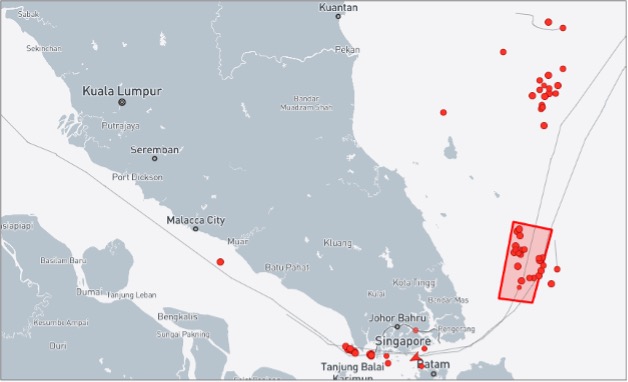
Ghost Armada tankers near Malaysia on November 23 (Credit: Marine Traffic)
Iran-flagged tankers, empty after conducting STS transfers in the EOPL, are now loitering at anchorages across the Indo-Pacific rather than transiting back to Iranian ports because of the blockade. DIONA (IMO 9569695) is loitering offshore Duqm, Oman, while 18 empty Iran-flagged tankers are currently loitering off Sri Lanka. These tankers are STREAM (IMO 9569633), HALTI (IMO 9212890), SEA CLIFF (IMO 9569657), HERO II (IMO 9362073), SILVIA I (IMO 9172052), SNOW (IMO 9569619), HELM (IMO 9357391), DUNE (IMO 9569712), DEEP SEA (IMO 9218492), DIAMOND II (IMO 9218478), DINO 1 (IMO 9569671), SONIA I (IMO 9357365), DORE (IMO 9357717), HERBY (IMO 9362059), FELICITY (IMO 9183934), HENNA (IMO 9212929), AMBER (IMO 9357406), and HUGE (IMO 9357183).
Two Iran-flagged tankers, DREAM II (IMO 9356593) and SEVIN (IMO 9357353), departed their Sri Lankan anchorages and transited the Six Degree Channel eastbound. On November 21, DREAM II was observed via satellite imagery operating off Banda Aceh, Indonesia, while dark to AIS tracking. Meanwhile, SEVIN resumed broadcasting on AIS in the same vicinity on November 21. The reasoning behind the two unladen tankers departing Sri Lanka's coastline remains unclear. However, they are likely relocating to an alternate loitering area amid the blockade or positioning to receive logistics support or conduct an STS transfer.
Iran-Flagged Cargo Ships Globally
Despite ongoing pressure of OFAC sanctions and new constraints of the blockade, approximately 50 Iranian-flagged cargo ships continue to operate openly across sea lanes, ports, and anchorages throughout the Indo-Pacific region, Arabian Sea, Red Sea, Mediterranean, Atlantic Ocean, and Baltic Sea.
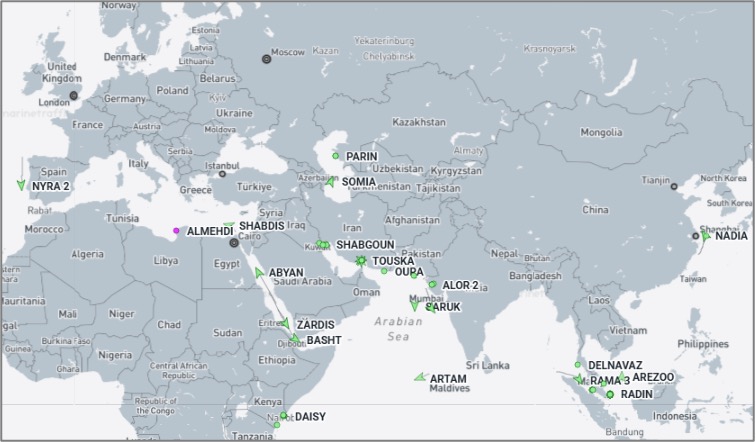
Iran-flagged cargo vessels across the region on November 23 (Credit: Marine Traffic)
At Benghazi, Libya, widespread reports indicate that a Russian warship was struck in port by Ukrainian unmanned surface vessels (USVs) and severely damaged or sunk at its berth. Additional reporting suggests other vessels in the offshore anchorage may also have been targeted. One unverified report indicates that the Iran-flagged general cargo ship ALVAN (IMO 9165798), which has been anchored off Benghazi since November 17, may have been hit. ALVAN continues to broadcast a false identity via an MMSI number associated with a pleasure craft named ALMEHDI.
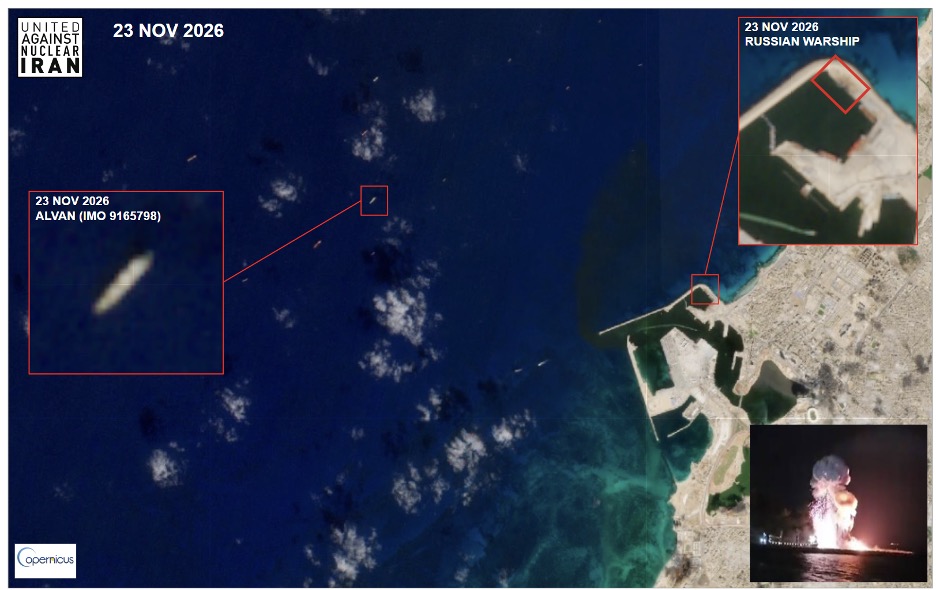
Iran-flagged cargo ship near Benghazi on November 23 (Credit: ESA Copernicus)
In the Gulf of Finland, the Iran-flagged container ship BEHTA (IMO 9349590) likely remained either at or near Bronka Port, near St. Petersburg, Russia, for cargo operations. The vessel’s AIS tracks are displaying signs of GPS jamming that is a regular feature in this area. It is noteworthy that the widely reported Ukrainian drone attack on the Russian cargo ship SPRATA II (IMO 9160994) occurred at the same time BEHTA was in port, following recent visits by other Iranian flagged cargos ships.
In the Atlantic, the container ship NYRA 2 (IMO 9241487) sailed south along the coast of Portugal toward the Gibraltar Strait, which it will transit on November 25, and will arrive at Port Said on December 2.
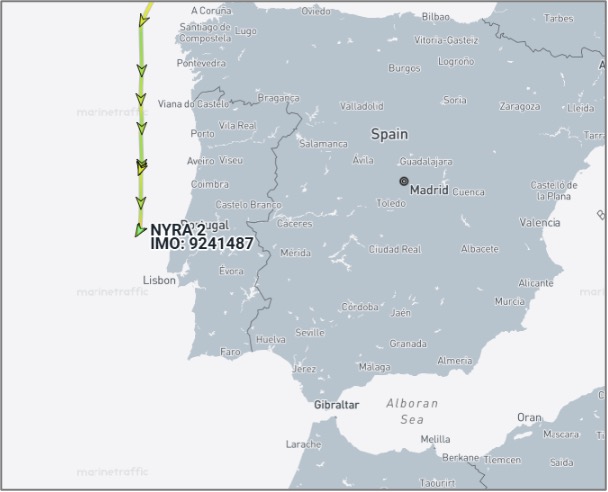
Iranian cargo ship in the Atlantic on November 23 (Credit: Marine Traffic)
At the Suez Canal, the Iran-flagged container ship SHABDIS (IMO 9349588) transited the Suez Canal north into the Mediterranean. The vessel reported its destination as Bronka Port, near St Petersburg, Russia, with an estimated arrival on December 3. Meanwhile, ABYAN (IMO 9349667) approached the Gulf of Suez.
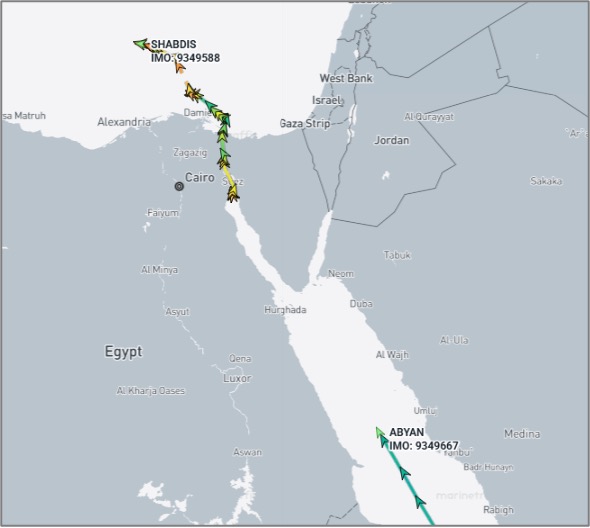
Iran-flagged cargo ships in the Mediterranean and Gulf of Suez on November 19 (Credit: Marine Traffic)
In the Gulf of Aden, ABYAN (IMO 9349667) entered the Gulf on its way to the Suez Canal from Zhuhai Port, China. This vessel is likely to continue to a Russian port following the Suez Canal transit.
In the southern Red Sea, the Iran-flagged container ships ZARDIS (IMO 9349679) and BASHT (IMO 9346536)approached the Bab el-Mandeb toward the Gulf of Aden. ZARDIS is bound for Port Klang with an estimated arrival on December 3, and BASHT is bound for Shanghai with an estimated arrival on December 11.
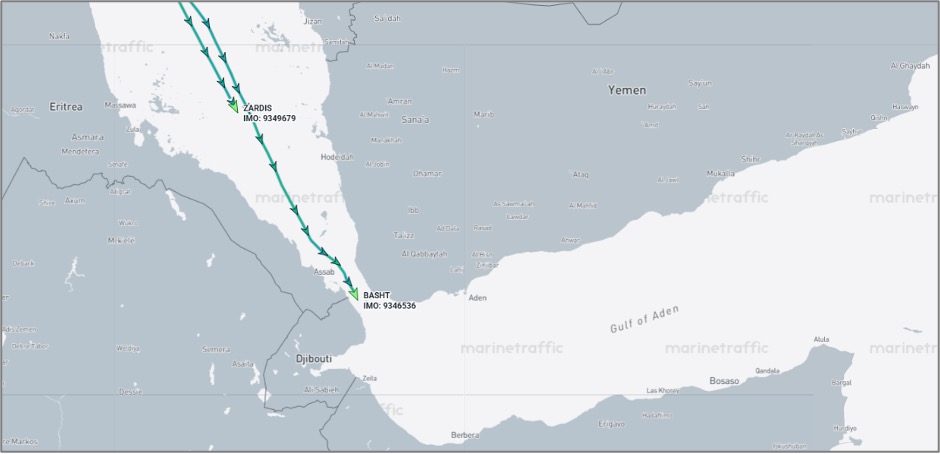
Iran-flagged cargo ship in the Red Sea and Bab el-Mandeb on November 23 (Credit: Marine Traffic)
In the Gulf of Kutch, the falsely flagged, OFAC-sanctioned container ship ENZO 2 (IMO 9236652) pulled into Kandla Container Terminal—occupying the exact berth vacated by FLEXI 2 immediately prior—despite the risk of U.S. secondary sanctions to the commercial port operator. ZYRA (IMO 9237084) arrived and anchored near the other ships. Meanwhile, the falsely flagged, OFAC-sanctioned container ship ZYRA (IMO 9237084) and the falsely flagged, Iran-linked cargo ship ALOR 2 (IMO 9228538) both arrived at Kandla and anchored alongside the other vessels. Concurrently, the container ships VIRA 1 (IMO 9088524) and FLEXI 2 (IMO 9246322) departed the anchorage, with VIRA 1 transiting toward Port Klang, Malaysia, and FLEXI 2 bound for Shanghai, China.
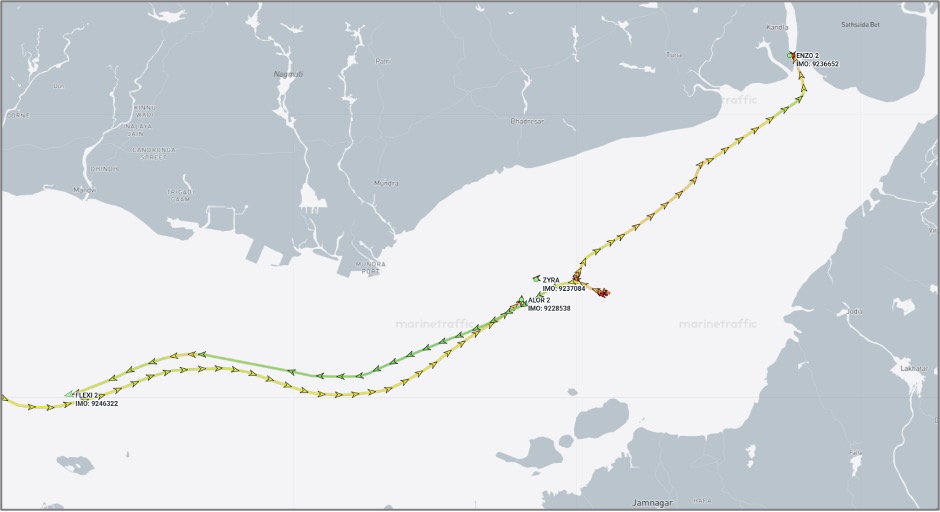
Iran-flagged cargo ships in the Gulf of Kutch on November 23 (Credit: Marine Traffic)
The container ships SARUK (IMO 9719862) and TAVA 4 (IMO 9292151) are still in the Arabian Sea, conducting unusual maneuvers and frequently going dark on AIS.
In the Malacca Strait, the container ship RAVA 3 (IMO 9303754) entered the northern portion of the waterway after transiting the Bay of Bengal and the Six Degree Channel. RAMA 3 likely departed Bandar Abbas, Iran, on or about November 12. During its transit across the Gulf of Oman and the Arabian Sea, the vessel employed deceptive AIS tactics—cycling through multiple false identities—to breach the blockade before resuming its true identity south of Sri Lanka on November 19 for the remainder of the voyage. RAMA 3 is scheduled to arrive at Port Klang, Malaysia, on November 24.
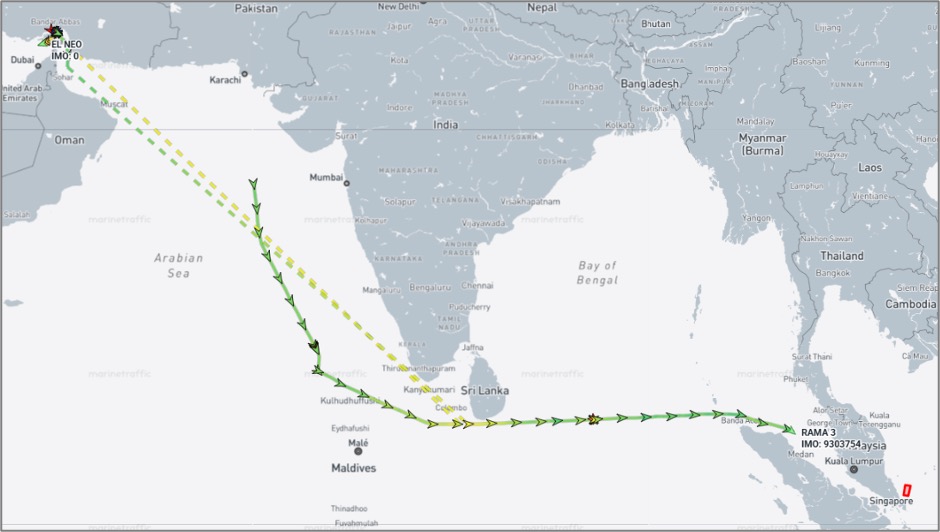
Iran-flagged cargo ship transiting the Indian Ocean into the Strait of Malacca on November 23
(Credit: Marine Traffic)
Near Port Klang, the container ships VELON 1 (IMO 9122473) and KASHAN (IMO 9270696) remained anchored outside the port. SHIBA (IMO 9270646) and FLORA (IMO 9349576) both arrived and anchored nearby. These ships will likely pull into Port Klang container terminal and conduct transshipment operations, despite the risk of secondary sanctions to the port operator and the shipping agents.
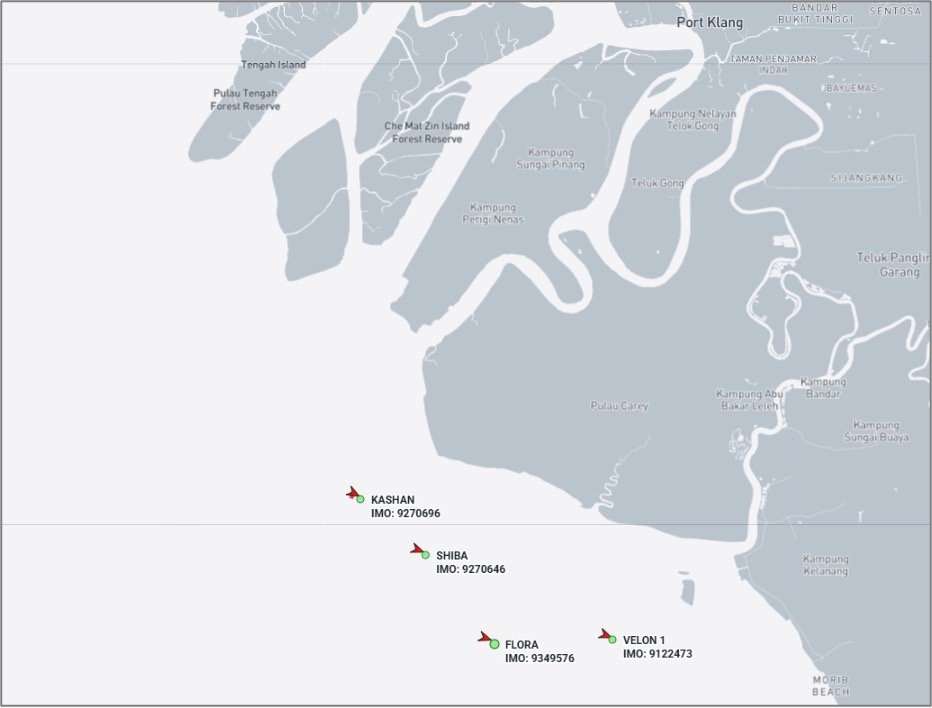
Iran-flagged cargo ships at Port Klang on November 23 (Credit: Marine Traffic)
At the Malaysian EOPL, 20 Iranian-flagged cargo ships remained in the anchorage: AMINA (IMO 9305192), ANDIA (IMO 9193197), ARDAVAN (IMO 9465863), ARIES (IMO 9369722), ARTABAZ (IMO 9283007), ARTENOS (IMO 9283021), ARTIN (IMO 9305221), ARZIN (IMO 9284142), BAHJAT (IMO 9405954), BARZIN (IMO 9820269), BEHDOKHT (IMO 9405978), DARYABAR (IMO 9369710), ELYANA (IMO 9165827), GANJ (IMO 9305219), GOLAFRUZ (IMO 9323833), PARISAN (IMO 9465851), PARNIA (IMO 9167265), PARSHAD (IMO 9387786), RADIN (IMO 9820257), and RAYEN (IMO 9820245). Most of these vessels will likely remain in the EOPL while the blockade is in force, receiving regular logistics support from Malaysian service providers, despite the risk of secondary sanctions from OFAC.
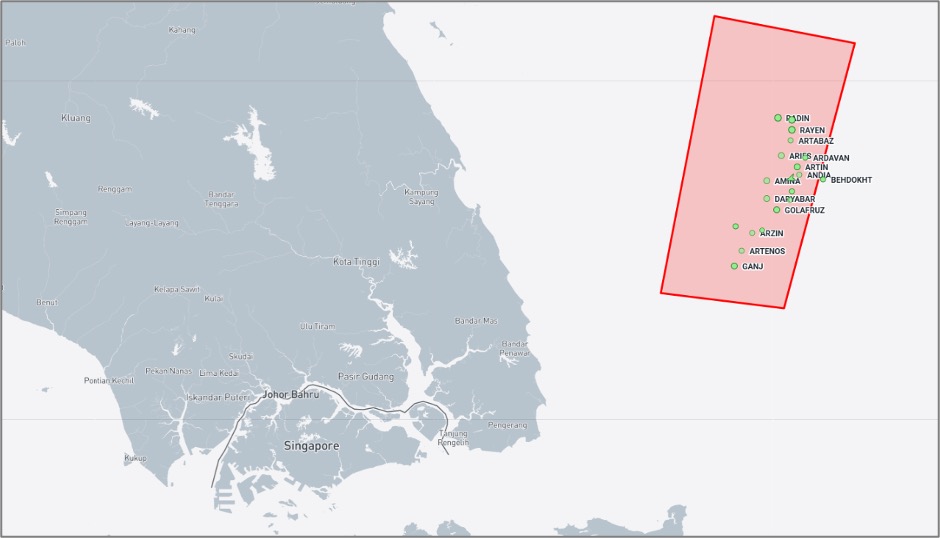
Iran-flagged cargo ships in the Malaysia EOPL on November 23 (Credit: Marine Traffic)
In the South China Sea, the container ship AREZOO (IMO 9165786) passed through the Natuna Sea as it continued sailing from Surabaya to Ho Chi Minh City, Vietnam, with an estimated arrival on November 25.
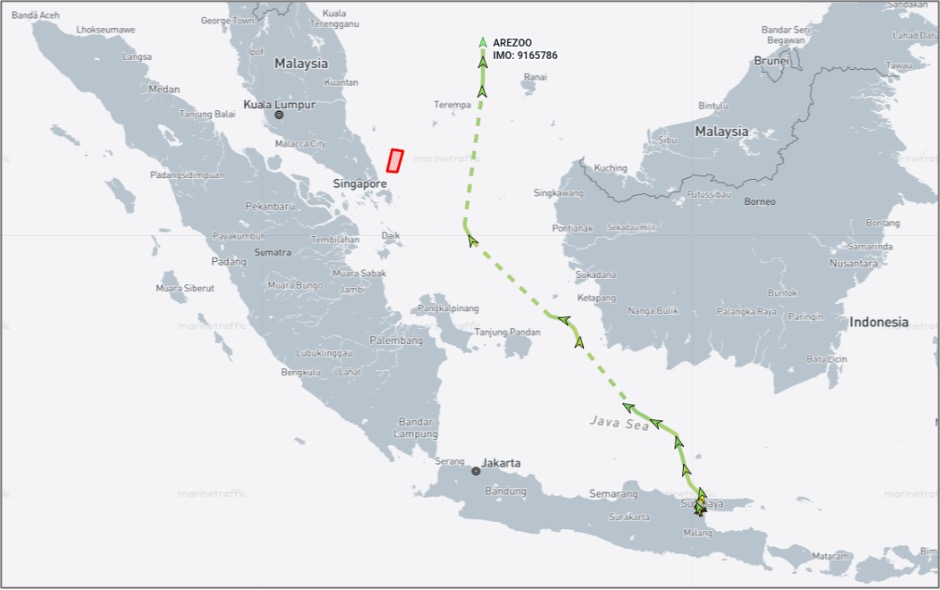
Iran-flagged cargo ship at Surabaya on November 20 (Credit: Marine Traffic)
Off Shanghai, China, the Iran-flagged, OFAC-sanctioned container ship NADIA (IMO 9122461) arrived at the Changjiangkou (CJK) anchorage near the Iran-flagged general cargo ship AYSAN (IMO 9165803), which has been in the anchorage since November 7 following its transit from Vladivostok, Russia.
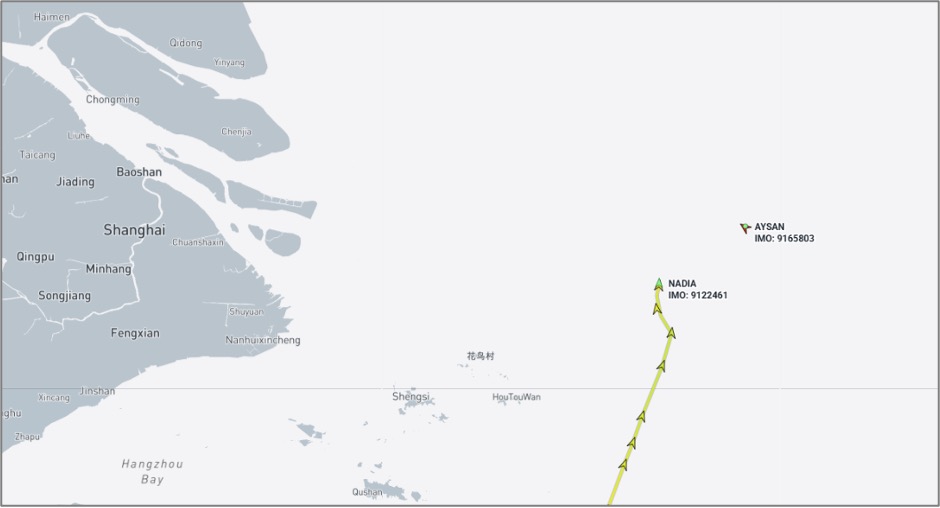
Iran-flagged cargo ships near Shanghai on November 23 (Credit: Marine Traffic)
Five Iranian-flagged cargo vessels are located in Kenyan waters. Near Mombasa, the container ship SHAMIN (IMO 9270658) pulled into port after drifting and loitering outside port limits. In Lamu, the cargo ships HAMOUNA (IMO 9820271), GOLSAN (IMO 9165815), and NESHAT (IMO 9167277) remained anchored inside the harbor near the container terminal. Meanwhile, the container ship DAISY (IMO 9270684) approached the port of Lamu after transiting from Kandla, India. The U.S. Navy announced that the warship USS Delbert D. Black (DDG 119) made a brief stop to refuel in Mombasa on November 19, at the same time the SHAMIN was loitering just offshore.
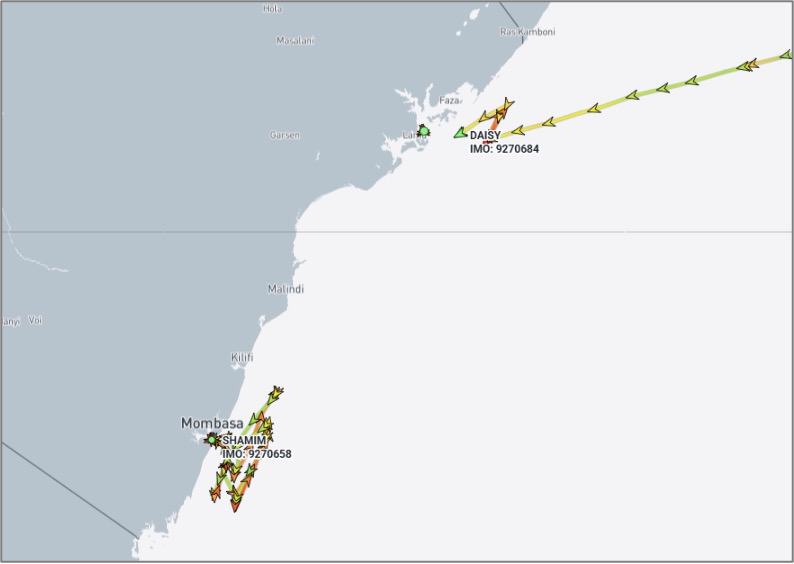
Iran-flagged cargo ships in Kenya on November 23 (Credit: Marine Traffic)
Receive Iran News in Your Inbox.
Eye on Iran is a news summary from United Against Nuclear Iran (UANI), a section 501(c)(3) organization. Eye on Iran is available to subscribers on a daily basis or weekly basis.