September 2026 Tanker Tracker
Introduction
The United States naval blockade continues to maintain a firm grip on Iran’s oil trade. During September 2026, the blockade successfully restricted illicit outflows, allowing only three small Handymax vessels—laden with Iranian liquefied petroleum gas (LPG) and methanol—to depart. This severe curtailment of crude exports raises pressing questions regarding how much longer the Iranian regime can economically survive under such stringent pressure. Simultaneously, floating storage reserves in the Malaysian Eastern Outside Port Limits (EOPL) anchorage have experienced a drastic reduction. The continued enforcement of the blockade compounds economic strain on Tehran, systematically exhausting its secondary reserves in the Malaysian EOPL.
Iranian Oil Exports Data (September 2026)
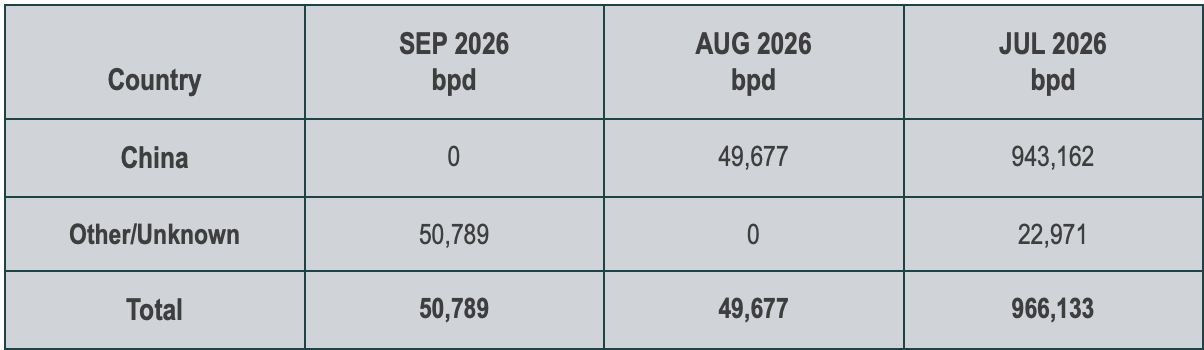
To ensure standardized month-over-month comparisons, export figures are presented in barrels per day (bpd). This framing does, however, require clarification. Daily averages imply an ongoing, continuous flow, whereas September 2026 exports were limited to three isolated handymax shipments.
UANI’s export figures are calculated when tankers cross the declared U.S. blockade line, rather than at the point of loading, as there are many vessels that have been unable to sail because of U.S. enforcement.
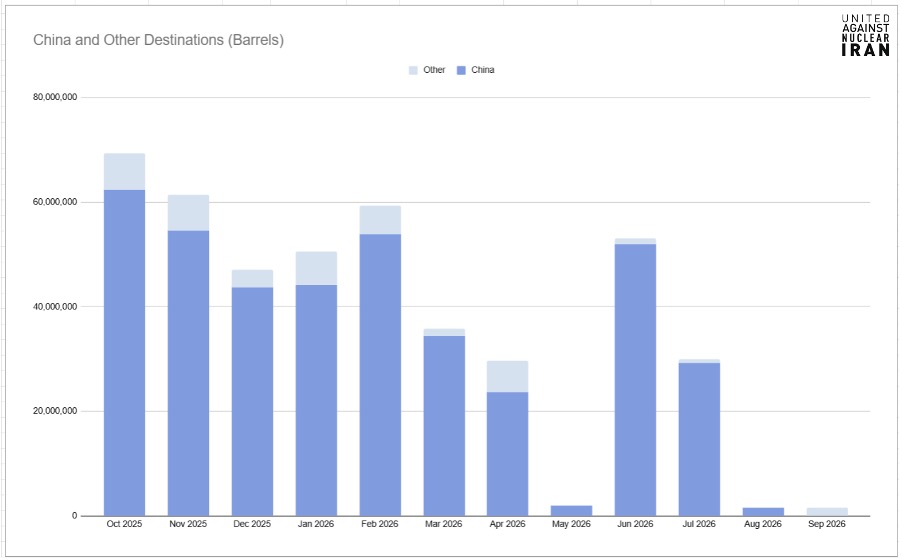
Across September, UANI has only observed three handymax tankers departing the Gulf of Oman and crossing the U.S. blockade line collectively carrying 1.52 million barrels of Iranian LPG and methanol, averaging 50,789 barrels per day (bpd). This extends the drastic drop in export volumes observed in August and remains far below historical averages.
Since July 14, the U.S. maritime blockade on vessels coming and going from Iranian ports has prevented Iran from exporting any of its crude. As of September 30, CENTCOM forces redirected 125 commercial vessels, disabled three that didn’t comply, and boarded two to ensure compliance.
During September, UANI satellite monitoring has also observed no crude oil loadings taking place across Iranian oil export hubs. Loadings were limited strictly to non-crude cargoes, including small volumes of LPG, naphtha and fuel oil.
Strait of Hormuz & Persian Gulf Dynamics
The security environment across the Strait of Hormuz and the wider Persian Gulf remained highly volatile throughout September following military actions targeting shipping and military infrastructure. At the beginning of the month, United States forces struck eight Islamic Revolutionary Guard Corps (IRGC) controlled tankers positioned across the Persian Gulf, dealing a severe blow to Iran’s paramilitary maritime infrastructure. In response, Iranian forces initiated a pattern of sporadic attacks against commercial shipping. The so-called Persian Gulf Shipping Authority (PGSA) published a list of tankers that would be targeted for taking the southern Omani route. While these attacks caused brief, sudden drops in commercial transit volumes, maritime traffic has often quickly rebounded each time as commercial vessels adapted to the threat environment.
Regional Middle East Exports & Dark Transits Rebound
Despite ongoing volatility in the Strait of Hormuz, non-Iranian Middle Eastern crude exports managed to rebound to exceed pre-war levels. According to reports published by Kpler and Vortexa on September 30, crude oil exports from key Middle Eastern producers rose to an average of 18.3 million barrels per day in the final seven days of the month. This represents the highest volume recorded since the outbreak of the conflict in late February, driven largely by significant production and export boosts from Saudi Arabia and the United Arab Emirates.
Maritime tracking services initially struggled to capture the full scope of oil leaving the Persian Gulf. The primary tracking discrepancy stemmed from vessels transiting the Strait of Hormuz dark, having completely disabled their Automatic Identification System (AIS) transponders. Consequently, initial tracking data gave the false impression that throughput through the Strait had plummeted. However, once these tankers reached the Gulf of Oman and reactivated their AIS broadcasts, satellite tracking confirmed that substantial volumes of non-Iranian Gulf crude were successfully reaching international markets. Furthermore, these figures are partly due to Saudi Arabia responding to persistent Houthi blockades and attacks in the Bab el-Mandeb strait by deliberately rerouting larger export volumes through the Strait of Hormuz rather than risk the southern Red Sea route.
Malaysian EOPL Floating Storage
Offshore floating storage inventories in the Malaysian Eastern Outside Port Limits (EOPL) anchorage have been drawn down significantly over the course of the month. Eight STS operations were observed via satellite imagery in September. Two involving Iranian LPG cargo and six STS transferring Iranian crude oil, for an estimated total of 9 million barrels of Iranian crude oil, ultimately bound for Chinese “Teapot” refineries. It is not exactly known how much Iranian crude oil remains in the EOPL, but it is likely not more than 10 million barrels. Given than no Iranian crude has made it past the blockade line, Iran's offshore floating storage in the South China Sea is rapidly dwindling.
UANI On-water Investigation in the South China Sea
On September 16, 2026, a United Anti-Nuclear Iran (UANI) field investigation team chartered a local supply vessel and sailed 100 nautical miles into the South China Sea to directly witness and document the illicit operations of the Ghost Fleet anchored in the Malaysian EOPL. The findings of this maritime expedition were detailed in two articles published by the Wall Street Journal, including an exclusive op-ed co-authored by UANI CEO Ambassador Mark Wallace and Chairman Governor Jeb Bush.
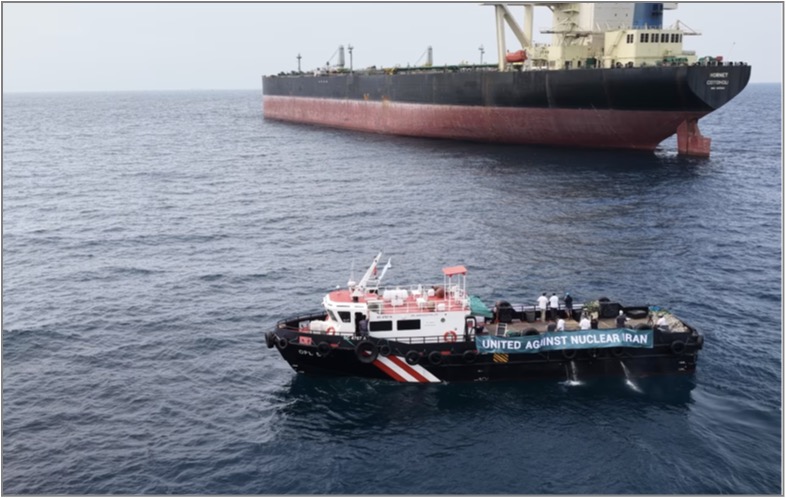
UANI team supply vessel in the Malaysian EOPL on September 16 (Credit: UANI)
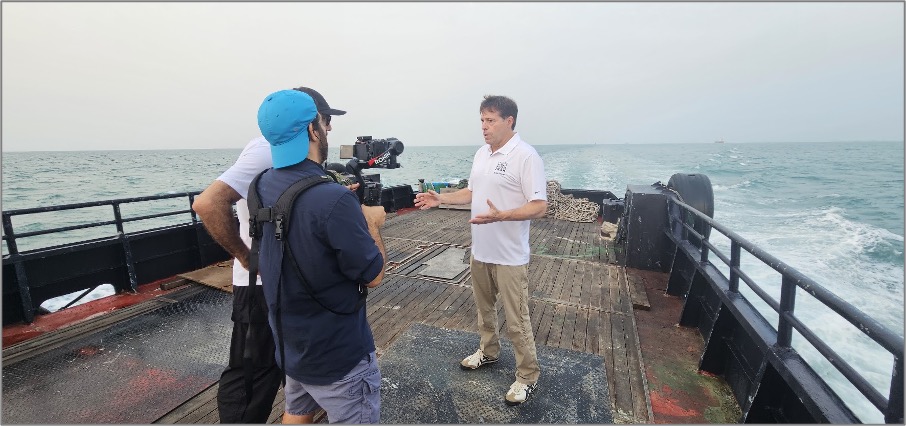
UANI CEO Ambassador Mark Wallace in the Malaysian EOPL on September 16 (Credit: UANI)
During the expedition, the UANI team observed more than 50 vessels anchored in the EOPL. On any given day there are normally about 200 vessels in the vast 1,200 square km area of the EOPL. The team successfully visually identified and catalogued 22 specific tankers and cargo vessels with links to Iran, as well as multiple smaller bunker tankers and support vessels that provide services to these ghost fleet tankers and Iran-flagged cargo ships.
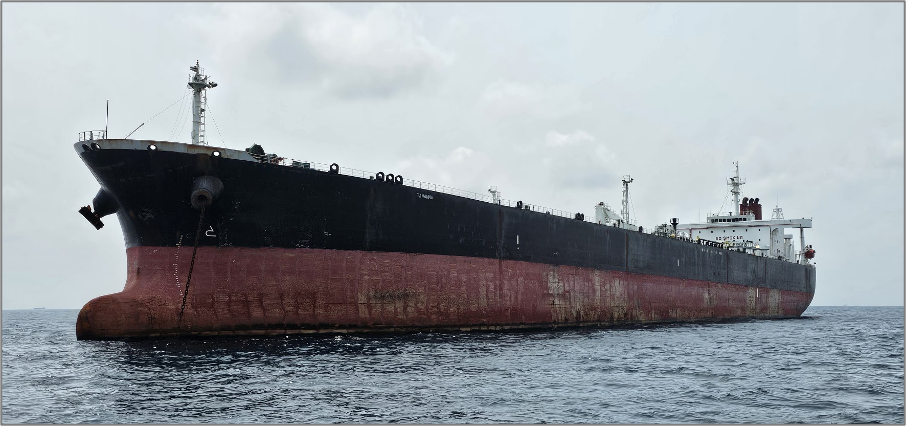
Ghost Armada Tanker in the Malaysian EOPL on September 16 (Credit: UANI)
Support & Bunkering Infrastructure in the EOPL
The field operation revealed a complex network of support and bunkering infrastructure sustaining the Iranian Ghost Fleet in international waters. Small bunker tankers—often found rafted together in groups, or directly alongside Iran-flagged vessels—were observed waiting in the anchorage for mother supply ships arriving from Malaysian shore facilities. These supply ships refill the bunker vessels with fuel drawn directly from major regional terminals, including the Pengerang Integrated Petroleum Complex. At the same time, local Malaysian support craft originating from various Malaysian ports routinely visit the anchored fleet to supply food, provisions, logistics, and vital services to Iran-linked crews.
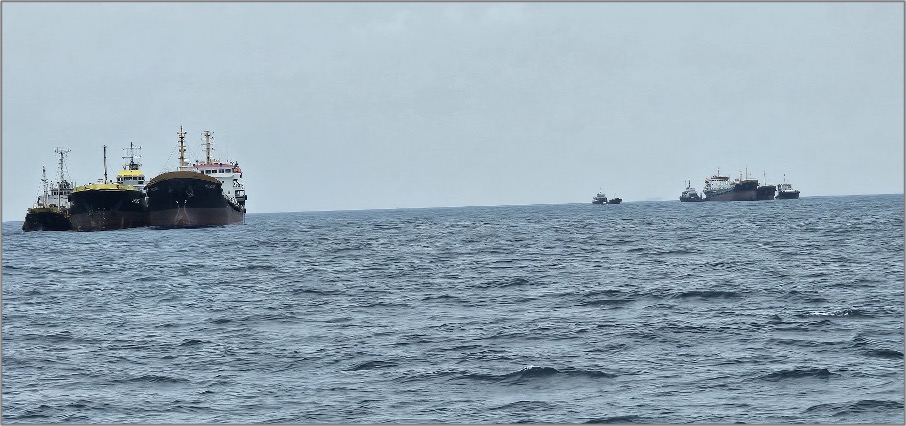
Small bunker tankers in the Malaysian EOPL on September 2016 (Credit: UANI)
Tanker Dispersal & Enforcement Actions in the EOPL
In the days immediately preceding the UANI expedition, local Malaysian authorities reportedly executed some targeted enforcement actions within the EOPL anchorage. These regulatory actions triggered partial movement of vessels across the anchorage. At least 25 Ghost Fleet tankers fled the area, transiting northward deeper into the South China Sea, while approximately 20 Ghost Fleet vessels chose to remain stationed within the EOPL anchorage.
Prior to purported recent enforcement actions, seven Iran-flagged tankers had been loitering in the anchorage, namely: HUMANITY (IMO 9180281), STARLA (IMO 9569621), HILDA I (IMO 9357389), DAN (IMO 9357729), HAPPINESS I (IMO 9212905), HEDY (IMO 9212888), and DORENA (IMO 9569669). These tankers either had already conducted or are waiting to conduct an STS transfer of Iranian oil. Satellite imagery captured on September 26 confirmed that four Iran-flagged tankers—DORENA, HEDY, HUMANITY, and STARLA—remained clustered together within the EOPL anchorage. However, the other Iran-flagged vessels responded to heightened enforcement and public scrutiny by relocating across regional waters and transiting north through the South China Sea to seek safer anchorages south of Hong Kong and Zhuhai, China.
These relocated vessels swiftly resumed ship-to-ship (STS) transfer operations in Chinese territorial waters. The HILDA 1 conducted an STS transfer of Iranian crude oil south of Zhuhai on September 17, while the HAPPINESS I transferred its Iranian crude south of Hong Kong on September 22. The precise location of the tanker DAN remained unconfirmed, though the vessel briefly broadcasted its AIS location on September 25 while transiting southbound through the South China Sea back toward the EOPL.
Indo-Pacific Loitering: Sri Lanka and Oman Anchorages
Prevented from returning to Iranian home ports by the United States blockade, empty Iran-flagged tankers are now loitering at various anchorages across the Indo-Pacific region. This behavior mirrors dispersal patterns observed near Sri Lanka during August. Off the coast of Duqm, Oman, the DIONA (IMO 9569695) remains loitering in deep water.
Concurrently, a group of 20 empty Iran-flagged tankers is loitering off the coast of Sri Lanka. This fleet includes the DREAM II (IMO 9356593), STREAM (IMO 9569633), HALTI (IMO 9212890), SEA CLIFF (IMO 9569657), HERO II (IMO 9362073), SILVIA I (IMO 9172052), SNOW (IMO 9569619), HELM (IMO 9357391), DUNE (IMO 9569712), DEEP SEA (IMO 9218492), DIAMOND II (IMO 9218478), DINO 1 (IMO 9569671), SONIA I (IMO 9357365), DORE (IMO 9357717), HERBY (IMO 9362059), SEVIN (IMO 9357353), FELICITY (IMO 9183934), HENNA (IMO 9212929), AMBER (IMO 9357406), and HUGE (IMO 9357183).
Starting around August 23, most of these vessels departed their previous positions at the Galle anchorage and began loitering across Sri Lanka's Exclusive Economic Zone (EEZ), driven by regulatory pressure following UANI's public exposure of their presence. By September 29, many of these tankers had relocated further north along the Sri Lankan coastline to establish a new OPL anchorage, broadcasting their AIS locations only intermittently.
Iranian Cargo Discharge Destinations & Port Operations
Despite rigorous enforcement, several international ports continue to receive Iranian cargo or facilitate dark transshipment operations. In India, the ports of Chennai, Kandla, and Mumbai continue to receive Iranian shipments and facilitate transshipment activities. In Malaysia, Port Klang remains a primary hub for ongoing cargo handling and likely transshipments. Across September, eight ships have anchored at Port Klang, and four of them pulled into the Port Klang container terminal for cargo operations and possible transhipments. In addition, up to 14 Iran-flagged tankers anchored in the Malaysian EOPL anchorage simultaneously – including the containership BASHT (IMO 9346536) laden with cargo partly loaded at Zhuhai Port, China. Zhuhai Port at Gaolan Island has previously been identified in media reports as a source of precursor chemicals for rocket fuel. All these ships are sanctioned by US OFAC and therefore puts the container terminals, port agents and local logistics providers at risk of secondary sanctions.
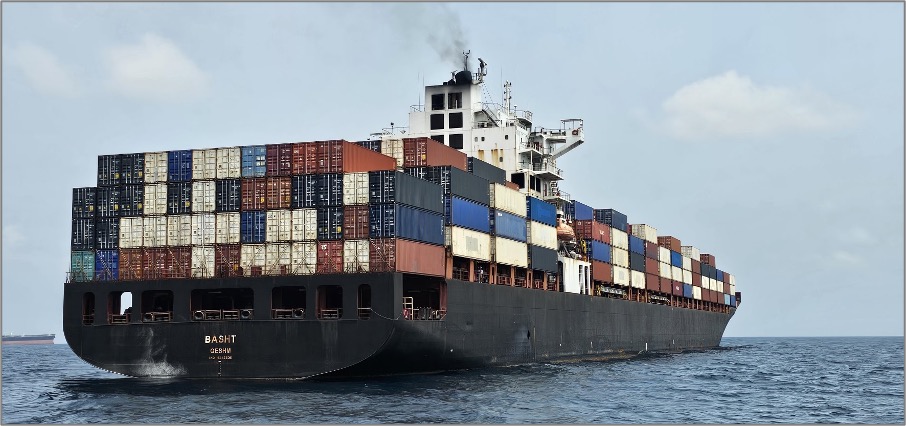
Iran-flagged containership BASHT in Malaysian EOPL on September 2016 (Credit: UANI)
Finally, ports and offloading anchorages across coastal China, particularly those surrounding Shanghai, Hong Kong and Zhuhai, remain active destination points for both Iranian cargo ships and tankers conducting STS transfers of Iranian crude. Across September, four ships have anchored in the anchorage outside Zhuhai Port, and one container ship RADIN (IMO 9820257) pulled into the Zhuhai container terminal for cargo operations.
Recommendations
To counter these evolving evasion tactics, international enforcement bodies must immediately extend secondary sanctions to target the regional supply craft, tugs, and bunker vessels that deliver fuel, provisions, and logistical services to Ghost Fleet ships in the EOPL.
Diplomatic pressure must also be applied directly to coastal states—specifically Malaysia and Sri Lanka—demanding they deny OPL services, provisions, and territorial anchorage rights to sanctioned Iranian vessels.
Finally, targeted sanctions should be expanded against Indian and Malaysian port operators, bunker fuel providers, and local service companies assisting Iran-flagged cargo ships.
Receive Iran News in Your Inbox.
Eye on Iran is a news summary from United Against Nuclear Iran (UANI), a section 501(c)(3) organization. Eye on Iran is available to subscribers on a daily basis or weekly basis.