Revelations About Mojtaba Khamenei from Iran’s Foreign Minister
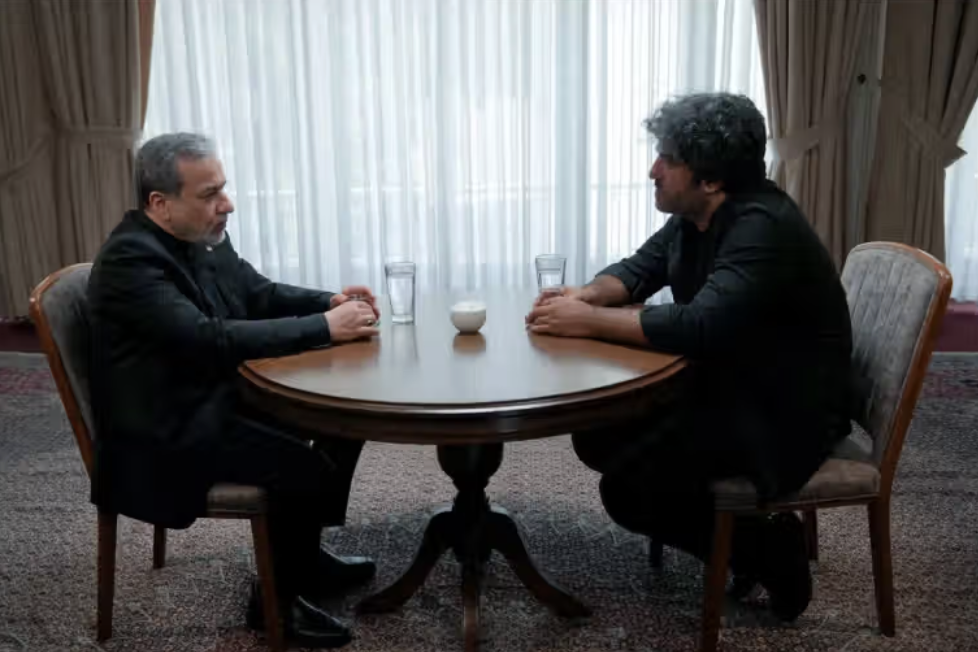
Iranian Foreign Minister Abbas Araghchi is interviewed for YouTube. Image: Telegram.
This week, Iran’s Foreign Minister Abbas Araghchi gave an interview to a pro-regime journalist Javad Mogouyi in which he made a striking revelation. Araghchi said that he had never interacted with Supreme Leader Mojtaba Khamenei—before he succeeded his father as supreme leader and after he was elevated to the top post.
Araghchi told Mogouyi, “Personally, I’ve never interacted with him. I’ve seen him from a distance a few times at public gatherings, but we’ve never had a conversation.” He added, “I don’t think many people have” met with Mojtaba Khamenei since he ascended to the Islamic Republic’s top position.
Such a dynamic in the Iranian leadership is highly unusual. For years, Ali Khamenei dominated Iranian foreign policy decision-making, both on policy and personnel, and micromanaged sensitive files. While the president technically nominates the foreign minister to be confirmed by parliament, in practice the supreme leader pre-approves the nomination. The supreme leader has traditionally had a close relationship with foreign ministers. For example, after Ali Akbar Velayati left his post as foreign minister in 1997, he became the supreme leader’s foreign policy advisor. Some previous foreign ministers, however, have had more complicated relationships with the supreme leader. For example, Ali Khamenei was displeased with a leaked interview that surfaced in 2021 where Javad Zarif was thought to have crossed red lines in criticizing the Islamic Revolutionary Guard Corps (IRGC).
Foreign ministers also traditionally appear alongside the supreme leader during his bilateral meetings with visiting world leaders to Tehran. This week, Iraq’s prime minister visited Iran. Normally, the prime minister would meet with the supreme leader. But with Mojtaba Khamenei in hiding and having not even met his own foreign minister since ascending to the supreme leadership, there was no such gathering.
In the same interview, Araghchi disclosed that he was briefing Ali Asghar Mir-Hejazi, Ali Khamenei’s longtime security advisor, when Israel targeted the Iranian leadership compound at the beginning of Operation Epic Fury in February, killing Khamenei. This shows a close interchange between the Office of the Supreme Leader and the foreign minister. Araghchi also mentioned that a six-person subcommittee of the Supreme National Security Council (SNSC) was making real-time decisions about the negotiations “because it was difficult to communicate with the top.” He noted that the president, speaker of parliament, secretary of the SNSC, and the foreign minister were members of this subcommittee. Other members likely include the commander-in-chief of the IRGC Ahmad Vahidi.
This model of decision-making in Iran is different from the era of Ali Khamenei, which was more centralized. Power today is more diffuse. Without an accessible and visible supreme leader as the glue of the system, the risks of fissures and factions within the Iranian political elite increase. Assuming Mojtaba Khamenei is still alive, Vahidi’s reportedly privileged access to the supreme leader provides him with an advantage to dominate the policy process. Hejazi no longer appears to be as powerful as he once was under Ali Khamenei’s supreme leadership, as efforts have reportedly been underway to purge him given he opposed the naming of Mojtaba Khamenei as supreme leader. This changes the dynamic in which Araghchi is used to operating.
At the beginning of his tenure, Mojtaba Khamenei also made the decision to retain the appointees of his father to key posts. Aside from a new military advisor, Mohsen Rezaei, the new supreme leader has not changed his core foreign policy advisors, especially after the killing of former Foreign Minister Kamal Kharazi who served as chairman of the Strategic Council on Foreign Relations. Velayati remains on the scene and is listed in Iranian media as an advisor to the supreme leader, although he is ageing and ailing.
This underscores the evolutions underway in Iranian leadership dynamics following Operation Epic Fury. Given wartime conditions, the Islamic Republic finds itself having to adapt and at times improvise to an ongoing multitude of crises.
Jason M. Brodsky is the policy director of United Against Nuclear Iran (UANI).
Receive Iran News in Your Inbox.
Eye on Iran is a news summary from United Against Nuclear Iran (UANI), a section 501(c)(3) organization. Eye on Iran is available to subscribers on a daily basis or weekly basis.