Iran War Shipping Update—March 19, 2026
Since the onset of Operation Epic Fury, UANI has monitored a significant volume of Iranian oil at sea. Illicit Iranian oil sales are a major source of funding for the Islamic Revolutionary Guard Corps (IRGC), which is currently conducting military and terrorist operations targeting the U.S., Israel, Arab states in the Persian Gulf, and international shipping. In the weeks leading up to the conflict, Tehran sharply increased crude loadings and offshore stockpiling to cushion the impact of war on its oil trade. Amid ongoing hostilities, the Iranian regime’s Ghost Fleet continues to operate actively — loading cargo, transiting the Strait of Hormuz, and heading east toward its primary buyer, China. UANI’s regular shipping update will continue to monitor and report on the illicit maritime movements of the Iranian regime’s ghost fleet throughout the conflict.
Status of South Pars Gas Field
On March 18, Israel conducted precision strikes on Iran’s South Pars gas field facilities, damaging key processing infrastructure and temporarily disrupting a portion of Iran’s gas output. The strike marks a clear escalation into the targeting of energy infrastructure, prompting immediate Iranian retaliation against Persian Gulf energy assets and elevating regional military alert levels. The risk of sustained tit-for-tat attacks on critical energy nodes is rising, with potential spillover into maritime chokepoints — particularly the Strait of Hormuz — threatening global energy flows and shipping security.
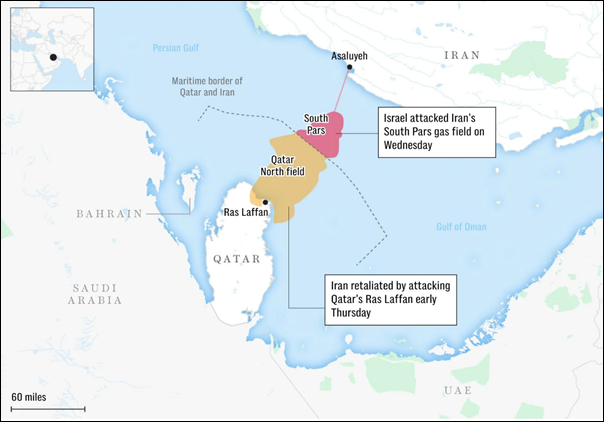
Map of Israeli strike on Iran’s South Pars Gas Fields (Credit: Telegraph)
IMO Council Extraordinary Meeting
The International Maritime Organization (IMO) Council convened in London for its 36th Extraordinary Session to address the impacts on shipping and seafarers from the ongoing conflict in the Arabian Sea, Sea of Oman, and Persian Gulf region — particularly in and around the Strait of Hormuz.
A large coalition of Member States strongly condemned Iran's egregious attacks on commercial vessels and regional territories, as well as the purported closure of the Strait of Hormuz, demanding immediate compliance with international law to ensure unhindered navigation.
The coalition urged IMO committees to enhance support for affected seafarers while requesting the Secretariat and leadership to closely monitor the situation and share ongoing updates with Member States. To address the immediate danger faced by stranded crews, a related proposal urgently called for the establishment of a provisional safe maritime corridor. The primary purpose of this framework was to facilitate the safe evacuation of merchant ships and seafarers from high-risk areas, protecting them from further military attacks.
Status of the Strait of Hormuz
The Strait of Hormuz remains a critical flashpoint in the ongoing Iran war, as the Iranian regime intensifies efforts to disrupt maritime traffic. Since the start of the conflict, at least 21 commercial vessels have been hit.
The escalating risk has created severe congestion and instability across the Persian Gulf’s shipping lanes. Prior to the outbreak of hostilities, about 138 vessels transited the Strait of Hormuz daily. Since March 1, 2026, marine traffic data shows growing clusters of loitering vessels on both sides of the Strait of Hormuz, with many refraining from transiting due to safety concerns. On March 17, just three vessels were reported to openly, with their AIS on, transit the Strait of Hormuz.
On March 18, three OFAC‑sanctioned, UANI‑listed tankers transited the strait westbound, hugging the Iranian coastline as they proceeded into the Persian Gulf, likely to load cargo — potentially Iranian oil.
Iranian Oil-Laden Tankers in the Persian Gulf
UANI has identified at least 25 tankers laden with Iranian oil — primarily crude — currently operating inside the Persian Gulf, west of the Strait of Hormuz.
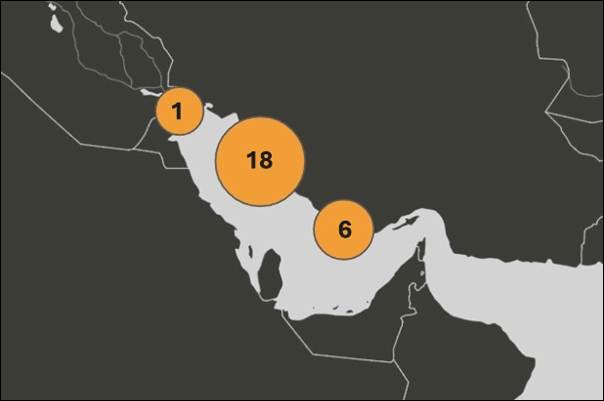
Map of Iranian oil laden tankers in the Persian Gulf on March 18
Number of Iranian Loadings
Since the outbreak of the conflict, UANI has tracked at least 15 Iranian oil loadings, 11 of which originated from Kharg Island. These shipments represent approximately 20 million barrels of Iranian oil, generating an estimated revenue of over $1 billion for the IRGC, which continues to fund Iran’s active missile and drone programs central to the conflict.
Iran-oil Laden Tankers That have Left the Persian Gulf
Since the start of the conflict, UANI has observed at least seven dark fleet tankers that have left the Persian Gulf — some broadcasting their AIS signals and others operating clandestinely — likely en route to Malaysia to conduct ship-to-ship (STS) transfers with other Ghost Fleet vessels bound for China.
Iran-flagged Tankers Globally
UANI has monitored Iranian-flagged tankers sailing outside of the Persian Gulf area. On March 19, two Iranian-flagged tankers laden with crude oil from Kharg Island, entered the northern part of the Strait of Malacca en route to the anchorages off Malaysia. These two ships make a total of twelve Iranian-flagged tankers that have arrived in the waters of Southeast Asia on their way to the Eastern Out of Port Limits (EOPL anchorage off Johor, Malaysia). Three un-laden Iranian-flagged tankers departed the EOPL anchorage and transited the Singapore Strait, westbound, beginning their journey back to Iran. Since the start of the conflict, fourteen tankers have begun to return from the Southeast Asian waters through the Indian Ocean towards Iran.
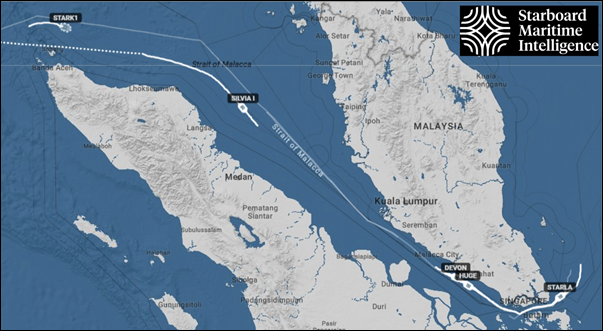
Two Iranian-flagged tankers, laden with oil cargo, arriving in the Malacca Strait, and three empty Iranian-flagged tankers passing the Singapore Strait westbound, on March 19 (Credit: Starboard Intel)
Iran-Oil Laden Tankers off the Malaysian Coast
Since the start of the conflict, UANI has recorded 67 Iranian oil laden tankers in the East Outer Port Limits (EOPL) area, a ghost fleet hotspot approximately 70 km off Malaysia’s coast. All of these have been spotted in satellite imagery, despite not broadcasting on AIS.
Receive Iran News in Your Inbox.
Eye on Iran is a news summary from United Against Nuclear Iran (UANI), a section 501(c)(3) organization. Eye on Iran is available to subscribers on a daily basis or weekly basis.