May 2026 Iran Tanker Tracker
Iran’s oil exports fell by more than 90% in May, as U.S. maritime enforcement of an American naval blockade severely disrupted Tehran’s sanctions‑busting network of ghost fleet tankers. Exports have fallen to record lows, with both total volumes and the number of loadings markedly reduced compared to previous months in 2026. Throughout the entire month, UANI recorded only four naphtha exports and an undetermined but limited volume of liquefied petroleum gas (LPG). No crude oil exports departed Iranian waters and successfully passed through the U.S. blockade.
May 2026 Oil Export Data
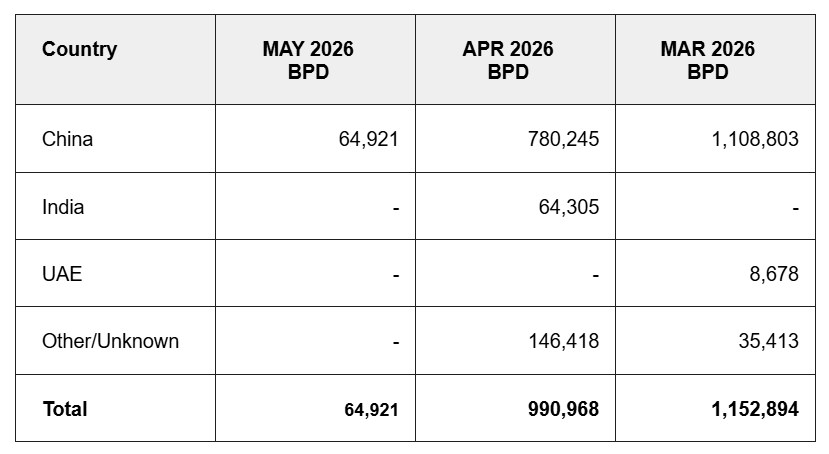
*Export figures are assessed when vessels cross the declared blockade line and exit the Gulf of Oman rather than at point of loading.
Total Iranian Oil Exports per Month (June 2025 – May 2026)
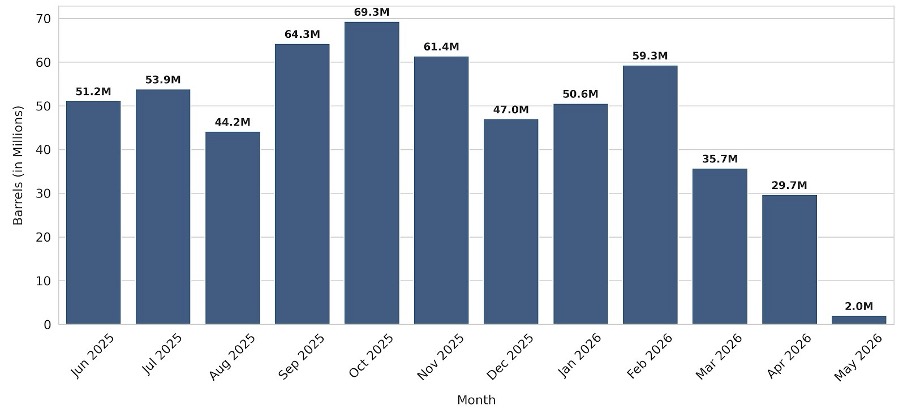
For the month of May 2026, UANI tracked a total of 2.01 million barrels (averaging 64,921 barrels per day, or BPD) in physical exports out of Iran, a 93% volume drop from April, due to disruptions from the U.S. blockade. The estimated value of oil exported in May 2026 is $219 million, down 94% from April. So far in 2026, Iran has exported 177.4 million barrels for an estimated total value of $14.88 billion.
UANI’s export figures are calculated when tankers cross the declared U.S. blockade line, rather than at the point of loading. As a result, these totals may appear lower than those reported by other organizations, particularly given the current buildup of Iranian oil-laden tankers in Iranian waters that have been unable to sail because of U.S. restrictions.
This huge blow to Iran’s oil exports, which have been limited to only a few smaller Panamax and Handymax tankers transporting Iranian petrochemicals to China, is demonstrative of how effective the U.S. blockade has been. In practical terms, Iran’s once robust sanctions busting network has been reduced to a trickle of small, high-risk voyages while the bulk of its oil sits idle offshore.
Collapsing export volumes and fewer loadings
Exports have dropped meaning that there is a build-up of oil laden tankers constrained by U.S. blockade measures, but also loadings have reduced and follow new patterns. Throughout May, most observed crude loadings have been on smaller Handymax or Panamax‑class vessels, each typically able to carry under 300,000 barrels per voyage. This represents a clear shift away from the larger Very Large Crude Carriers (VLCCs) that Iran has historically relied upon to move 2-million-barrel cargos in fewer trips. The increased use of these smaller vessels appears primarily linked to domestic movements of product between Iranian facilities, rather than to exports.
The combination of tighter U.S. enforcement and heightened risk of VLCC interdictions across key transit areas has forced Iran’s hydrocarbon exports into smaller, less efficient vessels, further constraining Tehran’s ability to monetize its oil.
Build-up of laden tankers inside the blockade line
At the same time, visible groups of tankers, both laden and unladen, have formed along the Iranian coastline. As of May 31, there were approximately 69 laden tankers inside the blockade line which runs from the most eastern point of Oman to the Iranian-Pakistan border. Major clusters include approximately 13 laden tankers in the Kharg Island anchorage and 14 laden tankers by Chabahar Port. This collectively adds up to over 80 million barrels of crude and petrochemicals effectively stranded and unable to proceed to traditional transshipment points in the Iranian oil trade to China.
On May 31, 22 tankers were observed at the Kharg Island anchorage, 14 of which were laden with Iranian hydrocarbons, highlighted in red in the map below.
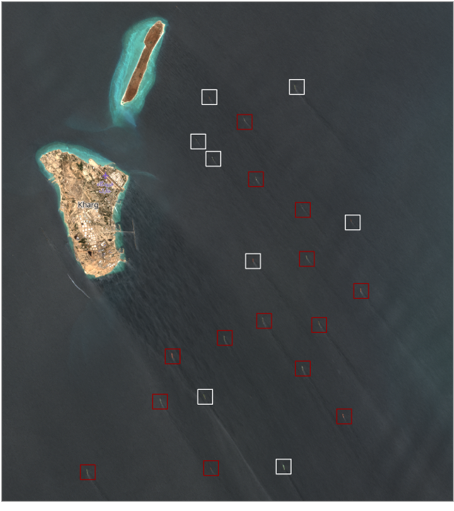
22 tankers near Kharg Island, Iran on May 31
This floating stockpile represents postponed and potentially lost revenue, as well as increased operational risk for Iran and its buyers: every additional day at anchor adds costs, raises exposure to detection and enforcement, and ties up vessels that Iran needs to sustain its export program.
Only a few tankers slipped through
While most tankers laden with Iranian hydrocarbons have been forced to turn back toward Iranian ports by the current enforcement posture, only a small handful have managed to pass through the blockade line. Even for those few, persistent monitoring and exposure by UANI has limited their ability to quietly deliver Iranian barrels to tankers bound for China.
UANI was the first to publicly locate the Iran flagged supertanker HUGE (IMO 9357183) on May 13 as it sailed the South China Sea northbound and toward an anchorage over 100 km southwest of Hong Kong, where it is likely waiting to conduct a ship‑to‑ship transfer with another tanker bound for China.
Separately, UANI monitored the falsely flagged supertanker SKYWAVE (IMO 9328716) transiting the Strait of Hormuz on March 11 with approximately 1.9 million barrels of Iranian crude bound for buyers in China. UANI blacklisted SKYWAVE in 2023 and added it to the Ghost Armada list, and OFAC subsequently sanctioned the vessel in 2025. On May 19, the falsely flagged supertanker SKYWAVE was seized by U.S. forces in the Indian Ocean, between Indonesia and Sri Lanka, on its way back from conducting a ship-to-ship transfer in the Malaysian Eastern Outer Port Limits (EOPL) and toward Iran. UANI Senior Advisor Charlie Brown also observed SKYWAVE firsthand during a trip to the Malaysian EOPL, where he photographed the empty supertanker on May 8.
During May, an additional 16 tankers previously identified and listed on UANI’s Ghost Armada were sanctioned by OFAC, underscoring the linkage between UANI monitoring, public exposure, and U.S. enforcement action.
New patterns in the Iranian oil routes to China
New patterns are emerging among a small number of Iran‑flagged tankers carrying Iranian oil to China due to the U.S. enforcement of the blockade. Rather than transiting the traditional Malacca and Singapore Straits, the tankers HUGE and DERYA (IMO 9569700) departed Iran laden with oil reportedly bound for China and likely took a longer, less economical route across the Indian Ocean via the Lombok Strait to reduce the risk of interdiction by U.S. naval forces.
In addition, HUGE and TOUR 2 (IMO 9364112) have both transited the South China Sea northbound to waters south of Hong Kong, an unusual pattern of movement for Iran‑flagged, OFAC‑sanctioned tankers and further evidence that Iranian oil flows are being forced onto more circuitous, high‑risk routes.
Global clustering of Iranian‑linked tankers and cargo ships
UANI has observed growing clusters of Iranian‑linked cargo vessels and tankers at multiple global hubs, particularly in Southeast Asia and known key ship‑to‑ship (STS) transfer zones.
The waters near Malaysia have continued to be a focal point for Iran flagged vessels. As of May 29, six Iran‑flagged cargo ships are anchored at the Malaysian EOPL, with a further two Iran‑flagged cargo ships anchored in the vicinity of Malaysia’s Port Klang.
Another sizeable cluster has formed around 70 km off Karachi, Pakistan, where five Iran‑flagged cargo ships and four Iran‑flagged tankers are currently at anchor. Furthermore, at least 8 other non-Iranian flagged Ghost Armada tankers are also anchored in Pakistan’s Exclusive Economic Zone (EEZ).
Additional groupings include four Iran‑flagged cargo ships and one tanker near Mogadishu, Somalia, as well as three Iran‑flagged cargo ships and one tanker to the southwest of Hong Kong. All of these vessels have been observed broadcasting on AIS.
Case study: On‑the‑water observation at the Malaysian EOPL anchorage
In May, UANI Senior Advisor Charlie Brown was featured in the Wall Street Journal investigation into the Malaysia EOPL anchorage, a major STS transfer hotspot. The investigation involved an on‑the‑water visit by boat to the anchorage to document ghost fleet activity. During this visit, Brown identified multiple ghost fleet tankers, including the FREDA (IMO 9402469) engaged in an STS transfer with CATALINA 7 (IMO 9310159), both vessels with a long history of deceptive practices used to move Iranian oil.
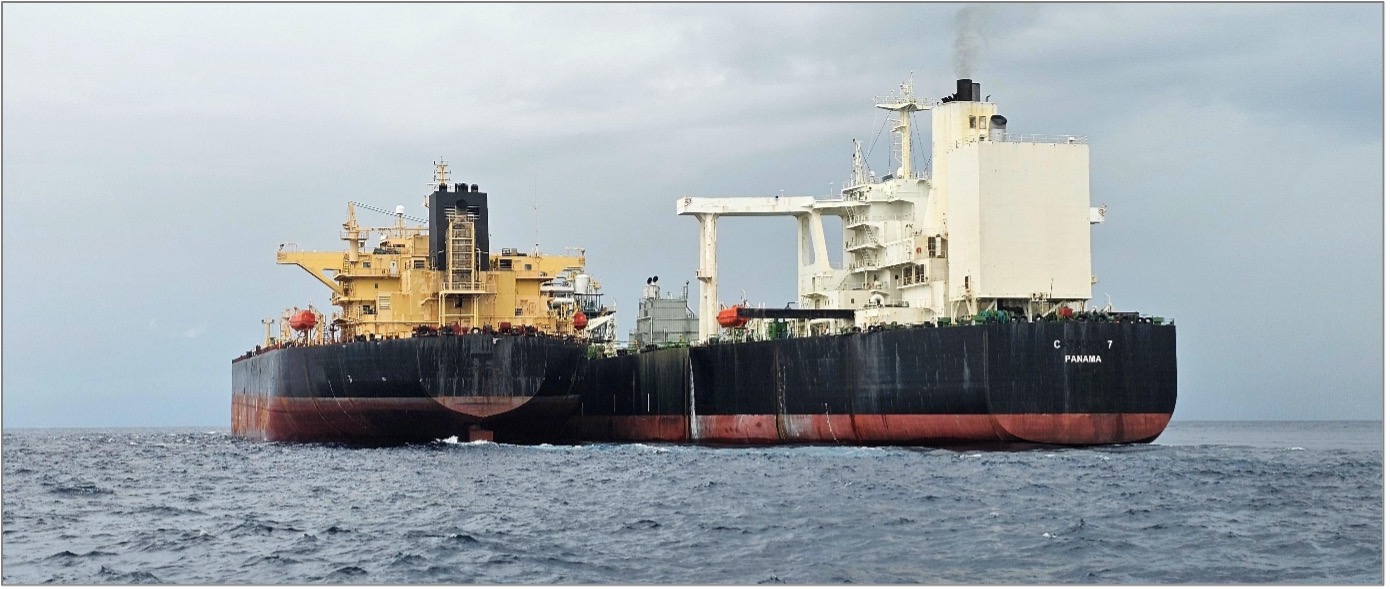
STS between CATALINA 7 and FREDA in the EOPL on May 8
This particular STS operation likely involved Iranian-origin crude. FREDA and CATALINA 7 have been loitering and anchoring in the EOPL for months, carrying out a complex sequence of STS transfers with various other tankers, potentially mixing sanctioned crudes from different sources in an effort to obfuscate the true origin of their cargos.
Both tankers have conducted multiple STS transfers of Iranian crude and have been associated with irregular AIS behaviour, including prolonged “dark” periods when engaged in an STS transfer or discharging at a Chinese port. This pattern underscores how Iranian barrels rely on increasingly elaborate, high‑risk schemes, and how sustained scrutiny at key hubs like the EOPL can materially disrupt the viability of Iran’s global sanctions‑evasion architecture.
Strategic impact on Iran and China
The current enforcement posture and the informal maritime blockade are proving effective: export volumes are down, loadings are smaller and less efficient, and an increasing share of Iran’s oil is stuck either on the water in the Persian Gulf, Gulf of Oman or bottlenecked at high‑risk STS hotspots.
These constraints are not only denying Tehran vital oil revenue but also complicating China’s ability to rely on heavily discounted Iranian crude, thereby increasing economic pressure on both the Iranian regime and its primary customer.
Taken together, the collapse in large‑scale loadings, the visible buildup of stranded tankers inside the blockade line, and the clustering of suspect cargos at places like the Malaysian EOPL anchorage demonstrate that robust enforcement is having real, tangible effects on Iran’s maritime networks and exports. If these measures are sustained, they will continue to increase the cost, risk, and difficulty of moving Iranian barrels, applying mounting pressure on the Iranian regime and its principal buyers.
Conclusion
The U.S. maritime blockade has driven Iran’s crude and petrochemical exports down to record lows and prevented dozens of oil‑laden tankers from leaving Iranian waters. Iran’s sanctions‑busting network are now stuck inside the blockade or, for the few that have escaped, forced onto longer, riskier routes and increasingly dependent on smaller, less efficient vessels.
To preserve and build on this leverage, policymakers should:
- Maintain the current U.S. maritime blockade and sustain enhanced sanctions enforcement until negotiations produce a favourable outcome that advances U.S. national security objectives.
- Coordinate with regional partners to crack down on Iranian‑linked STS transfers and ghost fleet activity at hubs, particularly the Malaysian EOPL.
These steps would help ensure that the gains achieved since April 13 are not temporary but instead translate into sustained economic pressure on Tehran.
Receive Iran News in Your Inbox.
Eye on Iran is a news summary from United Against Nuclear Iran (UANI), a section 501(c)(3) organization. Eye on Iran is available to subscribers on a daily basis or weekly basis.