Iran War Shipping Update - April 16, 2026
During the Iran War, the Iranian regime’s Ghost Fleet has continued to operate actively — loading cargo, transiting the Strait of Hormuz, and heading east toward its primary buyer, China. The U.S. blockade may now be constraining those exports, as UANI’s shipping updates continue to track the ghost fleet’s illicit maritime movements throughout the conflict.
U.S. Blockade
On April 7, President Trump announced a two-week ceasefire with Iran. Pakistan mediated ceasefire talks, which President Trump stated was contingent on the “complete, immediate, and safe opening” of the Strait of Hormuz, effectively ending its wartime closure. However, on April 12, after ceasefire talks with Iran ended without an agreement, President Trump announced that the U.S. would initiate a naval blockade of all Iranian ports and coastal areas effective April 13. U.S. Central Command posted that U.S. forces are “executing the mission to blockade ships entering and departing Iranian ports” on April 14. By blockading vessels calling on Iranian ports, including tankers carrying Iranian oil, the administration aims to cut off the Iranian regime’s major source of revenue. The blockade, now implemented, represents a significant escalation in U.S. enforcement strategy, with implications for global energy markets, regional stability, and the future calibration of U.S. sanctions policy.
On April 16, Joint Chiefs of Staff Chair Gen. Dan Caine provided an update on the U.S. Blockade, saying 13 vessels had turned around without passing through and that no vessels had yet been interdicted. In the map below, the red vessels are tankers departing Iranian ports and attempting to pass through, while the blue vessels are U.S. Navy warships.
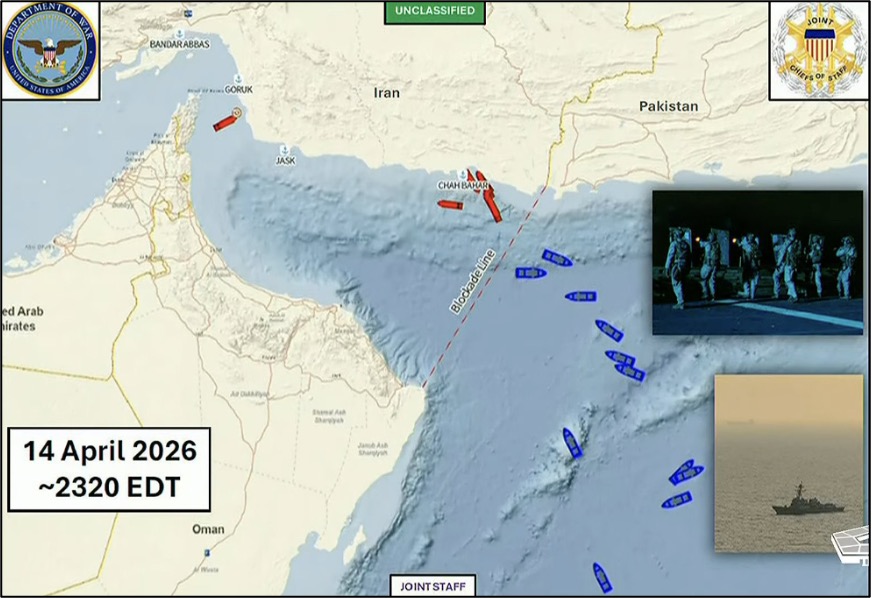
Map of U.S. blockade from Gen. Caine’s Update on April 16 (Credit: U.S. Department of War)
On April 15, there were 15 transits of the Strait of Hormuz, eight inbound and seven outbound, according to Windward. Most of these vessels appear to be reporting their location on AIS, though GPS jamming and potential spoofing makes confirmation difficult.
The continued presence of AIS signals from merchant traffic transiting the Strait of Hormuz is not evidence that the U.S. blockade is ineffective. Rather, it demonstrates that Iran’s attempted disruption of the international strait is being displaced and that freedom of navigation for neutral commerce is being restored. U.S. naval forces are exercising belligerent control primarily in the Gulf of Oman, where the operational focus is on blockade enforcement, visit and search, and diversion of vessels engaged in ingress to or egress from Iranian ports. Neutral merchant shipping engaged in legitimate commerce and not bound to or departing from Iranian ports is not, in itself, the object of interdiction. Priority is instead placed on laden tankers departing Iranian terminals, particularly those carrying crude oil, as these voyages constitute clear egress from the blockaded area and may amount to breach or attempted breach of blockade.
Status of the Strait of Hormuz
The Strait of Hormuz therefore remains a critical flashpoint in the Iran campaign. Since the start of the conflict, there have been at least 25 commercial vessels hit, plus four near misses.
The escalating risk has created severe congestion and instability across the Persian Gulf’s shipping lanes. Prior to the outbreak of hostilities, about 138 vessels transited the Strait of Hormuz daily. Since March 1, 2026, marine traffic data shows growing clusters of loitering vessels on both sides of the Strait of Hormuz, with many refraining from transiting due to safety concerns.
On April 8, an unconfirmed map issued by the Islamic Revolutionary Guard Corps (IRGC) outlined a proposed Hormuz traffic separation scheme requiring vessels to coordinate with the IRGC Navy. The latest purported guidance from Iran also warns of anti-ship mines in the main traffic lane, while the IRGC continues to vet traffic based on geopolitical affiliation.
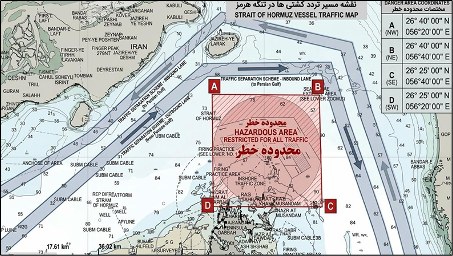
Iran’s formal notice of the Strait of Hormuz transit routes published on April 8 (Source: Iran’s National Security Commission)
OFAC-sanctioned and UANI-listed tankers — alongside some non-sanctioned, ostensibly legitimate vessels — have transited the Strait of Hormuz intermittently switching off their AIS signals. Many have passed the waterway between Larak and Qeshm islands before continuing through the strait, while a handful of others sailed via Omani waters along Oman’s coastline, creating two parallel transit patterns as shipping adapted to the evolving security environment. So far, there have been no openly transiting vessels through international shipping lanes since the conflict began, raising real questions of when usual patterns will resume as the fragile ceasefire holds.
Numerous vessels that have a history of transporting non-Iranian cargoes from the Persian Gulf are now diverting due to heightened security risks and shipping disruptions in the Strait of Hormuz from the Iran war, causing many to seek alternative cargoes in U.S. ports, such as Galveston.
Iranian Oil-Laden Tankers in the Persian Gulf
UANI has identified at least 33 tankers laden with Iranian oil — primarily crude — currently operating inside the Persian Gulf, west of the Strait of Hormuz.
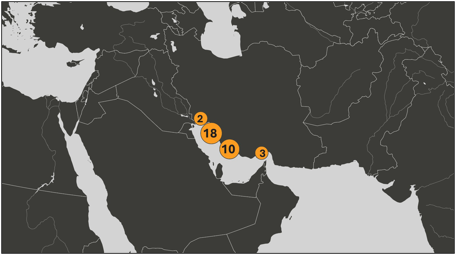
Map of Iranian oil laden tankers in the Persian Gulf on April 16
Iran-linked Vessels at Chabahar Port, Iran
Iran-linked tankers and cargo vessels are loitering and anchoring outside of the Persian Gulf at Chabahar Port, Iran. On April 16, there were 8 Iran-flagged tankers and 9 cargo ships all observed by satellite imagery near Chabahar Port.
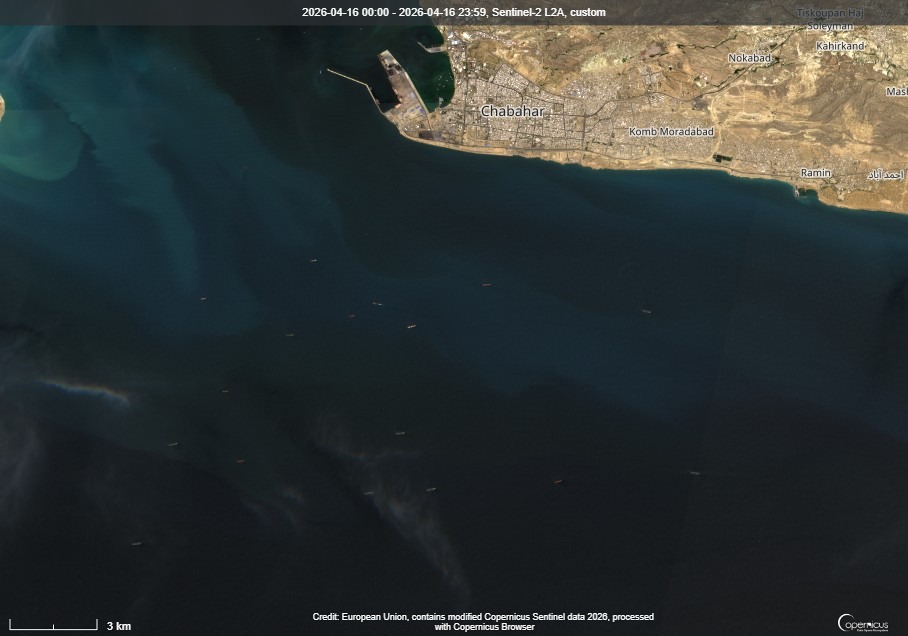
Tankers and cargo ships near Chabahar Port, Iran on April 16 (Credit: ESA Copernicus)
Number of Iranian Loadings
Since the outbreak of the conflict, UANI has tracked at least 49 Iranian oil loadings, 26 of which originated from Kharg Island, Iran. These shipments represent approximately 60 million barrels of Iranian oil, generating an estimated revenue of over $5 billion for the IRGC, which continues to fund Iran’s active missile and drone programs central to the conflict. This figure is notably higher than usual given the sharp increase in oil prices, including Iranian crude.
On April 16, three tankers were observed loading at the T-jetty of Kharg Island, Iran’s main oil export hub, in satellite imagery.
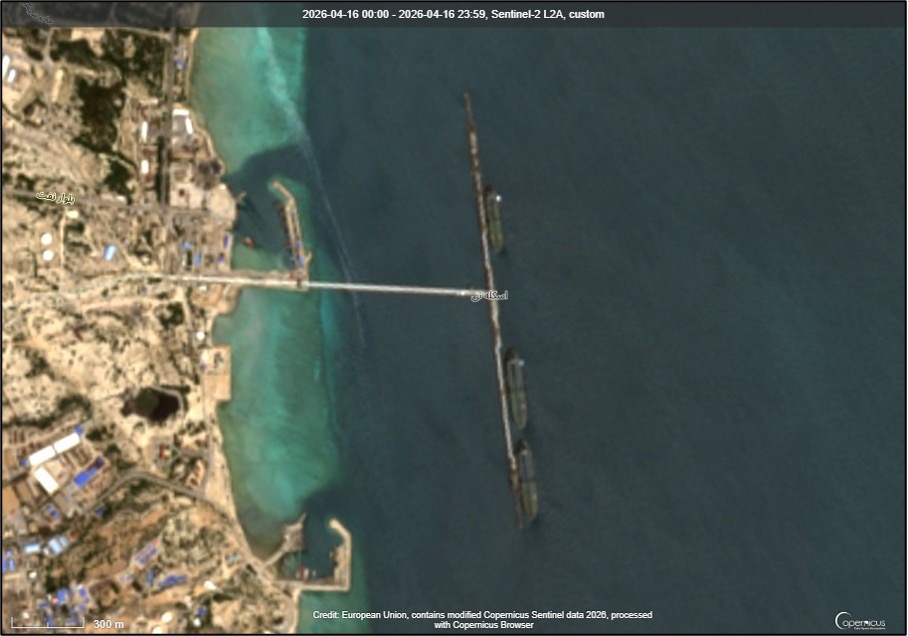
Satellite imagery of three tankers loading at Kharg Island, Iran on April 16 (Credit: ESA Copernicus)
Iran-oil Laden Tankers That Have Left the Persian Gulf
Since the start of the conflict, UANI has observed at least 37 ghost fleet tankers laden with Iranian oil that have left the Persian Gulf — some broadcasting their AIS signals and others operating clandestinely. These tankers are enroute to Malaysia to conduct ship-to-ship (STS) transfers with other ghost fleet vessels bound for China.
The Iran-flagged tanker DERYA (IMO 9569700) transited closer to Jamnagar, India on April 16, openly broadcasting AIS. It is reporting that it is laden with a deep draft of 20 meters. The Iran-flagged tanker FELICITY (IMO 9183934) remains loitering near Jamnagar, India on April 16, also openly broadcasting AIS, after arriving on April 12. Reports indicate these Iranian-oil laden tankers are struggling to discharge cargoes, as Indian refiners consider refusing them amid U.S. sanctions risks. It is also possible that Iranian-flagged merchant ships discharging sanctioned cargo represents a risk to India’s neutral status.
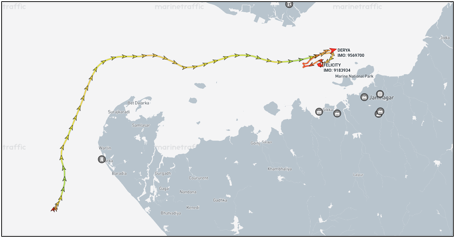
Iran flagged tankers near Gujarat, India, on April 16 (Credit: Marine Traffic)
Iran-flagged Tankers Globally
UANI has also monitored Iranian-flagged tankers operating beyond the Persian Gulf. Since the conflict began, at least 27 Iranian-flagged tankers have reached Southeast Asian waters bound for the Eastern Outer Port Limits (EOPL) anchorage off Johor, Malaysia. On April 16, the Iran-flagged tanker DAN (IMO 9357729) transited the Singapore Strait,while the Iran-flagged tankers HAWK (IMO 9362061) and SEA CLIFF (IMO 9569657) transited the Malacca Strait, all laden with Iranian crude from Kharg Island. They are headed for the Malaysian EOPL, where they will then conduct clandestine Ship-to-Ship (STS) transfers to another tanker bound for China.
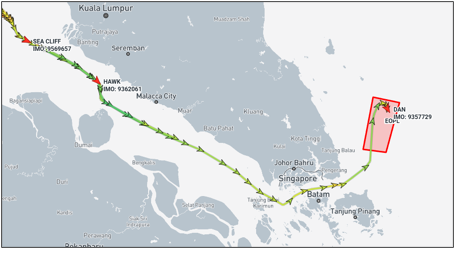
Iran flagged tankers transiting the Singapore Strait, on April 16 (Credit: Marine Traffic)
Meanwhile, at least 30 Iran-flagged tankers have begun returning and reporting empty to Iran from the Malaysian EOPL anchorage and Southeast Asian sea lanes, since the start of the conflict.
Iran-Oil Laden Tankers off the Malaysian Coast
Since the start of the conflict, UANI has recorded 104 Iranian oil laden tankers in the EOPL anchorage, a ghost fleet hotspot approximately 70 km off Malaysia’s coast. All of these tankers have been spotted in satellite imagery.
On April 16, 28 tankers listed on UANI's Ghost Armada were anchored or loitering in the EOPL area with their AIS signals active. Also today, two STS transfers of Iranian crude were spotted in this anchorage by satellite imagery. Despite the ongoing conflict, it is business as usual for the Iranian oil trade to China, where ghost fleet tankers continue to operate with impunity across Southeast Asia's sea lanes.
Iran-Flagged Cargo Ships Globally
The Iran-flagged bulk cargo ships WARTA (IMO 9465849) and MAHNAM (IMO 9213387) both transited the Singapore Strait westbound on April 16. WARTA, laden with an unknown cargo, departing Sri Racha, Thailand on April 12 is destined for Bandar Imam Khomeini (BIK), Iran, with an estimated arrival time of May 3, according to its AIS signal. Meanwhile, MAHNAM, after departed Dafeng, China, on April 5, is now in ballast condition after delivering its unknown cargo. Meanwhile, BAHJAT (IMO 9405954) transited the Singapore Strait eastbound, laden with in an unknown cargo after departing Rajaei Port, Iran on March 24.
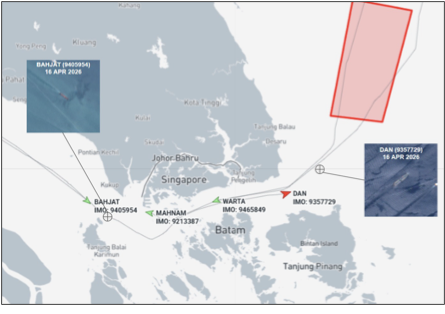
Iran flagged cargo ships and tanker transiting the Singapore Strait, on April 16 (Credit: Marine Traffic)
The Iran-flagged container ships ARTENOS (IMO 9283021) and AZARGOUN (IMO 9283019), laden with unknown cargoes, neared Deendayal Port, India on April 16. Like all Iran Shipping Lines (IRISL) containers ships, ARTENOS and AZARGOUN are sanctioned by U.S. OFAC.
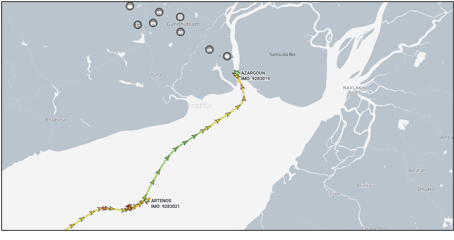
Iran flagged container ships near Gujarat, India on April 16 (Credit: Marine Traffic)
The Iran-flagged general cargo ship AREZOO (IMO 9165786), another OFAC-sanctioned IRISL vessel, arrived at Port Klang, Malaysia on April 16. It had previously visited Penang, Malaysia on April 15; Yangon, Myanmar on April 11–12; and departed Chittagong, Bangladesh on April 9.
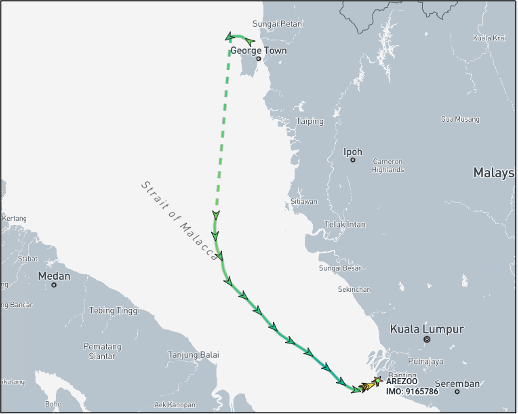
Iran flagged cargo ship arriving in Penang, Malaysia on April 16 (Credit: Marine Traffic)
Receive Iran News in Your Inbox.
Eye on Iran is a news summary from United Against Nuclear Iran (UANI), a section 501(c)(3) organization. Eye on Iran is available to subscribers on a daily basis or weekly basis.