April 2026 Iran Tanker Tracker
Charlie Brown and Jemima Shelley
April 2026 marked another month of continued Iranian crude exports although at lower volumes due to Operation Epic Fury, and the imposition of the U.S. blockade of Iranian ports. Iranian exports continued to rely heavily on the combined capabilities of the Iranian-flagged fleet and the wider “Ghost Fleet” system composed of aging tankers, shell-company ownership structures, deceptive AIS practices, and ship-to-ship (STS) transfer operations and illicit networks operating across Southeast Asia and China. And ultimately the Chinese “Teapot Refineries” that purchase and receive Iranian crude oil.
Preliminary tracking for April indicates that the U.S. blockade has caused Iranian oil and petrochemical exports to decrease. While exports noticeably dipped below peak levels observed earlier in the year, falling to less than half of February’s totals, the increase in global oil prices meant that Iran still likely made significant profits from these sales. Iran demonstrated a continued ability to adapt logistics patterns, reroute cargoes, increase floating storage and disperse operational risk across an increasingly decentralized maritime sanctions evasion architecture.
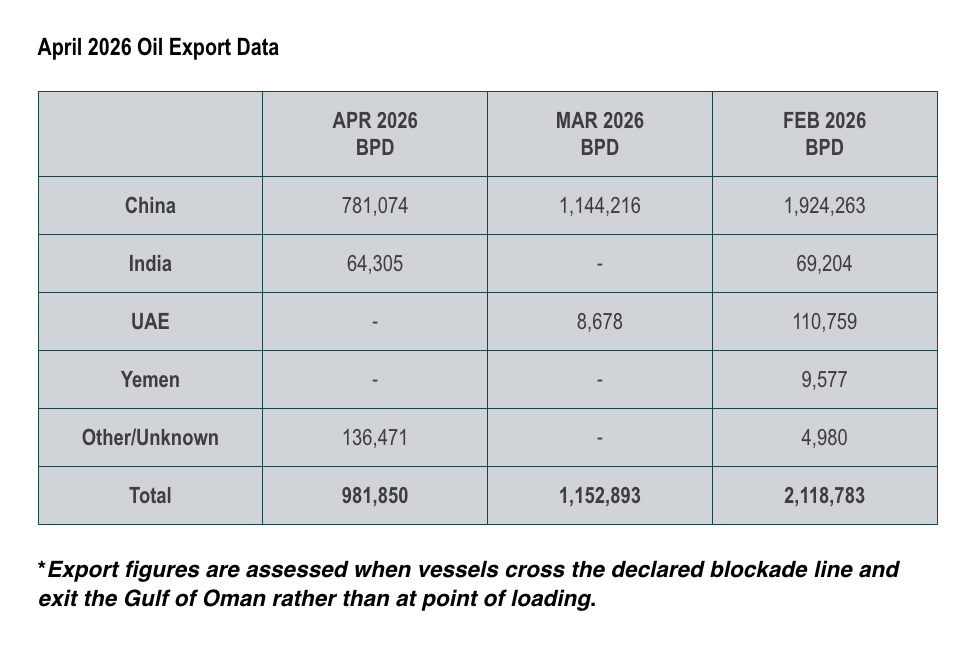
For the month of April 2026, UANI tracked a total of 29.5 million barrels (averaging 0.982 million barrels per day, or BPD) in physical exports out of Iran, a 18% volume drop from March and 50% from February due to wartime and blockade disruptions. The estimated value of oil exported in April 2026 is $3.42 billion, down 6% from March. The lower volume reflects operational disruptions of the war and blockade, but surging global oil prices mitigated much of the financial impact. Chinese pre-war stockpiling and afloat inventories cushioned the drop in oil exports. So far in 2026, Iran has exported 175.1 million barrels for an estimated total value of $14.6 billion.
UANI’s export figures are calculated when tankers depart Iranian waters, rather than at the point of loading. As a result, these totals may appear lower than those reported by other organizations, particularly given the current buildup of Iranian oil-laden tankers in Iranian waters that have been unable to sail because of U.S. restrictions.
Nearly all recorded Iranian shipments this month were bound for China. Historically, roughly 10 percent of Iranian oil was re-exported through hubs in the United Arab Emirates, but that secondary trade has now collapsed amid Iran’s missile and drone strikes on Gulf states, including most prominently the UAE. India also imported a small amount of Iranian crude, utilizing the now-closed temporary window provided by OFAC General License U.
Even amid active conflict conditions, the persistence of Iranian maritime exports underscores a core strategic reality: sanctions and military pressure have increased the cost and complexity of Iranian oil trade and has eroded much of its architecture but have not yet eliminated the underlying commercial ecosystem supporting it. This will take persistence and more time. Currently, the supply and demand equation persists. China generates the demand, and Iran has the supply.
Operation Epic Fury Update
In April 2026, Operation Epic Fury transitioned from intense kinetic strikes to a negotiated ceasefire after the United States accomplished its primary military objectives of decimating Iran's military capabilities.
Following the destruction of over 13,000 targets, which effectively destroyed Iran's navy, air force, and defense industrial base, Iranian leaders agreed on April 8 to pause combat operations and begin negotiations. Claims by Iran of opening and closing the Strait of Hormuz quickly bounced back and forth multiple times. In response, U.S. Navy destroyers initiated a mine clearance mission in the Strait on April 11 with the intention of safely restoring international shipping.
Attacks on Shipping
Commercial shipping faced elevated threats throughout April. Multiple merchant vessels reported GPS interference, suspicious small craft approaches, and drone attacks in the Persian Gulf and Gulf of Oman.
Open-source reporting and regional naval advisories indicated several notable incidents during April.
- Drone attacks operations against tankers transiting near the Strait of Hormuz.
- Suspicious approaches targeting commercial vessels associated with coalition logistics.
- Missile launches against offshore infrastructure and port-adjacent facilities.
- Electronic warfare activity affecting navigation systems and communications reliability.
Although no major tanker losses occurred during April, the cumulative effect of these incidents significantly increased operational caution among shipowners and charterers. Vessel operators continued to suspend Gulf transits and insurers demanded substantially higher freight premiums before accepting voyages into the region.
The Strait of Hormuz Status
Transit Activity
Daily transit volumes through the Strait of Hormuz fluctuated considerably during April due to evolving threat conditions and intermittent naval warnings. Reported traffic ranged from lows of just two transits per day to peaks of 19, according to the Joint Maritime Information Center (JMIC).
Commercial traffic remained far below historical averages of 138 transits per day, particularly during periods following kinetic incidents or widely disseminated security warnings from the Islamic Revolutionary Guard Corps (IRGC). For example, there were two vessel attacks and one count of suspicious activity on April 18, which meant that transits dropped from 19 to six the next day. Despite disruptions, the Strait remained partially operational for those ships willing to take the risk.
Commercial Risk Premiums
War risk insurance costs increased sharply during April. Insurers reassessed exposure to Gulf transits following multiple security advisories and maritime incident reports.
Key market developments included:
- Elevated additional war risk premiums for tankers entering the Gulf.
- Increased requirements for security coordination and voyage reporting.
- Expanded scrutiny of vessel ownership, AIS integrity, and cargo origin documentation.
- Greater reluctance among mainstream shipowners to participate in high-risk Gulf cargo movements.
Blockade & Contraband Enforcement
On April 7, President Trump announced a two-week ceasefire with Iran. Pakistan mediated ceasefire talks, which President Trump stated was contingent on the “complete, immediate, and safe opening” of the Strait of Hormuz, effectively ending its wartime closure. However, on April 12, after ceasefire talks with Iran ended without an agreement, President Trump announced that the U.S. would initiate a naval blockade of all Iranian ports and coastal areas effective April 13. By blockading vessels calling on Iranian ports, including tankers carrying Iranian oil, the administration aims to cut off the Iranian regime’s major source of revenue. On April 16, 2026, the U.S. CENTCOM published the contraband list for the naval blockade of Iran, authorizing naval forces to stop, search, and seize any vessels suspected of carrying "contraband" regardless of their location, in accordance with the recognized Laws of Naval Warfare.
Throughout the remainder of April, the U.S. military globally enforced this blockade, turning away dozens of ships and forcibly seizing non-compliant "dark fleet" oil tankers and other vessels, such as the TOUSKA, TIFANI, and MAJESTIC X, to prevent the shipment of contraband material to and from Iranian ports.
U.S. maritime forces conducted expanded patrols which seemed to focus on Very Large Crude Carriers (VLCC) carrying Iranian crude leaving the Gulf of Oman, as well as cargo vessels transiting towards an Iranian port. LNG carriers and product tankers, compared to VLCCs, seemed to experience varying degrees of U.S. interdiction efforts.
Reported enforcement actions included:
- Warning vessels over radio to turn around or return to an Iranian port.
- Boarding operations targeting vessels transiting to or from an Iranian port, as well as those suspected of carrying contraband cargo.
- Seizures or temporary detentions of vessels transiting to or from an Iranian port, as well as those suspected of carrying contraband cargo.
New patterns emerged in Iran’s oil trade to China in response to the oil trade. Numerous Iranian flagged National Iranian Tanker Company (NITC) tankers were anchored near Chabahar Port after attempting to cross the blockade and facing varying enforcement actions from U.S. forces. Less vessels carrying Iranian products have completed the journey to Southeast Asian waters. Apart from several small handymaxes carrying Iranian LPG and other petrochemical products, two recorded Iranian flagged vessels carrying Iranian crude have been observed in satellite imagery and AIS signals transiting the Lombok Strait in Indonesia. This marks a significant new operational pattern. These tankers likely departed Iran, laden with oil bound for China, after the imposition of the blockade, and likely took an uneconomical route through the Indian Ocean and the Lombok Strait in order to avoid interdiction by U.S. forces.
To read UANI’s full statement on FAQs and keys facts about the U.S. blockade, click here.
Iranian Counterstrategy
The “Toll Booth” Concept
Iranian regime officials and affiliated media outlets increasingly promoted rhetoric suggesting that vessels transiting the Strait of Hormuz should contribute financially toward regional security costs. Reports suggested that some vessels may have paid as much as $2 million for passage on an ad hoc basis. Although no formal internationally recognized transit fee mechanism exists, Iranian messaging appeared designed to normalize the concept of a de facto “security toll” or inspection regime. Such proposals were rejected by many governments and widely viewed as inconsistent with established freedom of navigation principles under international law. Singapore’s Foreign Minister, Dr. Vivian Balakrishnan, stated in Parliament that Singapore will not negotiate with Iran for safe passage or pay tolls for vessels passing through the Strait of Hormuz, upholding the legal principle that such navigation is an inalienable right.
Chabahar Expansion
Iran continued promoting Chabahar as a strategic outlet capable of reducing reliance on the Strait of Hormuz. Throughout April, 23 Iranian flagged tankers carrying Iranian crude were at some point anchored just outside Chabahar Port.
While Chabahar port’s capabilities remain limited relative to major Gulf export infrastructure—and is not a primary oil export hub, thus unable to serve as a true substitute for Hormuz-facing oil terminals—Iran is relying on Chabahar given its location outside the Strait of Hormuz and its utility as an alternate outlet to the Gulf of Oman.
Global Logistics Support
Malaysia & the EOPL
Malaysia’s East Outport Limits (EOPL) remained one of the most critical offshore logistics hubs facilitating Iranian petroleum flows, offering permissive waters for high-risk operations. Observed activities included ship-to-ship (STS) transfers, extended floating storage to obscure cargo origins, crew rotations to maintain operational continuity, and bunkering to extend voyage ranges. Over the month of April, 38 STS transfers of Iranian crude were observed in satellite imagery in this anchorage. These persistent operations underscore the vital role of flexible, unregulated offshore anchorages in sustaining Iran’s sanctions-evasion network.
Sri Lanka
Emerging as a newer pattern in Iran’s sanctions-evasion logistics, Sri Lanka’s offshore waters—particularly near Galle and Colombo—continued to function as a key logistics support provider for Iranian-linked tankers. Monitoring revealed logistics resupply, crew management including transfers and rotations, temporary anchorage for waiting or repositioning, and occasional port calls by vessels with concealed Iran connections. The “Galle-off-port” area has solidified as a strategic waypoint, enabling seamless transits between Gulf loading zones, Southeast Asian hubs like Malaysia’s EOPL, and final markets in China.
The Primary Buyer: China
Teapot Refineries
Independent Chinese refiners—commonly referred to as “teapot” refineries—remained the principal buyers of Iranian crude during April. Facilities, primarily in the Shandong province, continued processing Iranian grades despite escalating threats of secondary sanctions and intensified U.S. enforcement rhetoric and actions. On April 24, U.S. OFAC sanctioned the Dalian-based refiner Hengli Petrochemical, who UANI warned in March 2023 and again in April 2025 for its continued import of Iranian crude.
Key market incentives driving this demand included deeply discounted Iranian crude pricing, availability of intermediary trading structures, sophisticated blended cargo obfuscation techniques, and payment mechanisms operating outside traditional Western financial channels. Although some refiners reduced their visible exposure through shorter-term deals and diversified sourcing, aggregate demand for this discounted feedstock remained substantial.
Zhuhai Port (Gaolan) & Other Contraband Cargoes
Zhuhai’s Gaolan terminal area continued emerging as a strategically significant discharge node for Iran-linked cargo flows. The port’s logistical advantages encompass flexible cargo handling capabilities, direct integration with regional industrial demand centers, and access to extensive intermediary trading networks. Since the start of the conflict, UANI has noted 13 visits to Zhuhai Port by 11 OFAC sanctioned Iranian-flagged container ships since the start of the war.
Conclusion
April 2026 demonstrated both the resilience and vulnerability of Iran’s maritime export system.
Despite heightened conflict conditions and the erosion of much of Iran’s sanctions evasion architecture, Iranian crude exports continued moving through a highly adaptive logistics architecture built around opaque ownership networks, permissive sea lanes and offshore anchorages in Southeast Asia, STS transfer support systems, and sustained Chinese demand.
At the same time, operational strain increased measurably across several fronts. The U.S. blockade led to interdictions and other enforcement actions that prevented tankers from reaching their Chinese buyers, confining cargoes in Iranian waters. Commercial scrutiny expanded as charterers, traders, and insurers imposed stricter due diligence to avoid sanctions exposure. Vessel tracking visibility improved through enhanced satellite and AIS monitoring, making evasion tactics harder to conceal. Diplomatic pressure on logistics facilitators also grew, with targeted designations and public calls for compliance further tightening the sanctions net.
Looking ahead to May 2026, several trends warrant close monitoring:
- Assessment of U.S. blockade on tankers arriving in Malaysian EOPL and final deliveries to China.
- Secondary sanctions pressure on Southeast Asian maritime service providers that allow Iranian-flagged ships to conduct port visits and receive logistics support.
- Chinese teapot refinery purchasing behavior.
- Expansion of alternate Iranian logistics corridors.
- The evolution of Ghost Fleet operating methodologies.
To maximize the impact of the current blockade and disrupt the underlying trade architecture, the U.S. should increase pressure on Southeast Asian actors providing logistics support to illicit dark fleet activities at key supply chain nodes. The International Maritime Organization (IMO) called for specific actions in Assembly Resolution 1192 (33) in 2023; it is now time for Coastal States to actively implement these measures. To further strain logistics, the U.S. should target floating storage hotspots offshore Malaysia, utilizing satellite-derived evidence to designate and take action against specific tankers—all of which are substandard, often stateless vessels—used for STS transfers. Furthermore, the U.S. must pressure regional authorities to disrupt these unregulated anchorages and prevent local service providers from supporting the ghost fleet. Additionally, intensifying pressure on maritime service providers in Sri Lanka will deny these vessels the essential crew rotations and bunkering required for long-haul transits.
Ultimately, the April oil exports data reinforces a central lesson of modern maritime sanctions enforcement: controlling illicit oil trade is no longer solely a financial or diplomatic challenge, but a persistent contest over logistics, maritime governance, and freedom of navigation across the world’s most strategically vital sea lanes.
Receive Iran News in Your Inbox.
Eye on Iran is a news summary from United Against Nuclear Iran (UANI), a section 501(c)(3) organization. Eye on Iran is available to subscribers on a daily basis or weekly basis.