Hadid-110 Drone Capabilities Bring New Considerations for Regional Defense
The emergence of the Hadid-110 (also referenced in documentation as the Dalahu) unmanned aerial vehicle (UAV) marks a structural shift in the Iranian Revolutionary Guard Corps (IRGC) Aerospace Force’s drone warfare doctrine. First unveiled in February 2025 to Supreme Leader Ali Khamenei, it was then showcased for a test and evaluation by the Iranian Defense Ministry during the Sahand 20 military exercise a few months later. Transitioning from slower, piston-engine and propeller-driven loitering munitions toward jet-powered, low-observable platforms, Iran’s military industrial base has designed the Hadid-110 to address a critical vulnerability in asymmetric air warfare: the long reaction window afforded to modern Integrated Air and Missile Defense networks. Capable of speeds exceeding 510 km/h, the platform trades the extended range and heavy payload of legacy drones such as the Shahed series for rapid kinetic delivery and reduced radar cross-section (RCS).
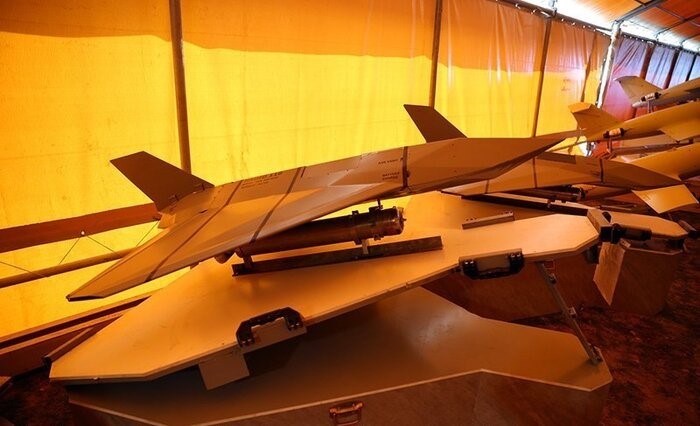
A Hadid-110 drone. Source: OE Data Integration Network (ODIN).
In a high-intensity confrontation involving U.S. and coalition forces, the Hadid-110 alters Iranian operational strategy by serving as a high-speed strike tool aimed at degrading forward-deployed sensors, naval air defense envelopes, and command-and-control (C2) infrastructure; and it has done so already in the midst of the ongoing war, such as the early March strikes on U.S. AN/TPY-2 radars at Muwaffaq Salti Air Base in Jordan, Umm Dahal in Qatar, and Prince Sultan Air Base in Saudi Arabia.
There are countless new features distinguishing this UAV only introduced into the Iranian drone fleet as of 2025. Its aforementioned solid-fuel rocket booster configuration makes it roughly three times faster than the propeller-driven Shahed-136. The reduced payload it carries relative to the Shahed series is equipped with a 30-kg high-explosive fragmentation or specialized blast warhead. Additional features include the one-hour roving flight time and a maximum flight ceiling of 30,000 feet.
The Hadid-110 is adding a capability that is focused on mass-volume saturation, or the overwhelming offensive use of drones to exploit enemy defenses; with stronger explosive payloads relative to preexisting short range UAVs in Iran’s arsenal and that are similar to those carried by the likes of the Shahed-131 and -136. The mass production has the intent with said doctrine to deplete enemy surface-to-air missile (SAM) inventories, like those of the MIM-104 Patriot or THAAD batteries.
The primary operational role of the Hadid-110 is not necessarily strategic deep strikes, but tactical and operational air defense suppression. With the Hadid-110’s speed and low radar profile, the IRGC can utilize it to target critical radar components (such as SPY-1 radar arrays on Aegis destroyers or AN/MPQ-65 radars of Patriot units). Destroying or blinding these sensor arrays disables entire SAM batteries, creating corridors for follow-on salvos of conventional ballistic and cruise missiles.
The Hadid nonetheless has plenty of vulnerabilities that American forces can exploit as they shore up their defenses in the region to protect warfighters down range. Despite its strategic advantages, military assessments highlight several critical limitations.
The blended wing-body design, for one, while reducing radar signature, will cause the mini-jet turbine to generate a higher heat exhaust profile than piston engines. This makes the drone more susceptible to short-range infrared-guided missiles (Sidewinder, Stinger, etc.) Secondly, because the jet engine consumes fuel at a higher rate than internal combustion engines, to be effective, swarms of Hadids must be launched ideally from forward deployed areas or mobile coastal platforms. This limits their reach, especially in a conflict where U.S. forces can go tit for tat in anti-access area denial (A2AD) capabilities.
The Hadid will likely not be capable of being deployed by proxies in the region, either. The shock and awe it enables, as noted in Iranian drone doctrine, is intended to free up follow-on ballistic missile strike zones from air defense systems in a Suppression/Destruction of Enemy Air Defenses (SEAD/DEAD) function. Executing this multi-tiered "shock-and-penetration" attack requires real-time radar intelligence, precise timing, and C2. The IRGC possesses the sensor-to-shooter infrastructure required to coordinate these strikes; most proxy groups neither operate at that same capacity nor possess any meaningful capability to engage in head-to-head multi-domain warfare. The IRGC views the Hadid-110 as a specialized tactical tool, not a mass-burn attrition drone. However, it will likely be a substantively used weapon for as long as the Iranians intend to directly engage in the current war.
Standard air defense systems face an economic and reaction-time bottleneck when confronting small, fast jet drones. To counter this threat, CENTCOM and Air Force Doctrine rely on five integrated operational layers typically that translate to addressing the kind of threat a Hadid-type UAV employs: Multi-Sensor Early Warning Networks, High-Speed Kinetic Interceptors (Lower-Cost Missile Options), Directed Energy (High-Energy Lasers & High-Power Microwave), Close-In Rapid Fire & Kinetic Hard-Kill (Terminal Layer), and Passive Base Hardening and Dispersal (ACE Framework). These layers of integrated defense allow bases and strategic sites the capacity to have early detection notice and, once identifying a threat, employ the kind of practical systems that ensure there is a balance of preserving munitions, especially for drone swarms. Having robust layered defense also ensures that drones can be neutralized at various ranges through a collection of systems that service as a force multiplier (e.g., laser and microwave systems like the 50kW–300kW DE M-SHORAD and THOR can act as a first line of defense, while 300 mm canons such as the C-RAM and Phalanx will engage threats at close range in a discriminatory capacity).
The primary difficulty in defeating fast UAVs such as the Hadid-110 is reaction time. Defending an air base requires automated C2 systems to detect, classify, and cue an interceptor within less than 45 seconds from initial radar detection.
The introduction of jet-powered loitering munitions like the Hadid-110 represents a modernization step for Iran’s uncrewed inventory. By combining low-observable geometric design with jet propulsion, the IRGC seeks to counter advances in Western counter-UAS and layered missile defense technology. It is critical for CENTCOM, the Joint Force, and decision makers in the Pentagon to continue evaluating and understanding how the threat continues to evolve as the duration of the war carries on. Tracking the advancements in the IRGC’s array of weaponry is one step in developing a proactive response, as review of military doctrine, and operational battlefield employment showcases that these systems being built in the Iranian military industrial base are intentionally developed to address their military’s strategic thinking as the war carries on.
Nick Pacheco is special assistant at United Against Nuclear Iran (UANI).
Receive Iran News in Your Inbox.
Eye on Iran is a news summary from United Against Nuclear Iran (UANI), a section 501(c)(3) organization. Eye on Iran is available to subscribers on a daily basis or weekly basis.